Guide


Table of Contents
Student goals examples are specific, time-bound targets a student sets across the main parts of student life: a GPA you want to reach by the end of term, a savings figure to hit before summer, a study routine you hold through exam weeks. The hard part is rarely picking a goal. It is keeping the goal connected to something that still matters in December, after the September enthusiasm has worn off.
Most advice on student goals jumps straight to the list. You copy a few bullet points, and by midterms the list is gone. The reason is structural: a goal written on its own, with nothing above it and no daily action below it, has no reason to survive a busy week.
The examples below are organised by the five parts of student life (academic, health, money, social and relationships, and personal growth), each built to connect to a goal you care about. For the broader practice, the goal setting hub covers the fundamentals.
The five parts of student life below:
Academic goals
Health and energy goals
Money goals
Social and relationship goals
Personal growth and career goals
Key takeaways
Organising student goals by part of life keeps any single area, usually health or relationships, from being quietly dropped during a heavy academic term.
A student goal needs a measurable target and a deadline before it can tell you, on any given Tuesday, whether you are on track.
Students who set and reflect on personal goals report higher self-efficacy and set more ambitious goals afterward, which is why the goal you write matters as much as the action.
Griply links each student goal to a life area and a vision, then connects daily habits and tasks to it, so the goal stays visible instead of fading after week three.
Why most student goals examples are forgotten by midterms
A student copies ten goals off a list in the first week of term. By the time midterms arrive, most of them are forgotten. The usual explanation is that the student lacked discipline, but the more useful explanation is that the goals were never attached to anything.
A goal sitting alone in a notes app has no daily action beneath it and no larger outcome above it. When a deadline-heavy week hits, the goal has nothing to defend its place in your attention, so it loses to whatever is urgent. This is a design problem in how the goal was set, which the guide on the characteristics of a strong goal breaks down in full.
The fix is to give each goal a measurable target, a deadline, and a connection to a part of your life you care about. Goals tied to clear progress feedback help students judge whether they are improving and keep going, according to research on goal setting during self-regulated learning. Without that feedback, you can study for a week and have no idea whether it worked, which is exactly the state where motivation drains away.
Academic goals for students
Academic goals are the ones students name first, and also the ones most likely to be vague. "Do better this semester" gives you nothing to act on. Any useful list of goals for students in school starts here, and each academic goals example below carries a number and a deadline so you can tell mid-term whether you are on track.
Raise your GPA from 3.0 to 3.4 by the end of the semester by attending every lecture and submitting all assignments at least one day early.
Read and summarise one assigned chapter before each lecture for the next 12 weeks, so you arrive prepared rather than catching up.
Score at least 80% on your next three exams by running two practice tests per subject in the week before each.
Finish your dissertation first draft by April 30 by writing 500 words every weekday morning.
Cut last-minute cramming by spacing study into four 45-minute sessions per subject each week.
That last example is worth setting deliberately. Spreading study across several spaced sessions produces stronger long-term recall than the same hours crammed at once, a finding that holds across ages and subjects, so a goal built around spaced study rather than total hours turns a vague "study more" into something measurable. If your problem is finding the hours at all, the time blocking method guide shows how to protect study sessions in a full week.
Health and energy goals for students
Health is the first thing students drop when coursework piles up, which is the opposite of what helps. Sleep, movement, and food are what let you study at all, so they deserve goals as specific as your academic ones.
Sleep at least 7 hours on 5 of 7 nights for the rest of the term by setting a fixed phone-down time of 11:30pm.
Walk or cycle to campus at least 4 days a week for 8 weeks instead of taking the bus.
Cook three meals at home each week for the semester rather than relying on takeout and dining-hall defaults.
Do a 20-minute workout three times a week for 10 weeks, scheduled on the same days each week.
Take one full screen-free evening per week through exam season to recover.
Pairing a health target with a fixed routine is what makes it survive a busy month, since the routine carries the goal when motivation dips. The guide on building a productive morning routine shows how to anchor one of these habits to a time of day so it runs without a daily decision.
Money goals for students
Student finances are tight, which makes money goals more useful, not less. A clear target turns a constant low-level worry into something you can act on each month.
Save €500 by the end of the academic year by setting aside €50 on the first of each month.
Cut monthly food and coffee spending from €300 to €200 by meal-prepping every Sunday for the term.
Pay off your €600 overdraft by June by putting €100 toward it each month.
Earn €1,200 from a part-time job this semester by working two fixed shifts a week.
Track every expense for 30 days to find where your money actually goes before setting the next target.
Each of these is the kind of goal Griply treats as accumulative: a start value, a target value, and steady progress logged toward it. Seeing the line move toward €500 is what keeps a savings goal in front of you when an impulse purchase tempts you off track.
Social and relationship goals for students
Relationships are the part of life students rarely write a goal for, then regret neglecting once term ends. Friendships, family, and new connections all benefit from the same intentional treatment you give your studies.
Call one family member every Sunday for the whole semester.
Attend one society or club event each week for the first half of term to build a circle outside your course.
Have one proper catch-up with a close friend every two weeks, planned at least a few days ahead.
Introduce yourself to one new person in each of your seminars within the first month.
Plan one non-academic activity (a hike, a film night, a trip) each month with friends.
Personal goals for students matter because they are yours rather than imposed by a syllabus, and goals you choose for your own reasons tend to hold your effort longer. The companion guide on personal goals examples covers this across adult life beyond the student years.
Personal growth and career goals for students
Personal growth and early career goals are about who you are becoming, beyond the grades you leave with. They are easy to defer because nothing external forces them, which is exactly why writing them down matters.
Read 12 books outside your reading list this year by reading 15 pages each night before sleep.
Complete one online course in a skill your degree does not teach by the end of term, spending 3 hours a week on it.
Apply to five internships or placements by March 1, with a tailored cover letter for each.
Learn a new language to a conversational level over two semesters using 20 minutes of practice each weekday.
Attend three guest lectures or industry talks this term and note one takeaway from each.
Consistent effort sustained over years is a stronger predictor of long-term achievement than raw talent, which makes habit-based growth goals especially worth setting as a student. A goal to "get better at coding" does little; a goal to ship one small project a month gives that ambition a shape you can hold.
How to turn student goals examples into daily action
A goal you copy from a list is only as good as the structure you put it in. The fix that makes a student goal survive the term is a simple chain: a part of your life at the top, a measurable goal beneath it, and the daily habits and tasks that move it.
Take "raise my GPA to 3.4." On its own it is a wish you check at exam time. Placed in a hierarchy, it sits under your Academic life area, breaks into smaller subgoals like "80% on the midterm," and connects down to the habits that get you there, such as four spaced study sessions a week, so the goal now has a daily action behind it and a clear part of your life giving it meaning.
This is why disconnected lists fail. The goal at the top and the action at the bottom never meet, so a busy week breaks a connection that was never built in the first place. Reflecting on your own goals and progress is what builds the confidence to keep pursuing them, and that reflection only works when there is a visible structure to reflect on.
How Griply keeps student goals connected to daily life
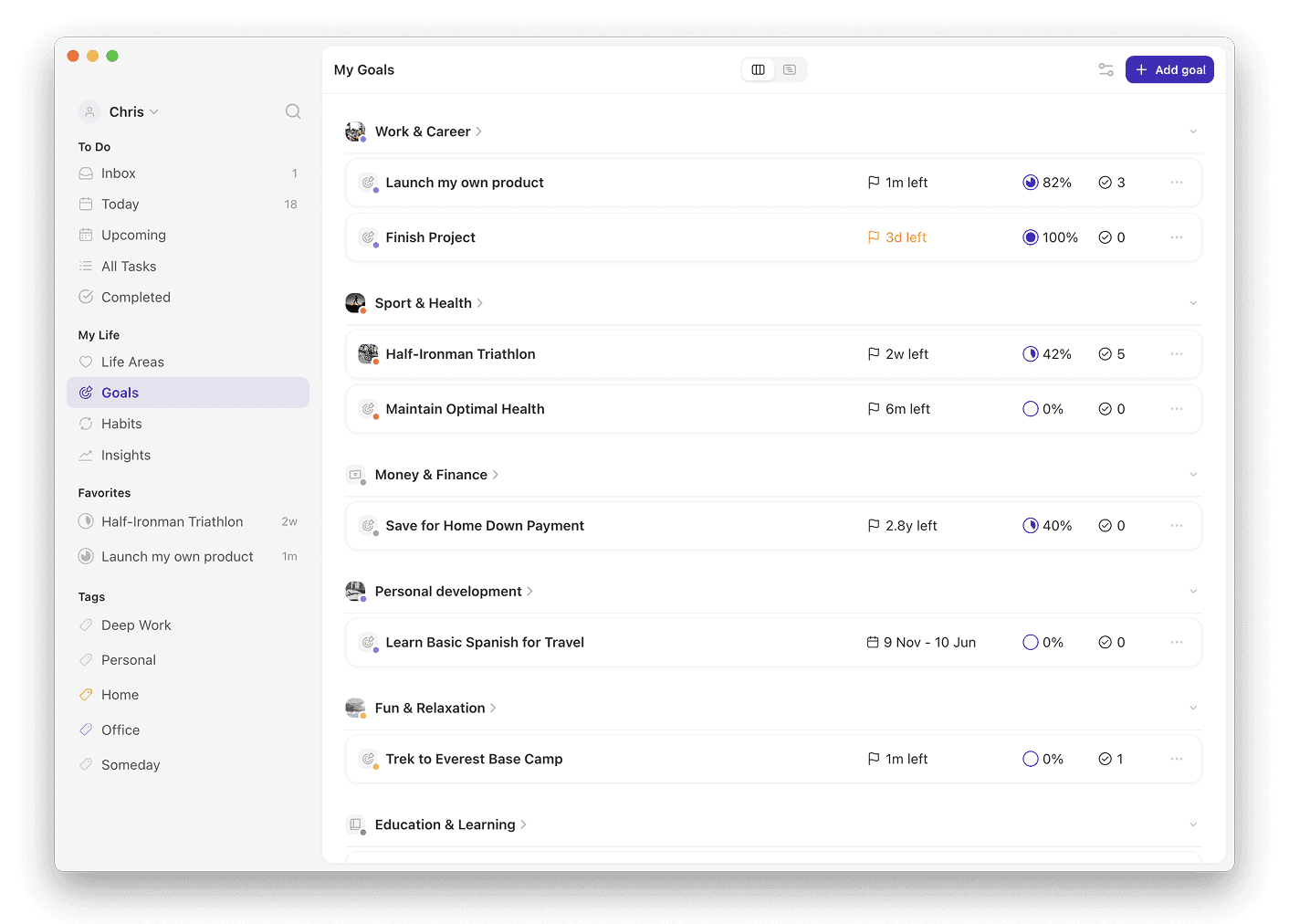
Once you have your student goals written, the next question is where to keep them so they do not get lost between a notes app and a calendar. Griply is built around the same chain described above: life areas at the top, goals nested inside, and daily habits and tasks connected underneath.
You set a life area like Study or Health, write a short vision for what that part of student life looks like when it is going well, then add your goals beneath it. Each goal in the goal planner has a start value, a target value, and a deadline, and you log progress on a line chart, so a savings target or a GPA goal starts showing real distance to done. When you add a task or habit, Griply surfaces the goal it belongs to, so a habit like "four study sessions this week" stays linked to the GPA goal it serves.
The result is that your goals stay visible in your daily view through the parts of term when motivation alone would not carry them. That connection between today's action and the outcome you set is what a flat list of student goals examples can never give you.
Frequently asked questions
What are good academic goals for students?
Good academic goals name a measurable target and a deadline: raise your GPA from 3.0 to 3.4 this semester, score 80% on your next exam, or finish a draft by a set date. Pair each with a study habit, such as spaced sessions through the week, so the goal has a daily action behind it.
How many goals should a student set at once?
Three to five active goals is a workable ceiling for most students, spread across different parts of life so academics do not crowd out health and relationships. Setting too many at once thins the effort available for any single one, which is why a short, balanced list beats a long one.
What is the difference between a student goal and a task?
A student goal is an outcome you want, like passing a module or saving €500. A task is a single action that moves you toward it, like reviewing one chapter. Goals give tasks their reason to exist; without a goal above it, a task is just something on a list.
How do I keep student goals from being forgotten by midterms?
Connect each goal to a part of your life and to daily habits, then keep it somewhere you see every day rather than in a closed notebook. Griply keeps each goal linked to its life area and visible in your daily view, so it stays in front of you when a busy week would otherwise bury it.
What are good weekly goals for students?
Weekly goals for students work best as small, measurable steps toward a bigger goal: finish two practice tests, attend every lecture, or read 75 pages. Tying the week to a larger goal above it stops weekly goals from becoming a disconnected to-do list.
Student goals last when each one is connected to a part of your life
The student goals examples in this guide are starting points, and the numbers should be adjusted to your own situation before you commit to any of them. What turns them from a list into a plan you keep is the structure underneath: each goal connected to a part of student life you care about, and to the daily habits that move it through exam weeks. A goal with that connection has a reason to survive past midterms, and a goal without it rarely does.
Related Guides
Schunk, Dale H. "Goal Setting and Self-Efficacy During Self-Regulated Learning." Educational Psychologist, Vol. 25, No. 1, 1990. https://libres.uncg.edu/ir/uncg/f/D_Schunk_Goal_1990.pdf
Travers, Cheryl J., Dominique Morisano, and Edwin A. Locke. "Self-reflection, growth goals, and academic outcomes: A qualitative study." British Journal of Educational Psychology, Vol. 85, No. 2, 2015. https://blog.lboro.ac.uk/teaching-learning/wp-content/uploads/sites/16/2017/01/Travers-self-reflection-growth-goals-and-academic-outcomes.pdf
Dunlosky, John, Katherine A. Rawson, Elizabeth J. Marsh, Mitchell J. Nathan, and Daniel T. Willingham. "Improving Students' Learning With Effective Learning Techniques." Psychological Science in the Public Interest, Vol. 14, No. 1, 2013. https://pubmed.ncbi.nlm.nih.gov/26173288/
Duckworth, Angela. Grit: The Power of Passion and Perseverance. Scribner, 2016. https://angeladuckworth.com/grit-book/