Guide


Table of Contents
Backcasting is a planning method that starts from a defined future state and works backward to identify the steps needed to reach it. Instead of asking "where can we realistically get to from here?" you ask "what would have to be true by then, and what do we need to do now to make it happen?" The method was originally developed by energy policy researcher John Robinson in 1982 to plan for sustainable futures. Applied to personal goals, it gives you a clear gap between where you are and where you need to be, along with the milestones that close that gap.
The practical problem with backcasting is that it tends to produce a list of abstract steps rather than a working plan. That changes when the method runs inside a timeline-based system where your Vision, your subgoal checkpoints, and your first task all live in the same place.
Key takeaways
Backcasting defines a desired future state first, then works backward to map the checkpoints between there and today.
The core difference from forecasting is direction: forecasting projects forward from current conditions; backcasting projects backward from a chosen destination.
A backcasting exercise only becomes actionable when each checkpoint has a deadline and generates at least one task you can act on today.
Griply's Goal Roadmap gives backcasting a place to run: Vision as the destination, subgoals as checkpoints, and a daily task list as the execution layer.
What backcasting is
Backcasting defines a specific future outcome, then asks what conditions must be in place at each stage leading up to it. You are not predicting what will happen. You are designing what needs to happen.
The method has three steps. First, describe the future state in concrete terms: not "be financially secure" but "have $50,000 in savings by December 2026." Second, identify the checkpoints that would need to be true at each interval before the target date. Third, pull the first action back to today.
The output is a chain of milestones running from now to the target date, each milestone a precondition for the next. That chain is the plan.
How backcasting differs from forecasting
Forecasting asks: given current trends and available resources, where are we likely to end up? It projects from the present forward, which means it is constrained by current conditions. If your savings rate today is $200 a month, a forecast tells you you'll have $2,400 by year end. Accurate, but not ambitious.
Backcasting reverses the question: given where you want to end up, what does the path backward look like? You define the destination first, then identify what current conditions need to change to make that path viable. The $50,000 target becomes the anchor, and the question becomes what monthly contribution rate would actually get you there.
The two methods complement each other: use forecasting to understand what current conditions allow, and backcasting to define what conditions need to change.
The backcasting method step by step
Running backcasting on a personal goal takes four steps.
Define the future state. Write a specific, measurable outcome with a date. "Be better at public speaking" is not a future state. "Present at a company-wide meeting with confidence by Q4 2026" is. The more concrete the description, the more precisely you can map backward from it.
Identify the gap. Compare the future state to your current reality. What is the measurable distance between where you are now and where you need to be? This is the gap backcasting is designed to expose.
Work backward to checkpoints. Starting from the target date, ask: what would need to be true one quarter before the target? Six months before? One month before? Each answer becomes a checkpoint. Work backward until you reach the present.
Pull the first action to today. The checkpoint nearest to today should generate at least one concrete task. That task is your starting point. If it doesn't, the checkpoint is still too vague.
Why backcasting works for personal goals
Most goal-setting approaches start from the present and project forward under optimistic assumptions. You decide to save more or exercise more, and you estimate what you can achieve given current habits. The problem is that current habits tend to constrain ambition. A goal set this way often ends up being a modest extrapolation of the present.
Backcasting bypasses that constraint by treating the future state as non-negotiable and current conditions as the variable. You ask what needs to change to close the gap, rather than how much you can achieve given current habits. Plans built this way tend to be more ambitious and more specific than those built by projecting forward from the present.
The other advantage is that backcasting forces you to identify dependencies. You cannot present at a company-wide meeting before you have practised with smaller audiences. You cannot practise with smaller audiences before you have prepared a talk. Dependencies become visible in the plan instead of surfacing unexpectedly in execution.
Where backcasting becomes abstract
The gap between backcasting as a planning exercise and backcasting as a working plan is almost always structural. Spreadsheets produce static milestones with no connection to daily work. The checkpoints exist, but nothing connects them to what you do on Tuesday.
Two things cause this. First, the milestones have no owner at the task level. Second, there is no timeline holding them in sequence. When a checkpoint is a note in a document rather than a subgoal on a timeline, it has no force. It does not generate tasks. It does not show up in your day.
How to run backcasting in Griply
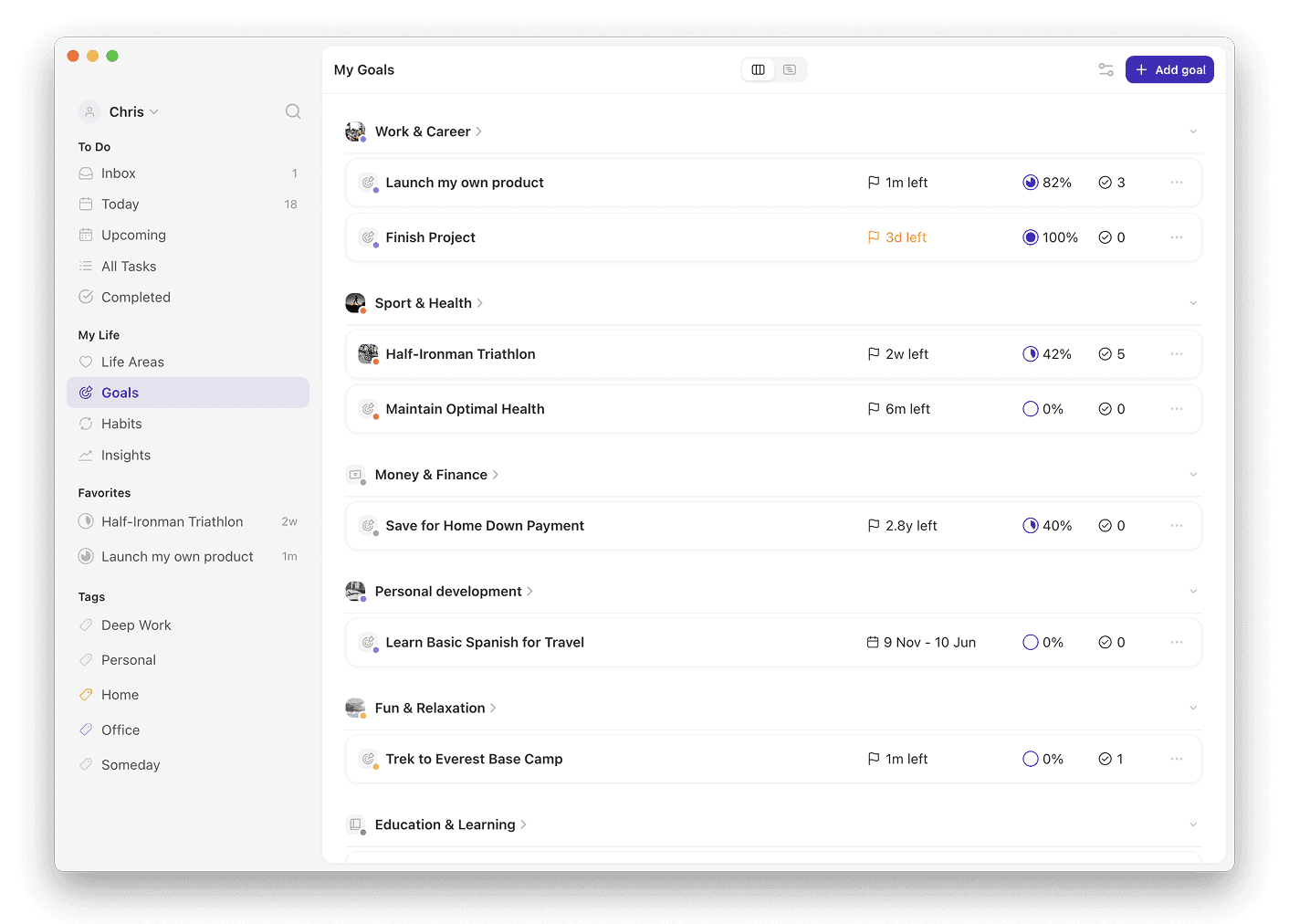
Griply's Goal Roadmap is a Gantt timeline of goals, subgoals, and projects.
Start with the Vision field on your Life Area. Write your desired future state there: the specific outcome you are planning backward from. This becomes the anchor for the whole plan.
Set your top-level Goal with a target value, start value, and deadline. This is the measurable gap backcasting exposes. For the public speaking example, that might be "speak at 5 public events by December 2026, starting from 0."
Add your backcasting checkpoints as subgoals with their own deadlines, each one a precondition for the next. "Complete 1 talk for a team of 10 by March" is a subgoal under the larger goal. Place each subgoal on the Roadmap and you have a visual timeline running from today to the target date.
The last step is to add a task under the nearest subgoal and plan it for today in the Today view. That is how a backcasting exercise moves from a future-oriented plan to a concrete action you can take now. The gap is visible and the first step is already in your day.
Frequently asked questions
What is the meaning of backcasting?
Backcasting is a planning method that defines a desired future state and works backward from it to identify the steps needed to reach it. The term was coined by John Robinson in 1982 in the context of energy policy. In personal planning, it means starting with a specific outcome by a target date and mapping the milestones back to today.
What is an example of backcasting?
You want to run a half marathon by October 2026. Working backward: 10-mile long run by August, 7-mile run by June, consistent 5-day-a-week training by March, base of 3 runs per week by January. Each milestone is a precondition for the next. You start by planning the January step, not by hoping the October goal works itself out.
What is the difference between backcasting and forecasting?
Forecasting projects forward from current conditions: given what you have now, where are you likely to end up? Backcasting projects backward from a chosen destination: given where you want to end up, what needs to change now? Forecasting is constrained by the present. Backcasting treats the future state as fixed and treats the present as the variable to adjust.
What is the difference between backtesting and backcasting?
Backtesting is used in finance and trading to test whether a strategy would have worked on historical data. It evaluates a model against past conditions. Backcasting looks forward toward a defined future state and works backward to map a path to it. Backtesting is retrospective and analytical. Backcasting is prospective and planning-oriented.
The plan only works when the checkpoints have somewhere to live
Backcasting gives you a gap analysis and a sequence. Without a timeline to hold the checkpoints and a task layer connected to your day, those checkpoints have no execution force.
The method works when Vision, subgoals, and tasks are in the same place. You set the destination in the Vision field, place your checkpoints as subgoals on the Goal Roadmap, and pull the first action into Today. That is when backcasting stops being a workshop exercise and becomes the actual plan you execute.
Related Guides
John B. Robinson, "Energy Backcasting: A Proposed Method of Policy Analysis," Energy Policy, Vol. 10, No. 4, Elsevier, 1982. https://www.sciencedirect.com/science/article/abs/pii/0301421582900489
K.H. Dreborg, "Essence of Backcasting," Futures, Vol. 28, No. 9, Elsevier, 1996. https://www.sciencedirect.com/science/article/abs/pii/S0016328796000444
Karl Henrik Robèrt et al., "Strategic Sustainable Development: Selection, Design and Synergies of Applied Tools," Journal of Cleaner Production, Vol. 10, No. 3, Elsevier, 2002. https://www.sciencedirect.com/science/article/abs/pii/S0959652601000610
Peter Bishop, Andy Hines, Terry Collins, "The Current State of Scenario Development," Foresight, Vol. 9, No. 1, Emerald, 2007. https://www.emerald.com/insight/content/doi/10.1108/14636680710727516
Edwin A. Locke and Gary P. Latham, A Theory of Goal Setting and Task Performance, Prentice-Hall, 1990.