Guide


Table of Contents
A professional development plan (PDP) is a short written plan for how you'll grow at work over the next one to three years. It sets out where you are now, where you want to be, two to four development goals with a measurable target and a deadline, what you'll do to reach each one, the support you need, and when you'll check your progress.
Most people write one because a manager, HR or their school asked for it, often just before year-end reviews. Others write one because they want to choose their next step themselves. Either way, the plan is only useful if you open it again after you hand it in, so this guide puts as much weight on the check-ins as on the writing.
Below you'll find what goes in a PDP and six steps to write one. There's a full example for a senior engineer aiming for staff level, a shorter one for a teacher, and a template table you can copy into a document. At the end, you'll see how to review the plan each quarter and how a PDP differs from a performance review or an individual development plan.
The six steps to write a professional development plan:
Assess where you are now.
Decide where you want to be in one to three years.
Choose two to four development goals with a measurable target and a deadline.
Plan the actions behind each goal.
Agree on the support you need.
Set check-in dates.
Key takeaways
Set two to four goals, each with a measurable target and a deadline.
Write each goal as a result; list courses and stretch projects as actions under it.
Review the plan each quarter: check progress on every goal, then plan next quarter's actions.
Griply, a goal app, charts each development goal so you see early if you're behind.
What goes in a professional development plan
A PDP has six parts. Most plans fit on one or two pages, and if your company or school gives you a form, you'll find the same parts on it, sometimes under other names.
Where you are now: your strengths and the gaps you want to close.
Where you want to be: the role or work you want within three years.
Development goals: two to four, each with a measurable target and a deadline.
Actions: stretch projects, courses, mentoring and feedback for each goal.
Support: the time, budget, mentor or project access you need.
Check-ins: the dates you'll review progress, usually once a quarter.
The goals are the part people get wrong most often, so steps 3 and 4 below spend the most time on them.
Step 1: assess where you are now
Start with what other people have already told you. Pull out your last performance review, any feedback from colleagues, and your company's career framework if it has one (many companies publish what each job level is expected to do). Then ask two or three colleagues two questions: what should I keep doing, and what would make the biggest difference to my work? If you work for yourself, ask two or three regular clients the same questions.
Write down two or three strengths and two or three gaps. Make each gap specific enough to plan around. "I haven't led a project that involved another team" gives you something to work on. "Leadership" doesn't.
Step 2: decide where you want to be in one to three years
Describe where you want to be in one sentence. It can be a role (staff engineer, team lead), a bigger scope (owning a product area) or a different kind of work (more time with clients). If you're not sure yet, pick the direction you'd most like to test. Our guide to setting career goals helps you choose one.
If your next step is managing people, these development goals for managers show what the new job asks of you.
If someone else decides whether you get there, keep it out of your goal list. A promotion committee decides whether you get promoted, for example. Your goals cover what you control: the skills the next level needs and the work that shows you have them.
Step 3: choose two to four development goals with a measurable target and a deadline
Each development goal should close one gap from step 1 and move you toward the role or work you described in step 2. Write it as a result someone else could check: what you'll measure, where it starts, the target and the deadline. "Lead two cross-team projects from design to launch by December 31" can be checked on December 31. "Get better at leadership" can't.
Stop at four goals. Each one needs real hours every month, on top of your normal work, and a fifth goal usually means none of them get enough. Our guide to SMART goals for work explains how to write each goal, and these professional development goal examples give you 25+ goals to adapt.
Step 4: plan the actions behind each goal
Actions are what you'll do to reach a goal: a stretch project, a course, time with a mentor, a request for feedback. Courses are the easiest to write down, but they're the smallest part of how people grow at work. Decades of research at the Center for Creative Leadership found that leaders learn most from challenging assignments, then from other people, and least from courses. That's the 70-20-10 rule.
So list one piece of real work first for each goal, then a person who'll help, and a course only if it fills a gap the work can't. Pair every stretch project with someone who'll tell you how it went. In a study of 60 managers, harder assignments built more leadership skill only up to a point, and feedback helped people keep learning from the hardest ones.
For a goal like "give four talks outside my team by December 31", the actions might be:
Present at the monthly engineering demo in March.
Do a practice run with two colleagues and ask what to cut.
Submit one talk to a local meetup by September.
Step 5: agree on the support you need
Write down what you need from other people: time (such as four hours a week for the project), budget for a course or conference, a mentor, or a place on a particular project. Bring the list when you discuss the plan with your manager. A specific request is easier to say yes to than "more support".
Send the plan a few days before that meeting, and use the meeting for two questions. Does your manager see the same next step for you? And which of the support you listed can they agree to now? Write down what they agree to in the plan itself.
A mentor is worth asking for: a meta-analysis found that people with mentors were more satisfied with their careers, though the links to pay and promotion were small. Choose a mentor for the skill you want to learn, such as writing design docs or running a team, and set a regular time to meet.
Step 6: set check-in dates
Put the dates in your calendar before you hand the plan in. Two kinds of check-in work well:
A 15-minute check for yourself once a month.
A review with your manager at the end of each quarter.
Decide now where you'll write down progress, which is easy when each goal has a measurable target. Without dates in the calendar, most people don't look at their plan again until next year's review, when it's too late to change anything.
Professional development plan examples
Here are two filled-in plans: a full one for a senior engineer and a shorter one for a teacher. Swap in your own details and keep the structure.
Example 1: senior software engineer aiming for staff level in 18 months
Sam is a senior backend engineer who wants to work at staff level within 18 months, setting the technical direction for work that spans several teams. The plan runs from January to the end of June the following year.
Strengths: ships complex features for his team and writes thorough code reviews.
Gaps: hasn't led work across teams, writes few design docs, rarely presents.
Where he wants to be: at staff level, and known outside his own team.
The promotion itself isn't one of Sam's goals, because a committee decides it. His goals cover the evidence his company's career framework asks for at staff level.
Goal | Why it matters | Measure | Actions | Support | Deadline | Check-in |
|---|---|---|---|---|---|---|
Lead two cross-team projects from design doc to launch | Staff engineers lead work that spans teams | Projects launched, 0 to 2 | Lead the payments migration; weekly sync with the other team leads | Manager assigns the project in Q1 | December 31 | Monthly with mentor |
Write six design docs approved by at least two other teams | Written docs are how staff engineers set direction | Docs approved, 0 to 6 | Read ten docs by staff engineers; mentor reviews the first two drafts | Staff engineer mentor, one hour a month | September 30 | End of each quarter with manager |
Give four technical talks outside his team | Staff engineers need to be known outside their own team | Talks given, 0 to 4 | Monthly engineering demo; one meetup talk; practice run with feedback | Half a day to prepare each talk | December 31 | End of each quarter with manager |
Sam left one thing out on purpose: learning a new programming language. It interests him, but it doesn't close a staff-level gap, so it waits until next year's plan.
Example 2: middle school science teacher, one school year
Teachers often write a PDP every school year with their principal or an instructional coach, and at least one goal usually comes from feedback on a classroom observation. Alex teaches eighth-grade science and runs strong labs, but class discussions are led by the same few students and lab reports are weak.
Goal 1: move from "developing" to "proficient" in questioning on the observation rubric by spring.
Goal 2: 75% of students meet the lab-report standard by April, up from 55%.
Actions: three coaching cycles, observe two colleagues, teach one lab-report section a month.
Support: class coverage for two peer observations, plus time with the school's coach.
Check-ins: after each coaching cycle, plus a mid-year meeting with the principal.
Coaching is worth putting in the plan. Across 60 studies, teacher coaching improved teaching practice and, to a smaller degree, student achievement.
Professional development plan template
Copy this into a document and fill it in. Write the top part first, then one row per goal.
Name and role: your name, job title and team or school.
Plan period: for example, January to December.
Where I am now: two or three strengths and two or three gaps.
Where I want to be: one sentence, one to three years out.
Goal | Why it matters | Measure | Actions | Support | Deadline | Check-in |
|---|---|---|---|---|---|---|
What you'll achieve, as a result someone could check | Which gap it closes or where it takes you | The number, from start to target | Work, people and courses that move the number | Time, budget, mentor or project access | The date | When and with whom |
Goal 2 | ||||||
Goal 3 |
If a goal has nothing to measure, such as rewriting your team's onboarding guide, list it as an action under another goal. It's a piece of work you finish, and that's fine.
How to review your professional development plan every quarter
A quarterly review takes about 30 minutes. Do it on your own first, then bring the result to your manager.
Update each goal's progress and compare it with where it should be by now.
Check which actions happened, which didn't, and why.
Ask one or two people for feedback on the goal that matters most.
For each goal, decide: keep it, change the target or deadline, or drop it.
Choose next quarter's actions and put them in your calendar.
Book the next review.
Dropping a goal is a normal result of a review. Your company's priorities change, and a goal that made sense in January can stop making sense by June. Write down why you dropped it, so the conversation at year-end is about decisions you made and not about goals you forgot.
Common mistakes when writing a development plan
Listing activities as goals
"Take a leadership course" is an action. When you finish the course, you still don't know whether you lead any better. Make the goal the result the course is for, such as running your team's quarterly planning by June, and list the course under it.
Too many goals
Six goals look ambitious on paper. In practice, each one gets a few hours a quarter and none of them move much. Two to four goals leave room for your real job.
No review dates
A plan without dates in the calendar gets opened again at the next annual review. Set the four quarterly check-ins on the day you write the plan.
A goal someone else decides
"Get promoted to staff engineer" depends on a committee, a budget and timing you don't control. Set goals for the evidence the promotion asks for, and keep the promotion as the direction.
PDP vs performance review vs IDP
A performance review looks back: your manager rates your past year against your job's goals. A PDP looks forward at the skills and experience you'll build next, and you write most of it yourself. An individual development plan (IDP) is the same kind of document under another name, and many large employers and government agencies use that term. A performance improvement plan (PIP) is a different thing: a short, formal plan to fix a performance problem. A personal development plan can cover any part of your life, while a professional development plan stays with your work.
How Griply shows your development plan's progress
A PDP usually gets written in December and read again the next December. In Griply, the goal app we make, you can see all year whether each development goal is on track. You give each goal a start value, a target and a deadline, and its chart draws the pace you need as a line. Every update you log appears as a point. If you've finished one design doc by June and the line says you should have three, you see the gap in June.
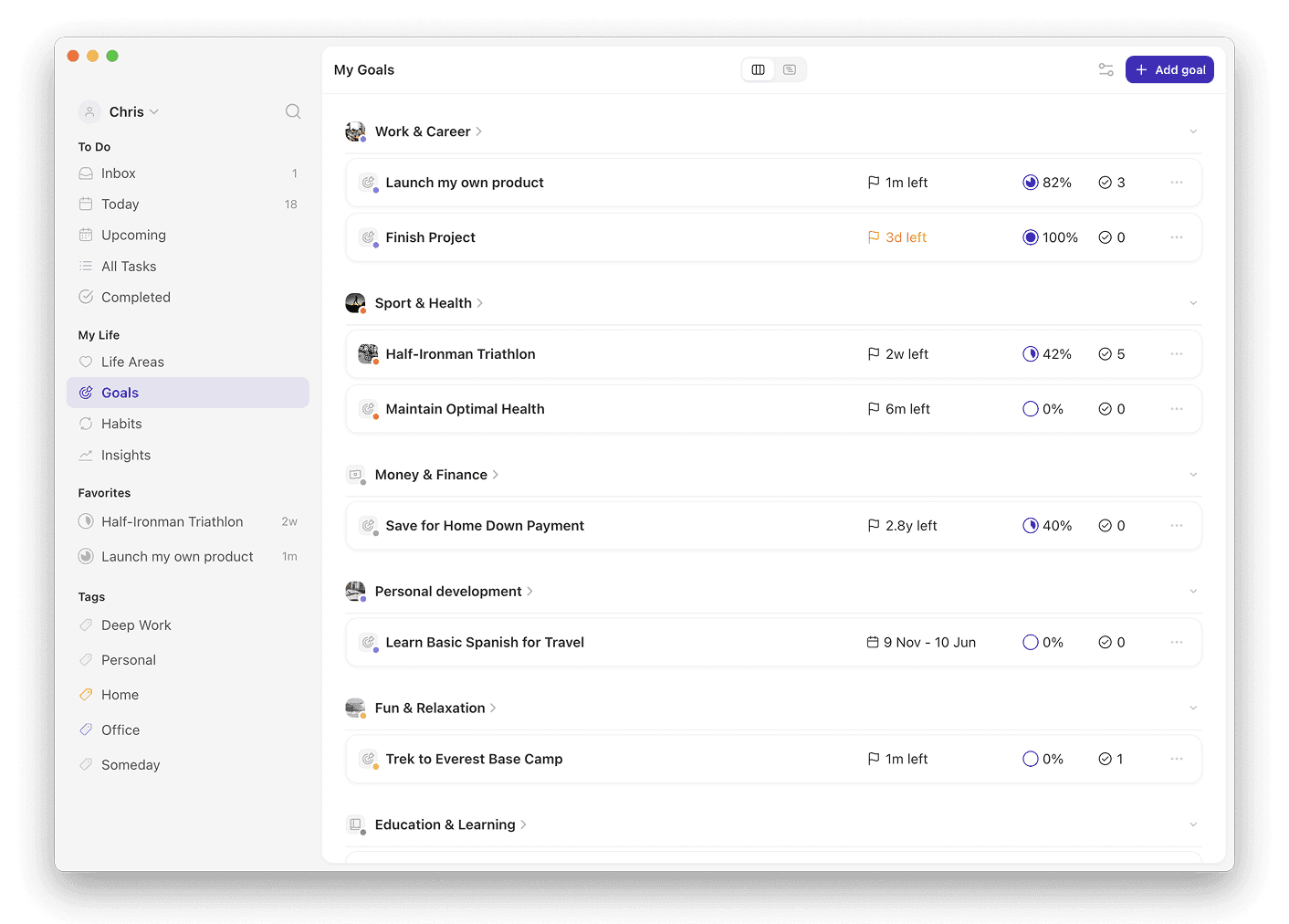
Your development goals can sit together in the Work & Career life area, next to a short vision for your career. Under each goal you can add subgoals for milestones and habits like an hour of reading every Friday. Work with nothing to measure, like preparing a conference talk, becomes a project: a list of tasks under the goal. When you link a task to a goal, Today shows which goal it serves, so you can prioritize the day's tasks by how they serve the big picture.
Griply is for your own plan. It has no manager sign-off, review cycles or team plans, so keep the official copy in your company's HR tool. See how Griply's goal planner works.
Frequently asked questions
What should be included in a professional development plan?
A professional development plan should include where you are now (strengths and gaps), where you want to be in one to three years, two to four development goals with a measurable target and a deadline, the actions behind each goal, the support you need, and dates to check progress, usually once a quarter.
What is an example of a professional development plan?
A senior engineer aiming for staff level in 18 months might set three goals: lead two cross-team projects by December 31, write six design docs approved by other teams by September 30, and give four talks outside the team by year-end. Each goal lists actions, such as a stretch project and monthly time with a mentor.
How often should you update a professional development plan?
Review a professional development plan once a quarter, and do a quick 15-minute check once a month. At each quarterly review, update every goal's progress, see which actions happened, and decide whether to keep, change or drop each goal. Rewrite the whole plan once a year.
How long should a professional development plan be?
Most professional development plans cover one year, to match annual reviews and school years, and fit on one or two pages. A plan for a bigger move, such as reaching the next job level or switching into management, can run 18 months to three years. In that case, set yearly goals and review them every quarter.
What is the difference between a professional and a personal development plan?
A professional development plan covers growth at work: skills, experience and the next step in your career, often agreed with a manager or school. A personal development plan can cover any part of your life, such as health, relationships or hobbies, and you usually keep it to yourself.
Build the plan around evidence you can show
Most development plans lean on courses, because a course is easy to write down and tick off. But the people who decide your next step, whether that's a manager, a promotion committee or a new employer, look at what you've done: the projects you led, the documents you wrote, the talks you gave, the results your students got.
So write each goal as a piece of evidence you'll have by a date. Pick two to four of them, plan the work and the people behind each one, and check the numbers every quarter. At next year's review, you won't need to piece the year together from memory. The evidence will already be in your plan, with dates.
Related Guides
McCauley, Cindy. "The 70-20-10 Rule for Leadership Development." Center for Creative Leadership, 2025. https://www.ccl.org/articles/leading-effectively-articles/70-20-10-rule/
DeRue, D. Scott, and Ned Wellman. "Developing Leaders via Experience: The Role of Developmental Challenge, Learning Orientation, and Feedback Availability." Journal of Applied Psychology, 2009. https://pubmed.ncbi.nlm.nih.gov/19594230/
Allen, Tammy D., Lillian T. Eby, Mark L. Poteet, Elizabeth Lentz, and Lizzette Lima. "Career Benefits Associated with Mentoring for Protégés: A Meta-Analysis." Journal of Applied Psychology, 2004. https://pubmed.ncbi.nlm.nih.gov/14769125/
Kraft, Matthew A., David Blazar, and Dylan Hogan. "The Effect of Teacher Coaching on Instruction and Achievement: A Meta-Analysis of the Causal Evidence." Review of Educational Research, 2018. https://annenberg.brown.edu/publications/effect-teacher-coaching-instruction-and-achievement-meta-analysis-causal-evidence