What is a personal development plan?
A personal development plan identifies your growth areas, sets goals for each one, and maps out the actions needed to reach them. Most versions fail because the goals stay in the document. Griply connects each development area to a measurable goal with tasks and habits beneath it.
Why the standard personal development plan breaks down
A personal development plan typically includes a self-assessment, a set of SMART goals, and a list of action steps. SMART, introduced by George T. Doran in 1981 in Management Review, stands for Specific, Measurable, Achievable, Relevant, and Time-bound. The framework gives each goal a number and a deadline, which is the right starting point.
The 70-20-10 model, developed by McCall, Eichinger, and Lombardo at the Centre for Creative Leadership in the mid-1990s, adds a layer by suggesting 70% of real development comes from doing, 20% from feedback and mentoring, and 10% from formal training. Together, these two frameworks describe what goes into a well-built PDP. The gap is that once you close the document, the goals have no connection to your calendar or daily work.
For a personal strategic plan to work, the goals need to live in the same place as your daily tasks.
How Griply structures a personal development plan
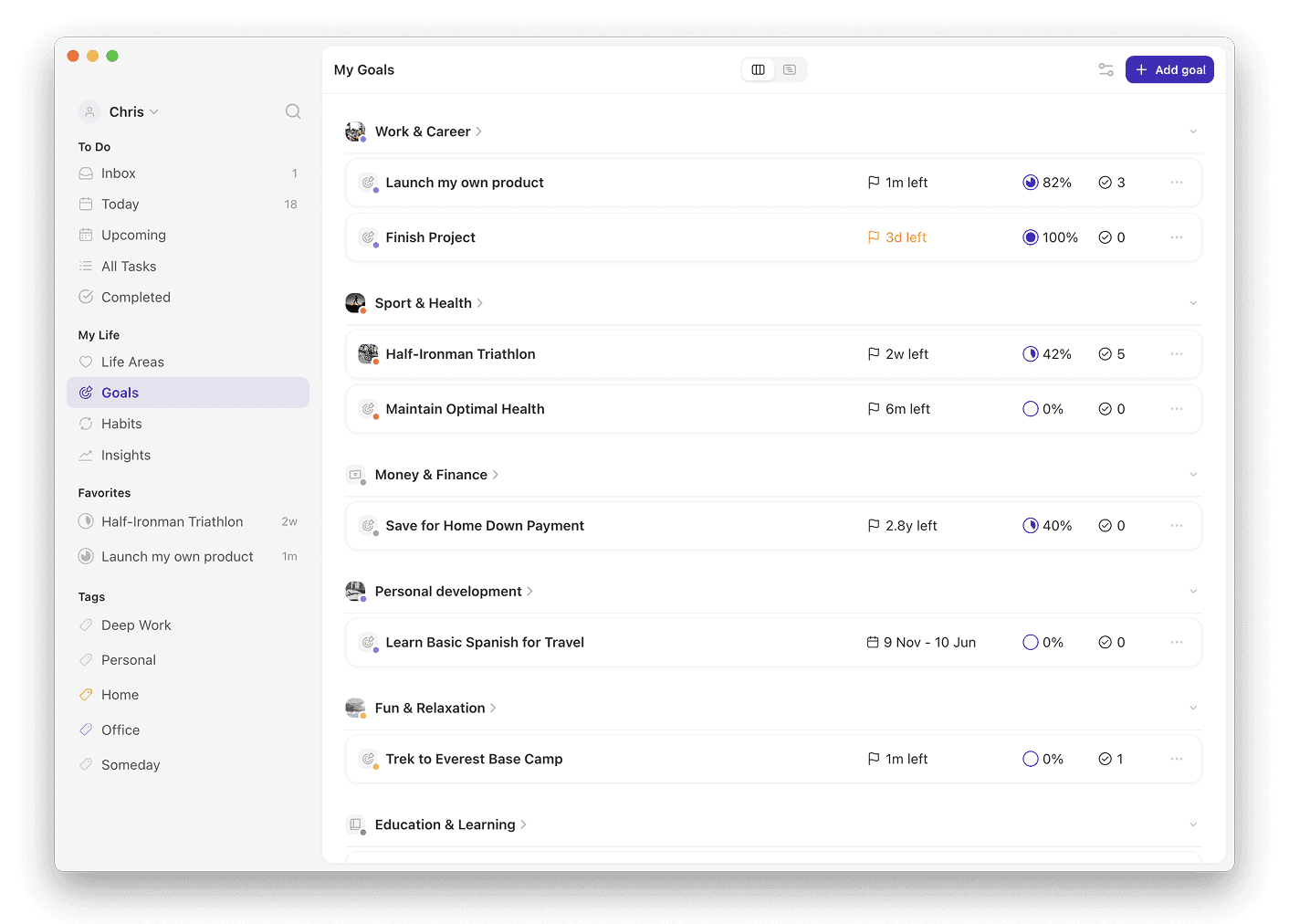
In Griply, a personal development plan is a goal hierarchy. You set up a Life Area for the development area you want to work on, write a Vision statement for where you want to be, and create a Goal with a start value, a target value, and a deadline beneath it.
Each Goal in Griply has a progress line chart that updates every time you log an entry. Subgoals nest inside goals with the same structure, so a yearly development goal breaks into quarterly milestones with visible progress at each level. You can see which professional development goals are on track and which are drifting without opening a separate spreadsheet.
The Goal Roadmap in Griply displays your goals and subgoals on a Gantt chart. If your plan covers multiple development areas, all of them appear in one timeline view with deadlines and progress visible at a glance.
How to build a personal development plan in Griply
Start with one Life Area that captures the domain you want to develop: Work & Career, for example, or a custom area you name yourself. Write a Vision for that area in one or two sentences describing what progress looks like in a year.
Beneath the Vision, create a Goal. Choose a measurable metric: if your development area is public speaking, the goal is "Complete 12 speaking engagements" with a start value of 0 and a target of 12 by December. Griply tracks every logged entry against the target line on the progress chart.
Break the goal into Subgoals if it spans multiple quarters. Add Tasks linked to the goal for discrete actions, and Habits linked to the goal for recurring practice. The Today view surfaces your goal-linked tasks and habits each morning, so your personal development plan has a daily presence.
Related questions
What is the difference between a personal development plan and a goal?
A personal development plan is a structured system that contains multiple goals, a self-assessment, and an action plan across one or more growth areas. A goal is one measurable outcome within that system. Without a goal hierarchy beneath it, a PDP is a list of intentions with no execution layer.
What should a personal development plan include?
A personal development plan should include a self-assessment of your current skills, SMART goals for each development area, specific actions to take, a timeline, and a way to track progress over time. The tracking layer is the part most plans omit, which is why most plans get abandoned.
How long should a personal development plan be?
A personal development plan typically covers 12 months, with quarterly checkpoints. Shorter plans of 30 or 90 days are useful for intensive skill development. In Griply, the goal deadline determines the plan window, and subgoals mark the checkpoints within it.
How does Griply compare to BetterUp for personal development plans?
BetterUp connects you with a coach who helps you build and review a development plan. Griply has no coach; it is a self-directed planning system. BetterUp has no field that connects your development goals to daily tasks, so the plan stays in the coaching conversation rather than your daily workflow.
Does a personal development plan work without an app?
A personal development plan works without an app if you review it daily and have a system for linking its goals to the work you do each day. In practice, most paper or document-based PDPs do not get reviewed more than once a quarter, which is why progress stalls.