Guide

Table of Contents
Good work habits are the routines you repeat at work almost automatically, like planning tomorrow before you log off, guarding a block of deep focus, and looking back on Friday at what you actually finished. Once a habit runs on its own it stops costing willpower, so your attention is free for the decisions only you can make.
Most lists of good habits at work stop there. They hand you twenty behaviours and assume you will keep all twenty through a pressured quarter, which nobody does. The work habits that survive a busy week are the ones attached to a goal you care about.
Start with these ten productive work habits worth building:
Plan tomorrow before today ends
Protect one block of deep focus every day
Batch your email and messages into set windows
Block time for your highest-impact work
Keep every task in one place you trust
Say no to low-impact work
Protect your recovery after work
Learn one skill on a schedule
Review your week and adjust what is not working
Follow through on what you commit to
Key takeaways
Build one work habit at a time; starting five at once usually means keeping none.
The strongest habits protect focus and recovery, so switching off after hours counts too.
A work habit sticks when you repeat one small action after the same daily trigger.
Griply lets you link a work habit to a bigger goal, so the habit appears under that goal.
What good work habits are and why they matter
A work habit is any routine you repeat at work on a schedule or a cue, from a daily planning block to a weekly review. Good ones move your real priorities forward; bad ones keep you busy on low-stakes tasks that feel productive. Once a work habit is formed you do it without deciding to, which is what makes it cheap to keep.
Much of what you do in a day runs on habit, triggered by the same place at the same time, and when you act on habit your mind is free to think about something else. At work that spare attention goes to the judgment calls a routine can't make for you. Good habits also add up, so a ten-minute planning habit repeated for a year shifts a lot of your week onto high-impact work.
You build these workplace habits the same way you build any habit, which our habit tracking guide covers in full.
1. Plan tomorrow before today ends
The strongest planning habit runs at the end of the day, not the start. Before you log off, list tomorrow's three or four highest-impact tasks and put the most important one first. You walk in already knowing what matters, so your first hour goes to real work, not to working out where to start.
2. Protect one block of deep focus every day
Working on one thing at a time is where your hardest problems get solved, and it needs protecting from interruption. Heavy multitaskers are more easily distracted by irrelevant information and worse at filtering it out, so every jump between tabs costs you more than the second it takes.
Block 60 to 90 minutes and cut the interruptions. One protected block a day gets more done than a whole day of interrupted effort.
3. Batch your email and messages into set windows
Answering every message the second it arrives interrupts your focus all day. Set two or three windows for email and messages, and keep both apps closed the rest of the time. You still answer everyone the same day, and nothing pulls you out of focused work every few minutes.
Tell your team when those windows are, so nobody expects an instant reply.
4. Block time for your highest-impact work
A task with a time on your calendar gets done more often than one left on a list. Block your highest-impact work into specific slots, starting with the hardest task while your attention is fresh. Treat those blocks as real appointments you would not cancel for a low-stakes request.
5. Keep every task in one place you trust
One list you check every day saves you the effort of holding everything in your head. Capture each task, idea, and follow-up the moment it appears, before it turns into a 2 a.m. worry. Then your end-of-day planning habit works from the full list, not from whatever you happen to remember.
6. Say no to low-impact work
Protect your priorities by declining or delegating work that does not move them forward, and give a clear reason when you do. Saying no gets easier once you can name the goal you are protecting the time for.
7. Protect your recovery after work
Good work habits include the ones that happen after you stop working. Switching off after hours is its own skill, and psychologically detaching from work is what lets you start the next day with attention to spend.
Set a shutdown time, and treat sleep and exercise as part of how you work, not as extras you drop when the week gets heavy. A pace you can hold is what keeps the other nine habits going all year.
8. Learn one skill on a schedule
Careers grow when you get deliberately better at one thing at a time. Pick the one skill that would make the biggest difference to your work, and give it a recurring slot, even 20 minutes twice a week. Steady, scheduled practice on one skill does more than occasional bursts across five.
9. Review your week and adjust what is not working
A weekly review is the habit that checks whether the others are working. Once a week, look at what you finished, what you did not get to, and what you kept avoiding, then adjust next week's plan around it. Fifteen minutes of looking back turns a pile of completed tasks into information you can act on.
10. Follow through on what you commit to
Reliability is a habit, and it builds trust faster than almost any skill. Do what you said you would do, by when you said it, and flag early when you cannot.
Bad work habits worth breaking
Building good work habits has a second half: dropping the ones that cost you time and focus. A few bad habits at work worth checking for:
Checking email and messages the moment they arrive, all day.
Saying yes to every request, then working late to cover it.
Starting the day by reacting to whatever landed in your inbox overnight.
Multitasking across three tabs and finishing none of them.
Skipping breaks until your afternoon output falls off.
Each of these has a replacement in the list of ten above, so break a bad habit by building the good one that takes its place.
How to make a work habit stick
Building a work habit works the same way as building any other habit. You start smaller than feels satisfying, attach the action to something that already happens in your day, and repeat it until it runs on its own. A behaviour becomes automatic when you repeat a simple action in a consistent context, so a reliable trigger matters more than how motivated you feel that morning.
Pick one work habit from the list of ten, shrink it, and attach it to something you already do at the same time every day. For the full mechanics of building a habit from scratch, including how to recover from a missed day, see our guide on how to build good habits. Track it somewhere you see every day, so you can tell at a glance whether you kept it up.
Why good work habits fail without a goal behind them
A work habit with no goal behind it depends on willpower, which fades fast in a pressured week. You keep the planning block while things are calm, then drop it the moment three deadlines land on the same Tuesday. The fix is to tie the habit to an outcome you can measure.
Goals that match your own values, paired with a concrete plan for acting on them, are the ones people actually make progress on. So a work habit sticks better when it serves a goal you chose yourself, and when that goal is specific enough to measure.
A goal in Griply has a start value, a target value, and a deadline, so the outcome behind "plan my day" is a number you can watch move. When you can see that number, keeping the habit takes less discipline.
Griply links a work habit to the goal it feeds
Take habit number one, planning tomorrow before today ends. On a calm week you keep it; under pressure it is the first thing to go. In Griply you link that habit to the goal it supports, so you can see what it is for on the days your motivation is gone.
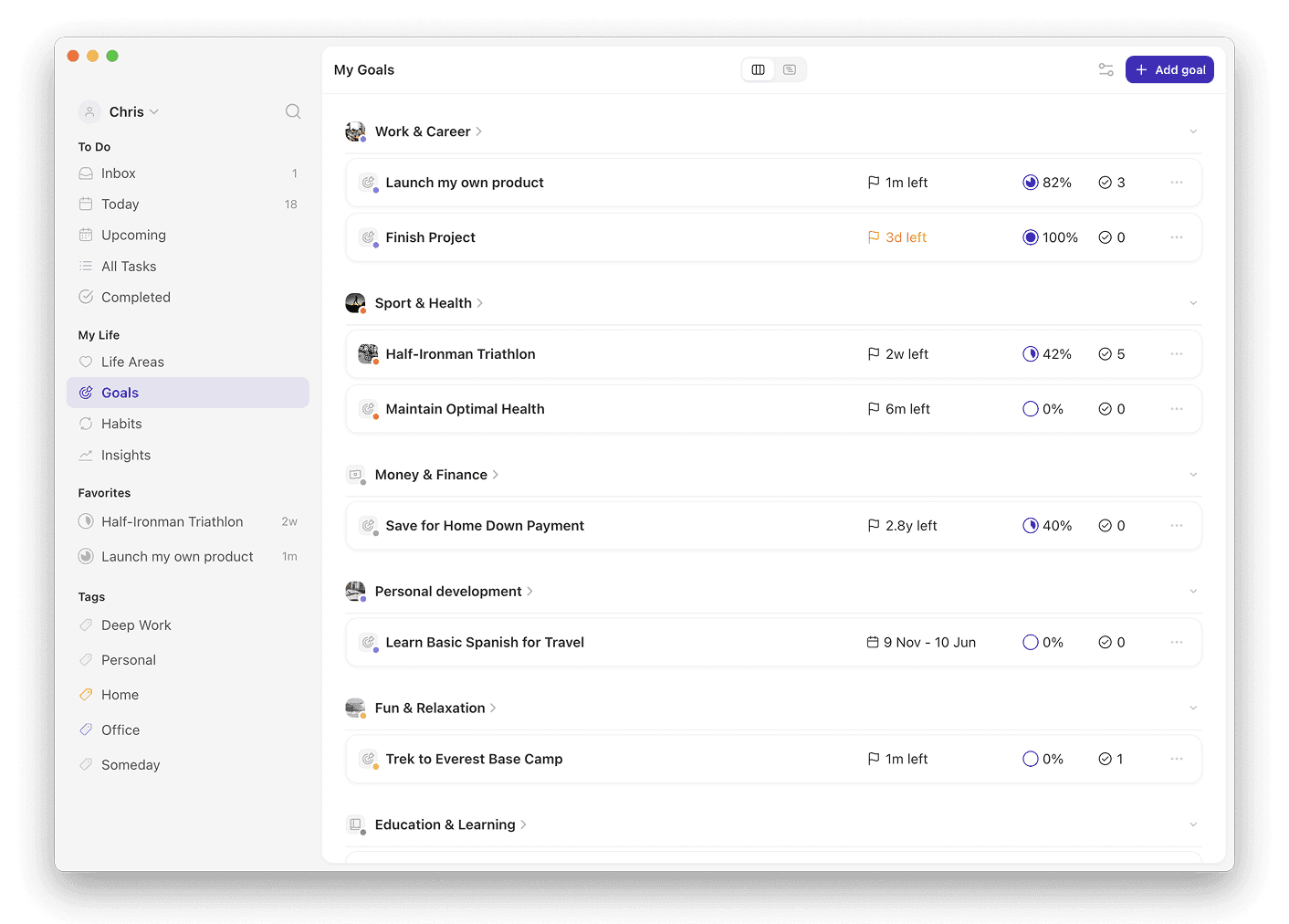
Griply keeps everything in one hierarchy: a life area holds a vision, a vision holds a goal, a goal holds subgoals, and a task or habit sits at the bottom. When you set up a work habit, Griply lets you link it to a bigger goal, and that goal has its own start value, target, and deadline.
The habit then appears under that goal, so you can see which goal your daily work is serving. Completing the habit does not move the goal's number for you, so you still update that number yourself. Griply shows your consistency as a completion rate and a count of perfect weeks, and there is no streak counter to protect.
Track your work habits and the goals they support with Griply's habit tracker.
Frequently asked questions
What are the most important good work habits?
Planning your day before it starts, protecting one block of deep focus, and reviewing your week are the habits that move the most work. They cover the three failure points of a workday: no plan, constant interruption, and no feedback. Start with one and add the next once it runs on its own.
How long does it take to build a work habit?
It varies by person and by how complex the habit is, so treat consistency as the target, not a fixed day count. Repeating a simple action at the same cue is what makes it automatic. Keep the action small enough that a busy day can't crowd it out.
What are the worst bad habits at work?
Reacting to email all day, saying yes to everything, and multitasking across tabs are the habits that quietly drain output. Each one pulls your attention off your own priorities. Replace each with its opposite: batched email, clear boundaries, and single-tasking.
Can a habit tracker help with work habits?
Yes. A habit tracker keeps the schedule and the record in one place, so you never have to remember whether you did it. In Griply you can also link a work habit to a bigger goal, so you can see which goal the habit belongs to.
What makes a work habit stick when things get busy?
A goal you care about. A work habit that serves a specific, measurable goal survives a pressured week, because you can see what dropping it would cost you. Habits that run on willpower alone are the ones you drop first.
The work habits you keep are the ones with a goal behind them
Try to build all ten habits in one week and you usually keep none past the first busy stretch. Pick the one that fixes your biggest failure point, whether that is a missing plan, constant interruption, or no time to recover. Shrink it, attach it to something you already do daily, and track it where you will see it.
Then connect it to a goal you care about, one specific enough to measure, so the habit has a reason to survive the weeks when motivation is gone. That connection is what separates a work habit you keep from one you abandon by February.
Related Guides
Wood, W., Quinn, J. M., & Kashy, D. A. "Habits in everyday life: Thought, emotion, and action." Journal of Personality and Social Psychology, 2002. https://pubmed.ncbi.nlm.nih.gov/12500811/
Koestner, R., Lekes, N., Powers, T. A., & Chicoine, E. "Attaining personal goals: Self-concordance plus implementation intentions equals success." Journal of Personality and Social Psychology, 2002. https://pubmed.ncbi.nlm.nih.gov/12088128/
Sonnentag, S., & Fritz, C. "The Recovery Experience Questionnaire: Development and validation of a measure for assessing recuperation and unwinding from work." Journal of Occupational Health Psychology, 2007. https://pubmed.ncbi.nlm.nih.gov/17638488/
Ophir, E., Nass, C., & Wagner, A. D. "Cognitive control in media multitaskers." Proceedings of the National Academy of Sciences, 2009. https://pmc.ncbi.nlm.nih.gov/articles/PMC2747164/
Gardner, B., Lally, P., & Wardle, J. "Making health habitual: the psychology of 'habit-formation' and general practice." British Journal of General Practice, 2012. https://bjgp.org/content/62/605/664