Guide


Table of Contents
Career goals are the outcomes you want your working life to reach over the next few years: the role you want to hold, the expertise you want to be known for, the income or freedom you want the work to pay you. Most career goals lists read like resume bullets, broad enough to fit anyone and too vague to act on. "Become a leader in my field" or "grow professionally" could belong to any person in any job, which is why they sit in a performance review and get forgotten by spring.
A career goal starts working when the habits and tasks that move it forward sit in the same plan as the goal itself, not in a separate document. "Lead a product team within 18 months" becomes a set of quarterly subgoals, a weekly milestone, and a task for this afternoon once you break it down.
Most career planning fails in the space between the sentence you wrote in the review and the work you actually do. You write an ambitious line, file it, and spend the next eleven months reacting to whatever is loudest. The fix is structural, and it is the thread through Griply's goal setting guides: keep the career goal connected to the week in front of you.
Key takeaways
A career goal only progresses when the weekly actions behind it are planned in the same place as your tasks.
Short term career goals are the checkpoints of a long term one. Set the three-to-five-year direction first, then break it into quarterly subgoals.
A career goal you chose yourself gets more effort than one copied from a list, and dropping a goal that no longer fits protects the ones that do.
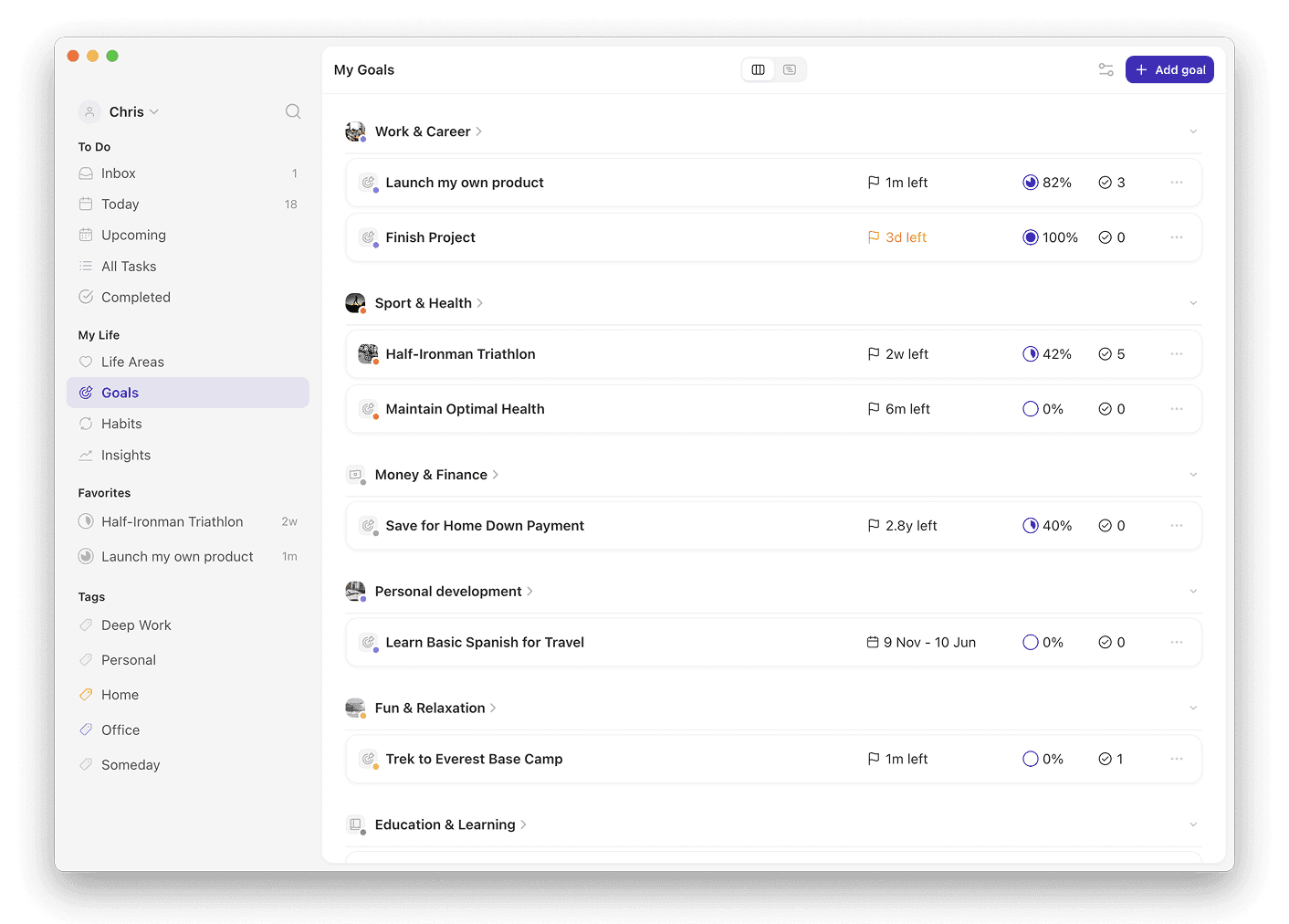
In Griply a career goal is a measurable Goal with a start value, a target value, and a deadline. It lives in a Work & Career life area, and you lay its subgoals out on the Goal Roadmap.
What career goals are, and why most lists fail
A career goal names a direction for your working life, not a duty on a job description. It answers where you want to be in a few years, while a task answers what you will do this afternoon. This is where career aspirations usually go wrong: a broad aspiration like "grow professionally" describes a feeling, not an outcome you can measure or act on.
Vagueness is not the only problem with a generic list. You work harder on a goal you set for your own reasons than on one copied from a template, because autonomy is one of the strongest drivers of self-directed motivation at work. A career goal written to sound impressive in a review is someone else's goal, and it gets the effort you give to someone else's homework.
So the first test of a career goal is a simple one. Would you still want it if no one were watching, and could you tell from a number whether you are getting closer?
Career goals set your direction, professional development goals build the skills
Career goals and professional goals are related, but they are not the same thing. A career goal names where your working life is heading over the next several years: the role you hold, the work you own, what you are known for, and how much control you have over your time. Professional development goals are the specific skills you build to get there, which is why they usually become the subgoals under a career goal.
Treating them as one list is a common mistake. You end up with "get better at public speaking" sitting next to "become a VP" as if they were the same size, when public speaking is a quarter of practice and reaching VP is five years of work. Keep the career direction at the top and make the skills its subgoals.
Which skills to build this quarter, and how to write them, is a separate question. The professional development goals guide covers the frameworks and the role-by-role examples in depth.
Short term and long term career goals belong to one hierarchy
Short term career goals and long term career goals are two levels of the same structure, not two separate lists. Long term career goals set the direction over three to five years, and short term career goals are the checkpoints that prove you are moving toward that direction. Set the long term career goal first, then write each short term goal as a checkpoint on the way to it.
The direction at the top has to be one you care about, because a long term career goal is a multi-year commitment. Perseverance and passion for long-term goals predicts who reaches them more reliably than talent does. If the direction would not hold your interest through a dull year, drop it before you build a plan on it.
A career goal runs through five levels, each with its own name, from your career direction at the top to today's task at the bottom:
Your career direction is where your working life is heading over the next three to five years.
The yearly goal is the measurable outcome that moves the career direction forward this year.
The quarterly subgoal is the checkpoint that shows whether the yearly goal is on pace.
The weekly milestone is the progress you want to see on the quarterly subgoal by Friday.
The daily habit or task is the work you do today to hit the weekly milestone.
Six types of career goals worth setting
Career goals fall into six recurring types. Adapt these career goals examples to your own work, because a goal only gets real effort from you when you chose it yourself:
An advancement goal might be moving from senior engineer to engineering manager within 18 months.
An expertise goal might be becoming your team's go-to reviewer for data privacy this year.
A scope goal might be taking over a product line that a more senior colleague runs today.
An income goal might be reaching a target salary band by a set date.
An autonomy goal might be replacing your salary with client work over two years.
A reputation goal might be giving four talks or publishing four articles your field cites.
As written above, most of these are still too loose to track. Turn each one into a number with a deadline before you commit to it, because measurable goals give you the feedback loop that tells you whether the year is on pace or slipping.
How to connect a career goal to this week's work
A career direction gets clearer when you act on it. In her research on career reinvention, Herminia Ibarra found that people work out where they are going through small projects and new conversations, not by planning it on paper. Treat the first weeks of a career goal as experiments that tell you whether the direction still fits.
Then protect the time for it, because a career goal competes with a full inbox every week. Block the hours for the work that moves it before the week fills with everyone else's priorities. Once a week, check the career goal against the tasks you finished, which turns "am I making progress" from a feeling into a five-minute answer.
When dropping a career goal is the right call
Sometimes the right move is to drop a career goal, not push harder on it. Letting go of a goal that no longer fits, and committing to a better one, protects both your well-being and your momentum. Staying with a stale goal out of stubbornness costs you your motivation and the year you could have spent on a better goal.
A career goal you wrote once and filed away gives you nothing to make that call with. There is no progress line to read, so you do not notice the goal going nowhere until the year is over. A career goal you review every week gives you the evidence to push, adjust, or replace it with the direction you want now.
How Griply keeps a career goal connected to the work
Career goals fail most often in the gap between the direction you wrote down and the work you do on a Tuesday. Griply closes that gap by keeping both in one structure: Life Area, Vision, Goal, Subgoal, Task or Habit.
Your career lives in a Work & Career life area, and the Vision field on that life area is where you write your three-to-five-year career direction in plain words. The yearly career goal is a Goal with a start value, a target value, and a deadline, so "reach a principal engineer role" or "replace my salary with client work" stops being a phrase and becomes a number you can watch move toward a target. Subgoals break that yearly goal into quarters you can lay out on the Goal Roadmap, and the Today view shows which goal a linked task is serving.
You can link a habit to your career goal so the habit shows up with the goal it supports, and Griply's free plan covers two goals, so you can set a direction before you pay for anything.
Frequently asked questions
What are career goals?
Career goals are the outcomes you want your working life to reach over the next few years, such as the role you want to hold or the expertise and income you want your work to produce. They differ from tasks because they name a direction, not a single action. The ones that work stay connected to your weekly plan.
What is the difference between short term and long term career goals?
A long term career goal is your three-to-five-year direction, like reaching a leadership role or building a reputation in a field. A short term career goal is the checkpoint that proves you are on pace this quarter or year. Set the long term direction first, then write each short term goal as a checkpoint toward it.
What are some examples of career goals?
Examples include moving into management within 18 months, becoming your team's expert on a specific skill this year, owning a product line, reaching a target salary band, or replacing your salary with client work over two years. Each works best written with a number and a deadline so you can tell whether it is on track.
How do you keep career goals from being forgotten?
Keep the career goal in the same place as your daily tasks and review it every week, so the direction stays visible while you work. In Griply a career goal is a measurable Goal with subgoals, and the Today view shows which goal a linked task is serving. Seeing that connection is what keeps the goal from being forgotten.
How many career goals should you set at once?
One or two active career goals is usually enough, with two or three quarterly subgoals under each. More than that splits your attention and turns the list into aspirations you are not pursuing. Archive the rest until a current goal is finished or dropped on purpose.
A career goal earns its place only when it reaches this week
A career goal shapes your years when it reaches the habits and tasks you will do this week. Pick the direction yourself, break it into a measurable yearly goal and quarterly subgoals, and an ordinary workday starts pointing somewhere you chose.
That is also why the resume-bullet version keeps failing. "Grow professionally" gives you nothing to do on Monday morning, so there is nothing to review and nothing to protect when the busy weeks come. Write the direction you want, put a yearly goal and quarterly subgoals under it, and let the weekly review tell you whether this month moved it.
Related Guides
Duckworth, Angela L., Christopher Peterson, Michael D. Matthews, and Dennis R. Kelly. "Grit: Perseverance and Passion for Long-Term Goals." Journal of Personality and Social Psychology, Vol. 92, No. 6, 2007. https://pubmed.ncbi.nlm.nih.gov/17547490/
Gagné, Marylène, Sharon K. Parker, Mark A. Griffin, Patrick D. Dunlop, Caroline Knight, Florian E. Klonek, and Xavier Parent-Rocheleau. "Understanding and Shaping the Future of Work with Self-Determination Theory." Nature Reviews Psychology, Vol. 1, 2022. https://pmc.ncbi.nlm.nih.gov/articles/PMC9088153/
Ibarra, Herminia. "Working Identity: Unconventional Strategies for Reinventing Your Career." Harvard Business Review Press, 2003. https://herminiaibarra.com/working-identity-book/
Wrosch, Carsten, Michael F. Scheier, Gregory E. Miller, Richard Schulz, and Charles S. Carver. "Adaptive Self-Regulation of Unattainable Goals: Goal Disengagement, Goal Reengagement, and Subjective Well-Being." Personality and Social Psychology Bulletin, Vol. 29, No. 12, 2003. https://pubmed.ncbi.nlm.nih.gov/15018681/