Goal Setting


Table of Contents
Most goals written in January are quietly dropped by March, and motivation is almost never the real cause. The problem is rarely effort; the problem is that most people run goal setting as a wish list and goal tracking as a checkbox exercise, with nothing connecting the two.
A goal tracker is a system that records three things at once: the outcome you want, the current distance between you and that outcome, and the daily actions that close the distance. A progress tracker that only logs the first two is a wish list with a progress bar attached. You can tell the difference by asking whether, if you opened your tracker tomorrow morning, it would tell you what to do today; if the answer is no, the tracking is decorative.
By the end of this guide you will know what makes a goal worth tracking, why tracking alone is not enough, which frameworks hold up under research, and how to plan goals across your life without drowning in them. Every section links into a deeper article if you want the full breakdown.
Key Takeaways
A goal tracker only helps when it connects the outcome you want to the daily tasks and habits that get you there. Without that link, you are just journaling.
A specific, challenging goal beats a vague "do your best" goal in around 90% of studies.
Writing your goals down and sending a weekly progress update makes you 33% more likely to reach them.
SMART shapes how a goal is worded. It does not decide which goals you pursue, so treat it as a final polish on a goal you already chose.
Most goals fail because the daily work is not connected to them, so the goal quietly slips off your list.
A new habit takes far longer to feel automatic than the popular 21-day rule, around 66 days on average.
A good goal tracker shows today's work next to the goal it serves, so your goals and your daily tasks never end up in two separate apps.
What is a goal tracker and what makes it different from a to-do list
A goal tracker is the thin layer above your to-do list where outcomes, deadlines, and the tasks that serve them live in one structure. A to-do list shows what you plan to do this week; a goal tracker shows why those tasks exist and whether they are moving the outcomes you chose. The distinction matters because most failed plans fail at the handoff between the two, not at the effort level.
The category splits into three rough groups. Spreadsheet templates are flexible and free but make you maintain the structure yourself. General productivity apps like Notion or Todoist can be bent into trackers but treat goals as a second-class object. Purpose-built goal trackers model goals as the top of the hierarchy and make everything else point upward, which is the shape that actually closes the tracker-to-execution gap.
What makes a goal worth tracking
A goal worth tracking has a clear owner (you), a measurable target, a deadline, and enough difficulty to matter. Research by Edwin Locke and Gary Latham, reviewed across more than four decades of studies, consistently shows that specific and difficult goals produce better performance than vague or easy ones. The reason is mechanical, not motivational: a specific goal gives your attention something to lock onto, and a difficult goal pulls harder on effort.
The characteristics that separate goals that stick from goals that fade tend to gather around four qualities: they are written down, they are measurable, and they have a deadline that is close enough to create urgency but far enough to allow real work. The fourth quality is the one most people skip: the goal has to connect to something you actually want, not something you think you should want.
For a full breakdown, see 📘 What are the characteristics of a strong goal.
Measurable goals and target setting
Measurement is where most goal trackers earn or lose their usefulness. A goal like "get fitter" cannot be tracked because it cannot be falsified; there is no value for which you would look at the number and say, "I am there." Measurable goals replace that fog with a unit, a starting point, and a target.
Target setting forces a useful conversation with yourself, because you have to choose the metric that captures the outcome rather than the activity. Running three times a week is an activity metric; running a sub-25-minute 5K is an outcome metric, which is harder to track and harder to fake, which is precisely why it is worth the extra effort. A goals tracker that only lets you mark a goal as "done" without a numeric target is back in checkbox territory.
For a full breakdown, see 📘 How measurable goals drive real results.
Why goals fail
Motivation is the most over-blamed cause of goal failure. The real culprit is usually structural. Goals fail when daily work is not connected to them, when the tracker lives in a different app from the task list, or when the goal itself is too vague to refute. Peter Gollwitzer's research on implementation intentions, covering a meta-analysis of 94 studies with more than 8,000 participants, found a medium-to-large positive effect (d = 0.65) on goal attainment when people formed concrete if-then plans rather than relying on general intent (Gollwitzer, 1999).
In plainer terms: deciding what you will do, when you will do it, and where you will do it beats deciding what you want. Most people skip the first three and over-invest in the fourth. James Clear puts the same idea in plainer language in Atomic Habits: "You do not rise to the level of your goals; you fall to the level of your systems," which is why a goal without a system of daily tasks behind it tends to collapse. A goal tracker that forces you to attach a task or a habit to each goal is quietly doing Gollwitzer's work for you.
For a full breakdown, see 📘 Why you're not achieving your goals and what to do about it.
The SMART framework, used correctly
SMART (Specific, Measurable, Achievable, Relevant, Time-bound) is the most quoted framework in goal setting and the most misused. It is a writing structure. It tells you how a sentence describing your goal should be shaped. It does not tell you which goals to pick, how many to run at once, or what to do when two SMART goals compete for the same weeknight.
Used well, SMART is a final pass on a goal you have already chosen. You draft the goal, then you run it through each letter and sharpen it. Used badly, SMART becomes the planning step itself, and you end up with ten perfectly-written goals you will never touch. The framework is strongest when paired with a separate prioritisation step, ideally one that forces you to rank by impact before you refine the wording.
For a full breakdown, see 📘 SMART goal generator: build any goal in 6 steps.
Goal-setting examples across life areas
A healthy goal list covers the parts of your life you care about, not the parts that shout loudest. Most people over-index on career and under-index on health, relationships, and finances, then wonder why the year felt lopsided. The fix is to split your goals across defined life areas before you write any of them down (the 📘 life planning guide covers how to run this exercise properly). Work and career, money and finance, sport and health, relationships, personal growth: a spread across these keeps any one domain from eating the others.
Examples are useful not because you should copy them, but because seeing a well-written goal in a domain you care about makes it easier to write your own. A good example has the unit, the target, the deadline, and a visible connection to a recurring habit.
For a full breakdown, see 📘 Personal goals examples: 25 ideas across every life area. If you are setting goals for the academic year, the student version splits the same life-area spread across study, health, money, social life, and personal growth, with examples sized to a semester. For a complete guide, see 📘 Student goals examples for every part of student life.
Goal planning and how to stay on track
Goal planning is the step between deciding what you want and doing anything about it. Skip it, and you default to reacting. A basic planning rhythm looks like this: a year-level view of where you want each life area to end up, a quarter-level view of which goals you will push on, a week-level view of which tasks and habits support those goals, and a day-level view that shows today's work with its goal attached.
Staying on track is less about willpower and more about review cadence. A weekly review where you open your goals tracker, log progress, and decide what next week's tasks should be will beat any streak-based motivation trick. The review is short, boring, and effective, which is the same pattern the 📘 productivity guide argues for across selection and execution.
For a full breakdown, see 📘 Plan your goals for 2026.
Professional development goals
Professional development goals deserve their own track. They move on different timescales than personal goals, they tangle with your employer's performance cycle, and they require a different kind of planning. A "read more" personal goal is a small ask, while a "lead a team through a platform migration" professional goal is a year of work that benefits from being broken into subgoals with named projects.
The rhythm of the goal has to match the rhythm of your role. A teacher's development runs on the academic year; a manager's goals centre on people rather than deliverables; an individual contributor's usually mix skills and visibility; and even when you love the job, growth goals still need a structure that holds up without a title change forcing them.
For a full breakdown of the whole category, including frameworks, examples by role, and how to write professional development goals in a format your team can act on, see 📘 Professional development.
Backcasting: planning your goals from the future back
Backcasting is a planning method that starts from a defined future state and works backward to identify the steps needed to reach it. Where forward planning asks how far you can get from where you are now, backcasting asks what needs to be true at each stage before the target date, and the answer is usually more specific than a forward projection produces.
The method works in four steps: define the future state with a date, identify the gap between where you are and where you need to be, work backward to place checkpoints at each interval, and pull the first concrete action to today. Every checkpoint becomes a subgoal with a deadline. Every first action becomes a task in your current week.
The practical limitation is that backcasting produces abstract milestones unless the checkpoints connect to your daily work. A goal-first system with a timeline view closes that gap.
For a full breakdown, see 📘 Backcasting: how to plan your goals from the future back.
What a goal tracker looks like when it connects goals, habits, and daily work
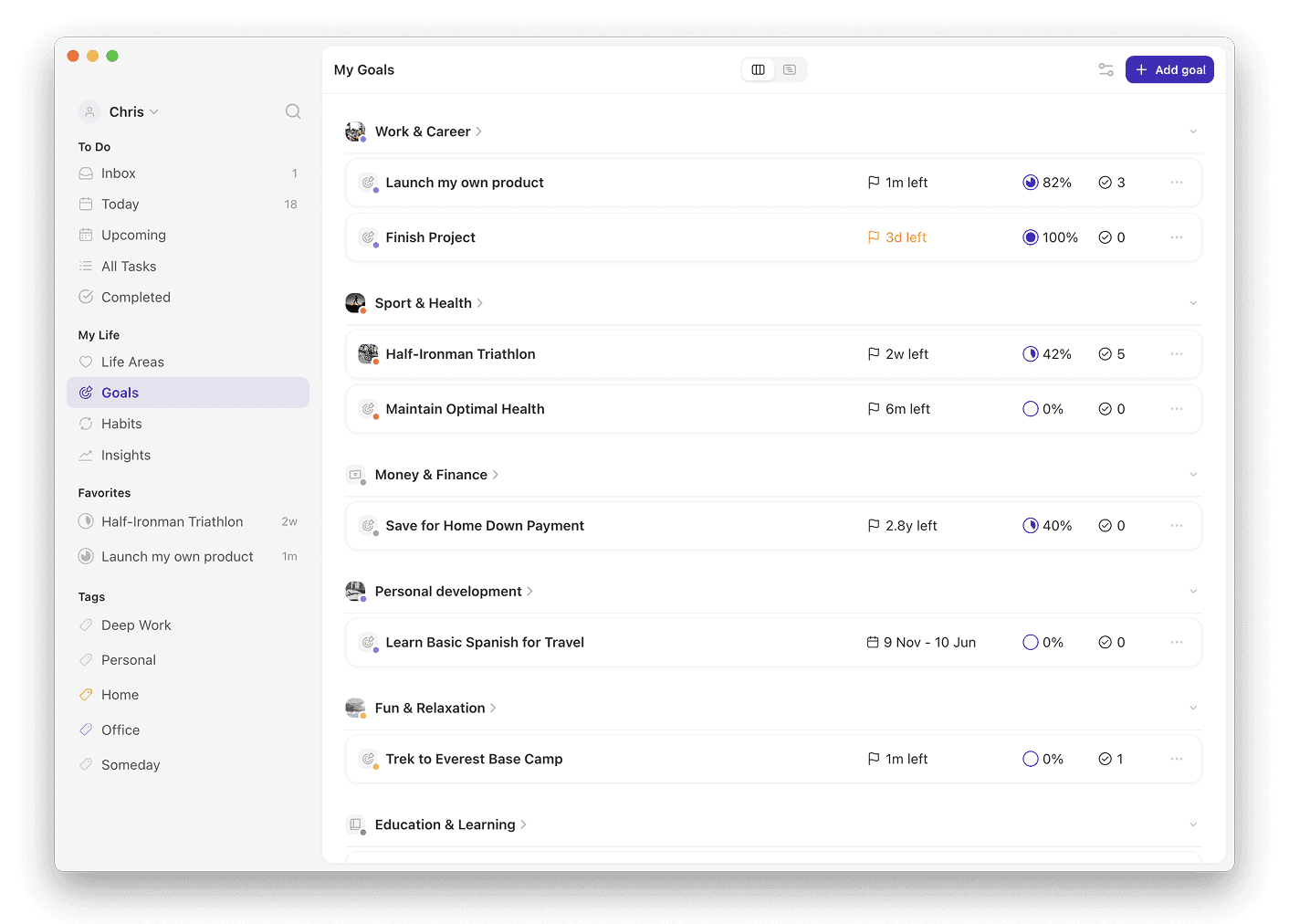
A goal tracker stops being decorative the moment today's work, this week's habits, and this quarter's outcomes share the same structure. The hierarchy matters: a life area holds a vision, a vision holds goals, a goal breaks into subgoals and projects, and projects break into the tasks and habits you actually do. When that chain is intact, any task on your plate traces up to an outcome you chose on purpose.
Griply is built on that Goal-First hierarchy: Life Area → Vision → Goal → Subgoal → Project → Task or Habit. The structural decision most trackers skip is that a goal is modelled as a start value, a target value, and a deadline, not as a checkbox with a percentage. Progress is plotted against a target line running from start to deadline, so at any point you can see whether you are ahead, on pace, or behind without inventing a progress percentage in your head.
The second decision is that habits and tasks live inside the same hierarchy, attached to the goals they serve, rather than in a separate app. The Today view shows today's work alongside the goal each item rolls up to, which is how deep habit tracking stays honest instead of becoming a streak for its own sake. For the execution layer most goal trackers skip, see the Griply goal planner.
Frequently Asked Questions (FAQ)
What is the difference between a goal tracker and a habit tracker?
A goal tracker records a measurable outcome you want to reach by a deadline, such as "save $10,000 by December" or "run a sub-25-minute 5K by June". A habit tracker records whether you performed a recurring action on a given day, such as "meditated for 10 minutes". The strongest systems link the two so each habit has a named goal it supports, which is the difference between tracking behavior for its own sake and tracking behavior as a lever on an outcome.
How many goals should you track at once?
Most people can hold three to five active goals across their life areas without diluting attention, with one or two designated as the current priority. More than seven active goals usually means you are tracking aspirations rather than pursuing them. If your tracker is full, archive the aspirational ones until a current goal is finished or abandoned on purpose.
Do you need a goal tracker app, or is a goal tracker template in a spreadsheet enough?
A spreadsheet goal tracker template works for outcome-only tracking with disciplined weekly review; a dedicated goal tracker app is worth it when you want goals, habits, and daily tasks linked in one system. The spreadsheet is cheaper and more flexible, but it puts the burden on you to keep structure consistent and to bring tasks over from wherever you actually do them. If you find yourself copying tasks out of your spreadsheet into a separate to-do list, you have outgrown the template.
How do you stay on track with goals when motivation drops?
Motivation is not the mechanism you should rely on. Replace it with a weekly review, a small number of habits tied to each goal, and a tracker that shows progress against a target line so you can see whether you are ahead or behind. Every goal accomplished this way is the result of architecture, not a motivational streak, and Peter Gollwitzer's research on implementation intentions shows that specifying when, where, and how you will act produces measurably better follow-through than willpower alone.
How long does it take to build a habit that supports a goal?
The Lally 2010 study cited in Key Takeaways found automaticity is measured in months, not weeks, with the exact timing depending heavily on the behavior. Plan for at least two to three months of consistent effort before a goal-supporting habit feels automatic, and longer for anything physically demanding. The popular "21 days" claim has no research basis in habit formation.
What is the difference between a goal tracker, a goal planner, and an OKR tool?
A goal tracker records outcomes, progress, and the tasks or habits that move them forward, so you can see on any given day whether you are on pace. A goal planner is the upstream step: it helps you decide which goals to pursue across your life areas and schedule the work that supports them. An OKR tool organises goals into Objectives and measurable Key Results, and the framework fits natively inside a goal-first tracker like Griply, where the Objective becomes the parent goal and each Key Result becomes a measurable sub-goal, so you do not need a separate OKR tool alongside your tracker.
Ambition becomes achievement when it is connected to today's work
A goal tracker is not the thing that gets you to the outcome; the work does. The tracker's job is to keep the outcome visible while the work happens, so that on any given Tuesday you know which small action moves which large ambition. Across every study on goal setting, the common thread is connection rather than intensity: written goals beat mental ones, specific goals beat vague ones, and goals tied to concrete plans beat goals tied to good intentions, which means a better tracker will not fix your system until the architecture does.
More guides on goal setting
📘 How measurable goals drive real results. Why measurable goals outperform vague ones and how to choose the right metric for any goal.
📘 Plan your goals for 2026. A step-by-step guide to planning meaningful goals for 2026, organised by life area with a review framework.
📘 Why you're not achieving your goals and what to do about it. The structural reasons goals fail and how to fix the goal-habit connection.
📘 What are the characteristics of a strong goal. The qualities that separate goals that stick from ones that fade.
📘 Personal goals examples: 25 ideas across every life area. 25+ personal goals examples across health, finances, relationships, personal growth, and career in SMART format.
📘 Life goals examples: things to accomplish in life: Lifetime goals across seven areas of life, and why the ones that last are tied to a written vision rather than copied from a generic list.
📘 SMART goal generator: build any goal in 6 steps. A six-step process for turning a vague intention into a written SMART goal.
📘 Monthly goals for self improvement that actually stick: How to set three to five monthly goals as subgoals of a yearly plan, with a month-end review that feeds the next month.
📘 Habits vs goals: why you need both to make progress: Why the habits-vs-goals debate is a false binary, and how to connect them so a habit produces the outcome and the goal gives the habit its reason to continue.
📘 Backcasting: how to plan your goals from the future back: The backcasting method for personal goals: define a desired future state, work backward to checkpoints, pull the first action to today.
📘 Short term goals: what they are and how to set them: How short term goals function as the subgoal layer of a longer plan, what makes them work, and examples across life areas and work.
📘 How to set daily goals that actually move you forward: Why the daily goal layer is what separates a crossed-off task list from real progress on a goal, and how to set one before the day decides itself.
📘 How to run a mid year review on your 2026 goals: How to read six months of progress data at the halfway point, then promote what works, archive what drifted, and rebuild the second half around a 90-day plan.
📘 Student goals examples for every part of student life: Goal examples across academics, health, money, social life, and personal growth, each connected to a goal hierarchy so they survive past midterms.
📘 Professional development: The full section on professional development goals: definitions, frameworks, examples by role, and how to write development goals in a format your team can act on.
📘 Goal setting for couples: build one shared system: Why shared goals fail when each partner runs a separate priority system, and how one agreed hierarchy turns the weekly planning conversation into a check-in instead of a negotiation.
Gollwitzer, Peter M. "Implementation Intentions: Strong Effects of Simple Plans." American Psychologist, Vol. 54, No. 7, 1999. https://psycnet.apa.org/doiLanding?doi=10.1037%2F0003-066X.54.7.493
Lally, Phillippa, Cornelia H. M. van Jaarsveld, Henry W. W. Potts, and Jane Wardle. "How are habits formed: Modelling habit formation in the real world." European Journal of Social Psychology, Vol. 40, Issue 6, 2010. https://onlinelibrary.wiley.com/doi/10.1002/ejsp.674
Locke, Edwin A., and Gary P. Latham. "Building a Practically Useful Theory of Goal Setting and Task Motivation: A 35-Year Odyssey." American Psychologist, Vol. 57, No. 9, 2002. https://www.academia.edu/download/38999325/Building_a_Practically_Useful_Theory_of_Goal_Setting_and_Task_Motivation.pdf
Matthews, Gail. "The Impact of Commitment, Accountability, and Written Goals on Goal Achievement." Dominican University of California, Psychology Department, 2015. https://www.dominican.edu/sites/default/files/2020-02/gailmatthews-harvard-goals-researchsummary.pdf