Guide


Table of Contents
People sort types of goals three ways: by time horizon, by area of life, and by what the goal measures. The first two give you a label to file the goal under. The third one, what the goal measures, is the one that tells you what to track and what to do this week.
How you measure a goal decides what you write down, how often you check it, and whether you can tell you have fallen behind. Two people can file the same goal in the same category and still run it completely differently, because one is counting a number and the other is ticking off tasks.
The other two sorts still earn their place. They show you where your goals are bunched up and which parts of life you have left empty. The goal setting guides cover writing and tracking a goal end to end.
The common types of goals, sorted three ways:
By time horizon: short-term, medium-term, and long-term goals
By area of life: personal, career, health, financial, relationship, and learning goals
By what the goal measures: process, performance, and outcome goals
Key takeaways
Long-term goals hold up better when you break them into a goal for this week.
Goal categories show a neglected part of life, not how to track a goal.
Process goals track a behavior you control. Outcome goals track a result you cannot control.
Griply gives each goal one measure: a number, a task count, or a subgoal average.
Types of goals by time horizon: short term and long term
The most common way to split goals is by when you want them finished. Each of the three time horizons does a different job, and you want more than one of them running at once.
Short-term goals cover the next few days to about a year.
Medium-term goals span roughly one to three years.
Long-term goals set a direction three or more years out.
A long-term goal tells you where you are heading, but it is too far off to tell you what to do this week. A short-term goal does the other half of the job: it fills this week, and on its own it is not attached to anything bigger.
Running both at once, a long-term goal with a short-term goal feeding it, works better than pushing on either one alone. The short-term goal gives you something to do now. The long-term one gives you the reason to keep doing it.
So write them as a chain. Start with the multi-year direction, then break it down into a goal for this year, this quarter, and this week. Most of your day-to-day tracking happens on the short-term goals at the bottom of that chain.
Goal categories by area of life
The second way people sort goals is by the part of life the goal belongs to. These goal categories are the labels most planners and journals use.
Personal goals for character, habits, and self-improvement
Career goals for the work you want to do
Health goals for fitness, sleep, and energy
Financial goals for saving, earning, and paying down debt
Relationship goals for family, a partner, and friends
Learning goals for skills and knowledge
Sorting by category is good for one thing: seeing which parts of your life have no goal in them at all. If all your goals sit in one or two categories, the empty categories are easy to spot.
A category still does not tell you how to run the goal. "Get fit" and "get promoted" belong to different categories, but you could measure either one as a number, as a set of finished tasks, or as a group of smaller goals.
The category tells you which part of life the goal belongs to. It says nothing about what you check on Sunday night.
Process, performance, and outcome goals
The third way of sorting goals looks at what the goal measures: a behavior, a standard, or a result. That also decides how much of the result is in your hands.
Process goals name a behavior you repeat, like writing 500 words a day.
Performance goals set a standard to beat your own past, like a sub-25 5K.
Outcome goals name a result other people help decide, like winning a contract.
On any given day you fully control a process goal, partly control a performance goal, and barely control an outcome goal. That is why coaches lean on process goals: you can act on them and measure them straight away, and they feed the bigger goals above them. The full breakdown lives in the guide on process goals and outcome goals.
There is a fourth label worth knowing: the learning goal, where the point is to get better at something hard. Among premed students, learning goals kept people motivated and coping through setbacks where performance goals often did not. If your goal is about building a skill, calling it a learning goal makes the rough weeks easier to get through.
The types of goals that matter are the ones you can measure
All three sorts above help you see your goals from a distance. When you sit down to work on one, they come down to a single question: what will you check to see whether the goal is moving? Your answer is what you log, and it is what tells you when you are behind.
Only three answers work in practice:
A number you log, like revenue, kilograms, or pages read
A checklist of tasks, where the goal is done when the tasks are
An average across the smaller goals that make it up
Picking one matters. Across 141 studies, setting a real goal reliably changed behavior, and the effect was strongest when the goal was hard and stated out loud.
With no measure you have nothing to make hard and nothing to report on, which is what separates measurable goals from good intentions. Choose the measure first. The category the goal belongs to is then just a filing label.
How Griply turns a goal type into a way to track it
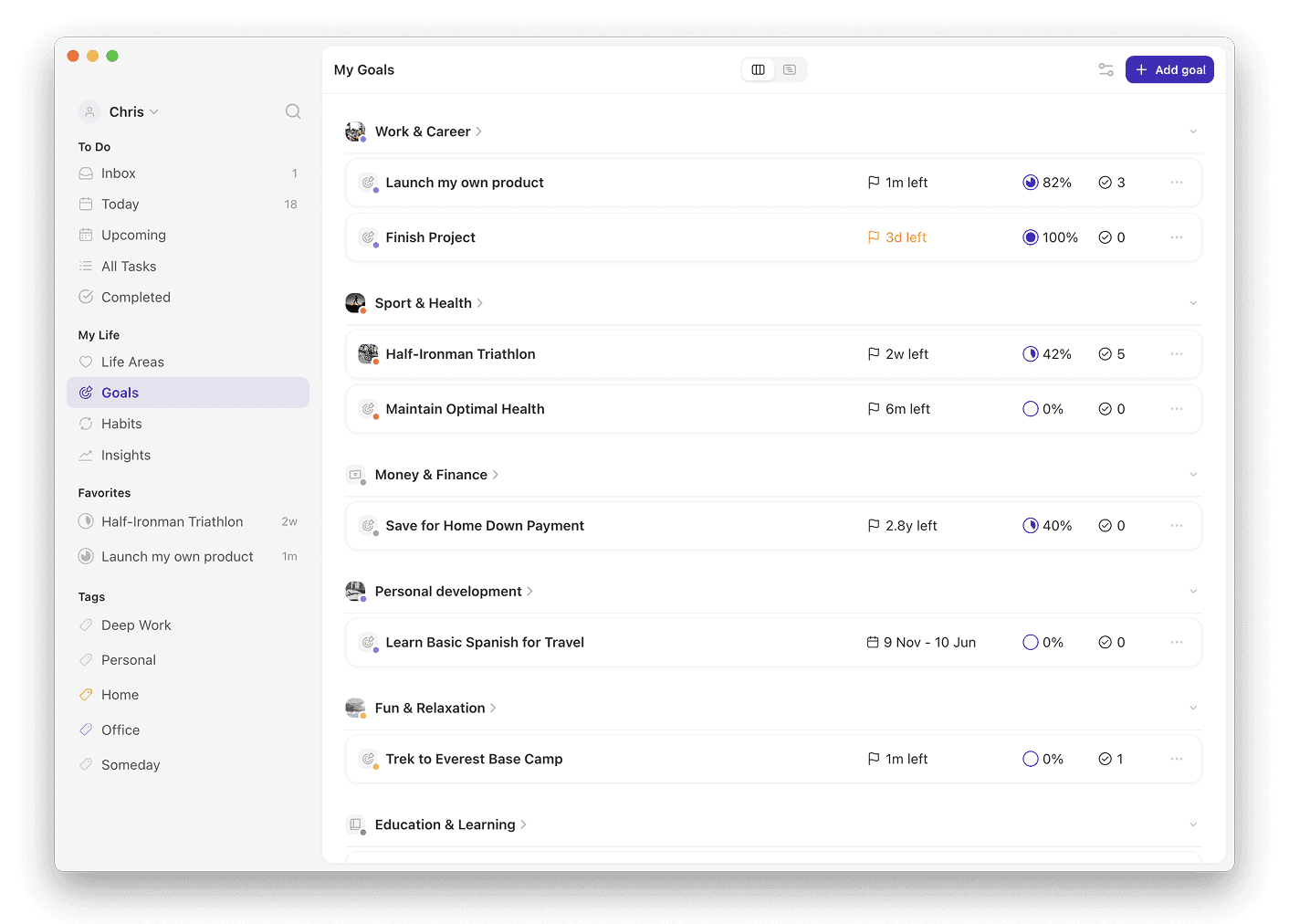
Most apps let you name a goal and then leave you to track it in your head. Griply asks how the goal is measured when you create it, then builds the tracking around your answer.
A number to reach, called a Unit-based target, for revenue, weight, or distance
A count of completed tasks, for a goal that is a fixed set of steps
An average of its subgoals, for a goal built from smaller goals
Every goal has a start value, a target, and a deadline. Its progress shows on a line chart next to the target line, so you can see how far today is from done.
Griply also gives your goals a structure: Life Area, then Vision, then Goal, then Subgoal, then the tasks and habits you do. That is what keeps this week's goal attached to the multi-year one it feeds.
You can link a habit to the goal it feeds, so the two stay in view together. Habits show a completion rate, and there is no streak counter to reset. You can set all of this up in Griply's goal planner.
Frequently asked questions
How many types of goals are there?
There is no single fixed number. Goals are most often sorted three ways: by time horizon, by area of life, and by what they measure. Lists that promise "3 types" or "4 types" of goals are usually just picking one of those three ways.
What are the three types of goals?
The three most cited are process, performance, and outcome goals. A process goal is a behavior you repeat, a performance goal is a standard you measure against your own past, and an outcome goal is a result you want. Process goals are the ones you fully control.
What is the difference between goal categories and goal types?
Goal categories group goals by area of life, such as health, career, or money. Goal types usually sort by time horizon or by what the goal measures. A category tells you which part of life the goal belongs to; a type tells you how to track it.
Which type of goal should you start with?
Start with a process goal, a behavior you repeat, and link it to the longer-term outcome it serves. A behavior you control gives you something to log from day one, before any result has had time to show up.
How do you track different types of goals in one place?
Give each goal a single measure: a number to reach, a count of finished tasks, or an average across its subgoals. Griply builds these three target types into every goal, so different types of goals track side by side in one place.
Pick how you'll measure the goal before you label it
Sorting your goals by time horizon or by area of life is worth doing once, to see where they are bunched up and which part of life you have left empty. It still does not tell you what to do on a Tuesday.
The measure is what fills in that Tuesday. It is the thing you log, and it is what your weekly review reads against. Decide it first, and the label you put on the goal matters much less.
Related Guides
Grant, H., & Dweck, C. S. "Clarifying Achievement Goals and Their Impact." Journal of Personality and Social Psychology, 2003. https://digital.library.temple.edu/digital/api/collection/p245801coll10/id/373025/download
Höchli, B., Brügger, A., & Messner, C. "How Focusing on Superordinate Goals Motivates Broad, Long-Term Goal Pursuit: A Theoretical Perspective." Frontiers in Psychology, 2018. https://pmc.ncbi.nlm.nih.gov/articles/PMC6176065/
Epton, T., Currie, S., & Armitage, C. J. "Unique Effects of Setting Goals on Behavior Change: Systematic Review and Meta-Analysis." Journal of Consulting and Clinical Psychology, 2017. https://pubmed.ncbi.nlm.nih.gov/29189034/