

The time blocking method is a scheduling practice where you assign specific tasks to fixed time slots in your calendar before the day starts, replacing reactive scheduling with intentional control over your attention.
That definition is straightforward. The reason most people's time blocking collapses within a week is also straightforward: they block time for their task list, not their priorities. Open any popular guide on time blocking and you'll find the same advice: capture your tasks, assign blocks, guard your calendar.
No one asks whether those tasks actually matter. Whether the two hours blocked for "admin" or "catch up on email" connects to any goal you've actually committed to.
The result is a perfectly blocked calendar that moves nothing important forward. The method works. The input was wrong.
What follows covers the time blocking method from first principles: what it is, why it works, and how to fix the failure mode that quietly kills it for most people, including how to build a time blocking planner that starts with your goals, not your inbox.
Key takeaways
A time blocking planner only works when every block traces back to a goal, a full calendar that moves nothing important forward is the most common failure mode.
Cal Newport's deep work system uses time blocking to create long, uninterrupted focus sessions, built on the premise that your most valuable cognitive work cannot happen in stolen minutes.
People with ADHD benefit from time blocking because fixed, pre-decided blocks remove the moment-to-moment decision about what to do next, which is where a lot of ADHD-related avoidance starts.
Including buffer blocks is not optional: one unexpected request without slack in the calendar unravels the whole day's schedule.
What is the time blocking method?
The time blocking method is a calendar-first approach to daily planning. Instead of keeping a running task list and working through it as time allows, you assign each task a specific start time and duration in your calendar before the day begins.
The core idea is that a task without a time slot rarely gets done. When a task sits on a list, it competes with every other item for your attention. When it has a block, it has a protected appointment with your day.
Cal Newport, author of Deep Work (Grand Central Publishing, 2016), is the researcher and writer most associated with time blocking as a formal system. He argues that unstructured time fills predictably with shallow work that feels productive but isn't: email, Slack, ad hoc requests. Blocking time is the structural answer to that drift.
Why the time blocking method fails most people
Most guides on the time blocking method teach you how to schedule. Almost none ask what you should schedule.
This is the failure mode. You take your existing task list, assign everything a block, and end up with a full calendar that doesn't move your actual goals forward.
The scheduling is correct. The prioritization was never done. You blocked four hours for projects that didn't connect to anything beyond this week's workload.
The cost is invisible because the calendar looks full. Every block appears productive. But a block occupied by something that doesn't move your goals forward is a more scheduled version of the same unproductive work.
The fix is to start from your goals. Before building your time blocking schedule, list the three to five goals that are active this week, then identify the tasks most likely to move each one forward. Finding your most important task first is a prerequisite to good scheduling, not an afterthought.
Block for those tasks first. Everything else fits into whatever space remains.
How to build a time blocking planner that starts with goals, not tasks
A time blocking planner is the structure you use to prepare your blocks before the week or day begins. The goal is not a full calendar: it's a calendar where every block has a clear purpose.
Start with your goals, not your task list. Write down the goals that are active this week. For each one, identify the one or two tasks that would move it forward the most. These are your anchor blocks, and they should be scheduled first.
Reserve your best cognitive hours for anchor blocks. Most people do their clearest thinking in the first two to four hours of the morning. Put the work that matters most there. Email, admin, and reactive work belong in the afternoon, when attention naturally dips. Scheduling around your energy like this is really attention management, the discipline that sits underneath time blocking.
Build blocks at roughly 60 to 90 minutes for deep or analytical work, and shorter blocks of around 30 minutes for correspondence or quick decisions. If a long anchor block is hard to sustain in one sitting, the pomodoro technique splits it into 25-minute focus sprints with short breaks. You can adjust as you learn what length works for your concentration, but starting at 90 minutes for your anchor tasks is a reliable baseline. This time blocking template, once you've used it for a week, becomes a reusable structure you can reset each Monday.
Include buffer blocks. Unexpected work will appear. If your calendar has no slack, one urgent request unravels the whole day. One 30-minute buffer mid-morning and one in the afternoon catches most interruptions without touching your anchor blocks.
Review and reset at the end of each day. Check which blocks completed, which didn't, and why. Adjust tomorrow's plan. The daily review is the feedback loop that makes time blocking compound over time rather than fall apart.
Your best hours belong to goal-connected work, not whatever arrives first
A time blocking schedule has more structure than a to-do list but less rigidity than a meeting calendar. The design principle is to protect the work that moves your goals forward, then plan everything else around that.
A simple daily structure that works for most knowledge workers begins with one anchor block in the morning, from around 8 to 10am, for your most goal-connected task. This is protected time for focused work with no meetings and no email. A second work block or continuation of the anchor task follows, with a 30-minute buffer before noon to catch anything urgent.
The afternoon shifts to collaborative or reactive work: meetings, responses, short tasks. That time works best for anything that runs better with full availability and faster turnaround. A second anchor block in the late afternoon, from roughly 3 to 4:30pm, handles any goal-connected work that didn't fit in the morning, or time spent planning the next day's blocks.
The specific times are a starting point. What matters is that your most goal-connected work occupies your best hours, and your time blocking planner is set before the day starts, not as the day unfolds.
Time blocking works especially well for ADHD because it eliminates the in-the-moment decision
Time blocking for ADHD tends to work differently than it does for neurotypical planners, but often more effectively once the structure is in place.
The core ADHD challenge in daily planning is decision fatigue at the moment of action. When the day starts without a clear schedule, the brain has to decide right now what to work on from a full task list. For people with ADHD, that in-the-moment decision frequently triggers avoidance, context-switching, and the kind of time blindness where hours disappear without clear output.
Time blocking removes that decision. When you sit down at 9am and your block says "write the client proposal introduction," there is nothing to decide. The decision was made yesterday when you built the schedule. The block handles the initiation problem that drives a lot of ADHD-related procrastination.
A few adjustments make the method more accessible: shorter blocks of around 45 minutes rather than 90, more transition time between blocks, and a specific named task for each block rather than a vague category. "Write the first section of the client proposal" is more useful than "client work," because the vague version recreates the decision problem you were trying to solve.
Cal Newport's deep work principle: time blocking is only as good as what fills the blocks
Cal Newport's time blocking system, described in Deep Work, goes further than most productivity approaches. Newport draws a distinction most productivity systems ignore: the quality of work a block contains matters as much as whether the block exists.
Deep work, in Newport's framework, is cognitively demanding, distraction-free work that produces results difficult to replicate. Shallow work is everything else: email, meetings, administrative coordination. Both are necessary. The mistake is letting shallow work colonize the hours your most important deep work requires.
Newport's practice is to plan every minute of the workday in advance, assigning blocks to specific tasks and revising the plan when interruptions occur. The method accepts that the plan will change. What it doesn't accept is a day spent reacting rather than choosing.
The endpoint Newport describes is one that all good time blocking systems share: when the day ends, you should be able to look at your schedule and see where your cognitive energy went and why. A time blocking planner without that clarity is a tighter version of the same unexamined task list.
How Griply makes time blocking goal-first
The failure mode this article describes, a full calendar that moves nothing important forward, comes from scheduling the wrong inputs. The problem is not how the blocks are arranged but what fills them. Griply resolves that before you assign a single slot.
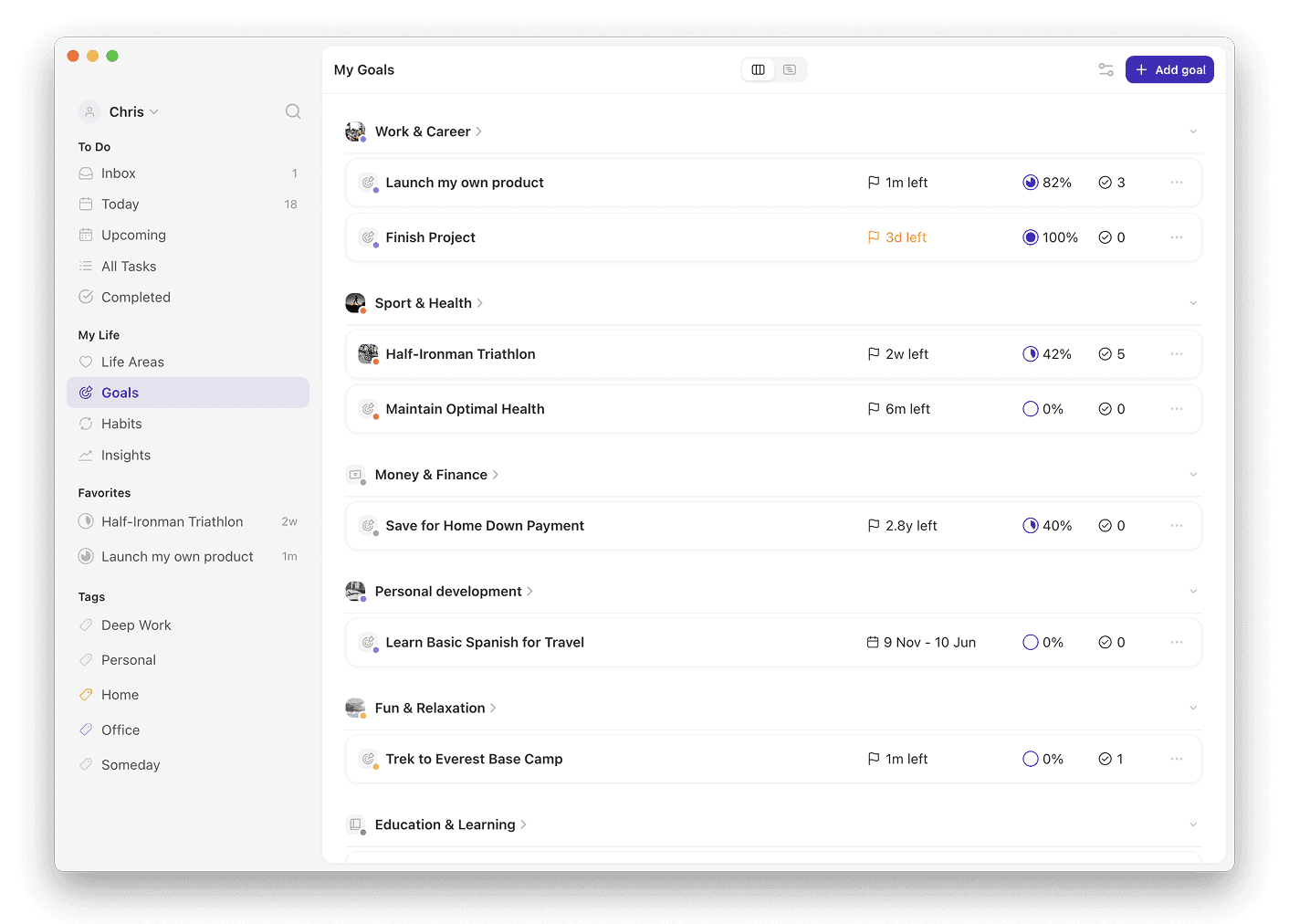
Griply's hierarchy runs Life Area → Vision → Goal → Subgoal → Project → Task/Habit, and your tasks hang inside it. When you open the Today view to plan your blocks, your tasks already carry goal context. You are not choosing from a flat list of equally-weighted items; you are looking at actions connected to outcomes you have already committed to. The question of which task deserves your best hour is answered before you open the calendar.
Each goal carries a start value, a target value, and a deadline, visualised in a progress chart. The Goal Roadmap shows all goals and subgoals on a Gantt timeline. You can see which goals are active this week before building your schedule, so anchor blocks go to the work that is actually in motion.
The Today view shows tasks on the left and your calendar on the right, with calendar integration pulling in Google or Outlook events. You drag goal-connected tasks onto the calendar to create blocks grounded in priority, not in what arrived in your inbox this morning.
Frequently asked questions about time blocking
What is the time blocking method in simple terms?
The time blocking method is a way of planning your day by assigning each task to a specific calendar slot before the day starts. You decide in advance when each task happens rather than working through a list reactively. Your calendar controls your attention rather than your inbox.
How long should each time block be?
Most practitioners recommend 60 to 90 minutes for deep, focused work and 30 minutes for administrative or reactive tasks. The right length depends on the task: complex analytical or creative work benefits from longer, uninterrupted blocks, while correspondence and quick decisions can be batched into shorter ones.
Does time blocking work for ADHD?
Yes, time blocking tends to work well for people with ADHD because it removes the in-the-moment decision about what to do next. The decision is made when you build the schedule, not when you sit down to work. Shorter blocks, specific task names, and transition time between slots make the method more accessible for ADHD brains.
What is a time blocking planner?
A time blocking planner is the tool or template you use to assign tasks to calendar slots before the week or day begins. Griply's Today view shows tasks alongside your calendar with goal context attached, so you can drag goal-connected tasks into blocks and verify that what you are scheduling reflects your actual priorities before the day starts.
What is the difference between time blocking and a to-do list?
A to-do list captures what needs to be done. A time blocking schedule specifies when each item happens and turns each task into a protected appointment. The two work together best when your task list is filtered through your active goals before you assign blocks.
The blocking is only as good as what you choose to block for
The time blocking method is one of the most durable productivity systems because it forces a decision most tools avoid: when does this actually happen? But the decision of when is only as good as the decision of what. Block time for tasks connected to your goals and the method builds momentum. Block time for tasks that connect to nothing and you fill a calendar without moving forward.
Build your time blocking planner starting from your active goals. Protect your best hours for work that moves them. Let the rest fit around that structure.
Related Guides
Newport, Cal. Deep Work: Rules for Focused Success in a Distracted World. Grand Central Publishing, 2016. https://www.calnewport.com/books/deep-work/