

Tony Robbins RPM stands for Result, Purpose, Massive Action Plan: a planning model that makes you define the outcome you want, the reason it matters, and the concrete actions before you touch your to-do list. Robbins also calls it the rapid planning method, and the order is the whole point. You decide what you are after and why, then you build the plan that gets you there. Most people meet RPM in a notebook or a seminar, write a clean Result and a list of actions, then watch the connection between them disappear by the second week. The model is sound. The problem is that the three layers usually live in three different places, a notebook, a planner, and a task list, and nothing keeps them linked once the planning session ends. The fix is to map each layer onto one planning structure that holds the connection past the first burst of motivation, so the Result you wrote on day one still drives the work two weeks later.
Key takeaways
RPM asks "what" and "why" before "what do I do today."
The model fails on enforcement: the Result, Purpose, and actions drift apart in separate tools.
Specifying when and where each action happens at planning time has a medium-to-large effect on follow-through.
Griply lets you link each Task back to its Goal and the life-area Vision above it.
What is the Tony Robbins RPM method?
RPM is the planning system Tony Robbins introduced in Awaken the Giant Within. It stands for Result, Purpose, Massive Action Plan, and Robbins designed it to stop people from starting with the to-do list. You start with the result you actually want before listing things to do.
The three letters map to three questions you answer in order:
Result: what specific, measurable outcome am I committed to?
Purpose: why do I want it, what makes it worth the effort?
Massive Action Plan: what is every action that could move me toward it?
Robbins calls this "chunking," grouping related actions under a single outcome so your days serve something larger than the next item on a list. The sequence matters because purpose is what carries you through the dull middle of any plan, and the result is what tells you whether the actions are working.
What the rapid planning method gets right
The rapid planning method starts from the outcome. Capture-and-organize methods sort what you already decided to do; RPM makes you decide the destination first. That single reorder is why a sound framework still needs an enforcing structure to deliver on it, a point worth holding onto if you have tried to build a personal productivity system before.
The Purpose layer is the part people skip and the part that does the most work. Naming the reason is what you reach for when the result alone stops pulling you. RPM's insistence on the "why" is its real strength.
There is research behind the order, too. Simulating the result alone does not improve performance, while simulating the actual process of getting there does. That finding maps cleanly onto RPM: a Result you only visualize stays a wish, and the Massive Action Plan is what turns it into something you can run.
Where Tony Robbins RPM breaks in week two
A Result written in a notebook and a Massive Action Plan typed into a task app are not linked, so the link is lost within a normal week. You finish the planning session feeling clear, then the actions land in your task list stripped of the outcome they were meant to serve. By Wednesday you are working the bare list while the plan stays back in the notebook.
This is an enforcement gap. RPM already asks why, so the usual "your system never starts from goals" critique does not apply here. The three layers sit in separate places with nothing holding the link.
Two patterns make it worse. A Massive Action Plan written in one sitting underestimates the work, because people predict tasks will take far less time than they do, so the plan is already too big by the time you start. And actions captured without their outcome attached lose the link to the Result.
The fix is to keep all three layers in one structure where each action carries its parent outcome at the point you write it down.
How each RPM layer maps onto a planning structure
Unlike most productivity methods, RPM survives only in a system that has a place for all three layers, and breaks in one that does not. A task app gives the action layer a home, while the Result and Purpose layers depend on whether the structure has somewhere to put them. A planning structure for RPM needs a measurable outcome, a stated reason above it, and actions that link back to both.
Here is the mapping that keeps the model intact:
Result becomes a measurable goal with a start value, a target value, and a deadline.
Purpose becomes the stated reason that sits above the goal.
Massive Action Plan becomes the tasks and subgoals under that goal, each linked to it.
A Result is only honest when it has a metric, which is why mapping it onto a measurable goal with a tracked number matters more than picking the right verb. When the outcome has a number and a deadline, you can see whether the action plan is working instead of guessing.
How to keep the massive action plan running past the first burst
A Massive Action Plan written today is easy to ignore two weeks later. The thing that keeps it running is visible movement on the Result. Progress on meaningful work is the strongest day-to-day driver of motivation, which is why a Result with a visible progress chart outlasts one you only revisit at the next planning session.
The action plan also works better when it is broken into nearer checkpoints. Compressing a long Massive Action Plan into subgoals with their own deadlines gives you outcomes you can reach this quarter.
How to lock each RPM action to its result
The link between action and outcome has to be made while you are still writing the action down. Specifying the when and where of each action at planning time produces a medium-to-large jump in follow-through across 94 tests. In RPM terms, that means writing each action with its Result already attached, so the plan stays connected the moment you set it down.
How Griply gives each RPM layer a home
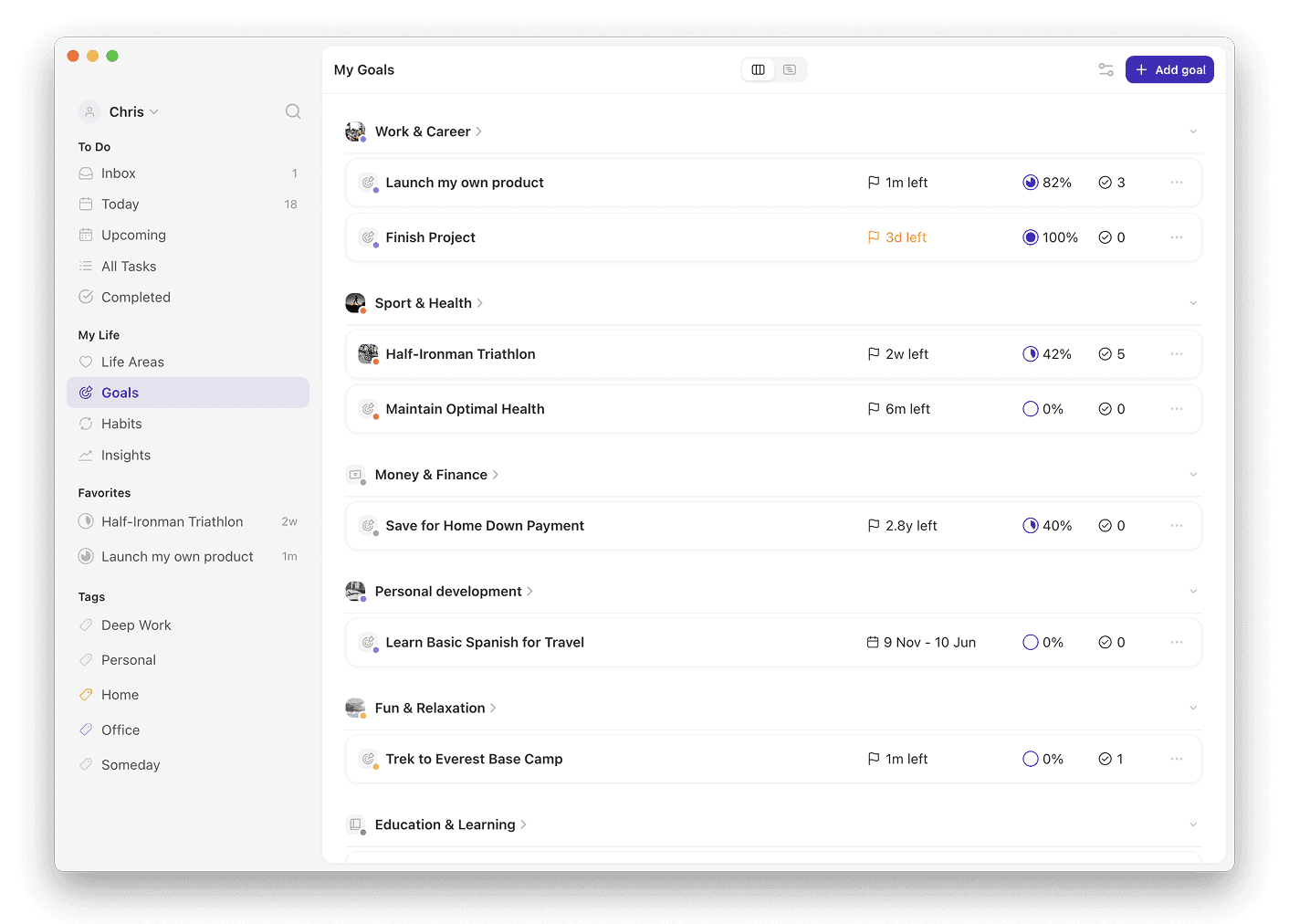
Griply runs on a Goal-First hierarchy: Life area, Vision, Goal, Subgoal, Task and Habit. That structure happens to give each RPM layer a real home instead of three disconnected ones.
RPM's Result maps onto a Griply Goal, a measurable outcome with a start value, a target value, and a deadline. Each Goal has a progress chart with a target line, so the outcome stays visible after the planning session rather than being forgotten in a notebook.
RPM's Purpose lives in the life-area Vision field, the long-text description of what a domain of your life looks like when it is going well. It sits above the Goal as the why, which is exactly where Robbins puts it.
RPM's Massive Action Plan becomes the Tasks and Subgoals under that Goal. A Task in Griply can link to its goal, subgoal, or life area, so each action surfaces the outcome it serves. The Today view then shows which Goals today's tasks are moving, which is where the action plan meets the day with its Result attached.
Frequently asked questions
What is the Tony Robbins RPM method?
RPM is a planning system from Tony Robbins that stands for Result, Purpose, Massive Action Plan. You define the outcome you want and the reason it matters before listing any actions. The order forces clarity on the destination before the work.
What does RPM mean in Tony Robbins?
RPM means Result, Purpose, Massive Action Plan. Robbins also calls it the rapid planning method. It is a way of grouping your actions under a clear outcome and a stated reason, so daily work stays tied to something you care about.
How much does Tony Robbins RPM cost?
The RPM concept is free to learn and apply: it appears in Robbins' book Awaken the Giant Within, which you can buy or borrow. Robbins also sells a branded RPM planner and seminars separately, but the method itself costs nothing to use in any planner you already have.
What is the rapid planning method?
The rapid planning method is another name Tony Robbins uses for RPM. It plans around the result and the reason first, then the actions. The "rapid" refers to how fast it gives you clarity on the destination, while the work itself still takes as long as it takes.
Why one structure has to carry all three layers
RPM fails when the Result, the Purpose, and the Massive Action Plan get scattered across a notebook, a planner, and a task list with nothing linking them. The model is right to start from the outcome and the reason, but the missing piece is a structure where each action still points at the Result you wrote it for two weeks ago. Run RPM in a system that can trace each task back to a measurable goal and the life-area reason above it, and the three layers stay connected long after the planning session ends.
Related Guides
Robbins, Anthony. "Awaken the Giant Within." Free Press / Simon & Schuster, 1991. https://go.tonyrobbins.com/awaken-the-giant-within
Buehler, Roger; Griffin, Dale; Ross, Michael. "Exploring the 'Planning Fallacy': Why People Underestimate Their Task Completion Times." Journal of Personality and Social Psychology, 1994. https://web.mit.edu/curhan/www/docs/Articles/biases/67_J_Personality_and_Social_Psychology_366,_1994.pdf
Pham, Lien B.; Taylor, Shelley E. "From Thought to Action: Effects of Process- Versus Outcome-Based Mental Simulations on Performance." Personality and Social Psychology Bulletin, 1999. https://journals.sagepub.com/doi/10.1177/0146167299025002010
Gollwitzer, Peter M.; Sheeran, Paschal. "Implementation Intentions and Goal Achievement: A Meta-Analysis of Effects and Processes." Advances in Experimental Social Psychology, 2006. https://cancercontrol.cancer.gov/sites/default/files/2020-06/goal_intent_attain.pdf
Amabile, Teresa; Kramer, Steven J. "The Power of Small Wins." Harvard Business Review, 2011. https://hbr.org/2011/05/the-power-of-small-wins