Productivity


Table of Contents
You wake up earlier, batch your emails, try Pomodoro, download a new app, and after two weeks the backlog is still the backlog. The frustrating part is that you are working. Working harder on the wrong list still leaves the important things untouched.
A productivity system is how you consistently select the right work and then execute it well, so daily effort compounds into outcomes you chose on purpose, rather than just clearing whichever inbox shouts loudest. Locke and Latham's four decades of goal-setting research make the point sharply: what you choose to work on matters more than how fast you work on it. Every productivity system has two layers: selection (are you working on the right thing?) and execution (are you working on it well?), and most advice only fixes the second.
This guide covers the full picture. You will find the case for starting with selection, the execution tactics worth keeping (time blocking, eat the frog, procrastination fixes), the systems debate (GTD, PARA, goal-first), and how it all fits into a life that includes more than work.
Key Takeaways
Productivity is really two problems: choosing the right work, then doing it well. Most advice only tackles the second.
A specific, difficult goal beats a vague "do your best" goal in around 90% of studies.
After an interruption, it takes 23 minutes 15 seconds on average to get back to the original task, which is why you have to protect your focused blocks.
Deciding in advance when and where you will act (if-then plans) makes you far more likely to follow through.
Procrastination is several different behaviours, and the fix depends on which type you are doing.
Lasting change comes from stable cues in your environment more than from willpower, which is why a system beats relying on self-control.
Block one protected hour tomorrow for the single task tied to your most important goal; one aligned block usually outproduces a week of rearranged tools.
A productivity system starts with selection, not speed
The dominant story about productivity is a speed story: finish more tasks per hour, cut meetings, batch email, pick a faster app. Every one of those moves is reasonable, and none of them will save you from spending a year polishing the wrong deliverable.
Selection is the layer above execution: out of everything you could do this quarter, what should be on the list in the first place? This is the distinction Peter Drucker drew sixty years ago in The Effective Executive: "Efficiency is doing things right; effectiveness is doing the right things." Most productivity systems assume the list is given and optimise the handling; goal-first systems invert that, starting from the life area and the outcome you want, then deriving tasks from the goal (the 📘 goal setting guide covers how to choose those outcomes well). If you only change one thing this year, make it the habit of asking "does this task trace back to a goal I chose?" before you ask "how fast can I finish it?"
Slow productivity and the selection-layer argument
Slow productivity is Cal Newport's name for the selection-layer framework his 2024 book Slow Productivity sets out, built on three principles: do fewer things, work at a natural pace, and obsess over quality. It is a direct reply to what Newport calls pseudo-productivity, the habit of treating visible activity as a proxy for real output. Most task managers reinforce that default by rewarding capture speed and checkmark volume.
The operational move is to cap your active commitments and extend your horizon from days to seasons, which forces the quality bar up because you can no longer hide behind volume. Griply's Goal-First hierarchy pushes this structurally by refusing to create a task without a parent Goal, and the Impact rating keeps attention on the work that moves an outcome you chose.
For a complete guide, see 📘 Slow productivity: what it is and how to apply Cal Newport's framework.
Time blocking as the bridge between intent and day
Time blocking is the most-cited modern productivity tactic for a reason: it is the moment your stated priorities meet your real calendar. If you say your Q1 priority is launching a new offer but your week has zero blocks for it, the priority is not real. A block on the calendar is the lowest-friction test of whether selection and execution agree.
The time blocking method works best when blocks are anchored to a goal, not to a generic label like "focus" or "deep work." A block called "Write launch email sequence" under the goal "Ship new offer by March" will survive a busy Tuesday; a block called "Deep work" will not. Cal Newport's argument in Deep Work is that focused, goal-linked concentration is becoming rarer and more rewarded at the same time, which means the people who can reliably protect these blocks will outpace those who cannot. Mark, Gudith and Klocke's CHI 2008 interruption study quantifies the cost of leaving them undefended, so the hours you do block should be tied to something specific enough to notice the absence and defended hard enough that the recovery tax is not paid twice a morning.
For a full breakdown, see 📘 The time blocking method: a goal-first guide.
Match the fix to your specific types of procrastination
Procrastination is not one behaviour. It is a category that includes perfectionist stalling, task aversion, decision avoidance, low-energy drift, and "productive procrastination," where you do work that feels useful while the important thing sits untouched. Treating all five with the same trick is why generic advice so often fails.
The fix depends on the pattern. Perfectionists need a lowered first-draft standard and a time cap rather than more planning, and Flett and Hewitt's work on perfectionism shows that socially prescribed perfectionism predicts procrastination precisely because the imagined standard blocks the first draft. Task-averse procrastinators need the work broken into a smaller two-minute opener, decision avoiders need the choice pre-made in writing the night before, and low-energy drifters need the work scheduled when their energy is highest; Gollwitzer and Sheeran's "if-then" implementation-intention research reliably closes the intention-action gap once the goal itself is set. Productive procrastinators need the hardest fix of all: a hierarchy that makes strategic work more visible than reactive work, which is a selection problem rather than a discipline one.
For a full breakdown, see 📘 Procrastination personas: the types of procrastination and how to fix each.
Personal productivity systems, and why most of them fail
Getting Things Done, PARA, the Bullet Journal, Second Brain. Every few years a new productivity system becomes the answer, and every few years people abandon it. The pattern is not that the systems are badly designed. It is that most of them are optimised for capturing and sorting tasks that already exist, not for deciding which tasks should exist in the first place.
A productivity system built around inboxes and project folders is excellent at preventing dropped balls. It is weak at preventing the slower, more expensive failure of spending three years juggling the wrong balls with precision. A personal productivity system that lasts is one where the top of the hierarchy is a small number of chosen goals, and every task, project, and folder hangs off those goals. When a task cannot be traced back to a goal on the list, the system should make that obvious rather than hide it inside a tidy folder.
For a full breakdown, see 📘 How to build a personal productivity system.
How to be more productive across every life area you care about
The final mistake of the standard productivity playbook is treating "more productive" as a synonym for "gets more work done at the job." That version produces a high-output career and a low-output body, marriage, and bank account. The cost shows up later, which is why it stays invisible for years.
Holistic productivity widens the target. The goal is steady output across every life area you care about, with trade-offs made on purpose instead of by neglect. In practice this means naming your life areas (career, health, relationships, money), attaching at least one active goal to each, and checking each quarter whether every area is moving or if one is quietly starving the others, the 📘 life planning guide covers the full diagnostic if you've never run the exercise.
For a full breakdown, see 📘 Holistic productivity: balancing effort across every life area.
Why tinkering with your productivity system is a sign of the wrong tool
Productivity systems built on flexible, open-ended tools generate a design question that never fully closes. You can reorganise the sidebar, add a new database view, and rename the tags, and the system will always have more to configure next Sunday. The procrastination research frames the mechanism: configuration delivers an immediate certain reward while strategic work delivers a distant uncertain one, making reconfiguration the path of least resistance.
The structural fix is a hierarchy where the design is settled once. Life Area, Vision, Goal, Subgoal, Task, and Habit in a fixed order: you fill in the contents rather than redesign the container each week. James Clear's argument in Atomic Habits applies: the system determines results more than goals do, and a system that keeps reopening how to be organised will keep producing more organisation.
For a complete guide, see 📘 Stop tinkering with your productivity system.
Why you can't finish projects
Temporal Motivation Theory explains it cleanly: motivation is a function of the expected value of the outcome. A project with no parent goal has no named outcome, so that value term approaches zero once novelty fades. Connecting each project to a measurable goal gives it a finish line that pulls attention back after the first week.
For a complete guide, see 📘 Why you can't finish anything: the structural fix.
The 12 Week Year as a compressed execution cycle
The 12 Week Year, by Brian Moran and Michael Lennington, replaces the annual planning cycle with a 12-week cycle. A December deadline carries almost no motivational weight in February; a 12-week deadline makes skipping a week a visible cost against the target. The framework breaks down when the 12-week goal, weekly plan, and execution review live in separate tools.
For a complete guide, see 📘 The 12 Week Year: how to make it actually work.
Getting Things Done and the capture-first method
Getting Things Done (GTD) is David Allen's 2001 method for emptying your head into a system you trust. It runs on five steps: capture everything into an inbox, clarify what each item is, organize it by project or context, reflect through a weekly review, and engage by picking what to do now.
The premise holds up. Writing a vague commitment down as a concrete next action is what stops it from intruding on your attention, and a system you review weekly stays trustworthy in a way your memory never will.
GTD's gap is the same one this guide keeps returning to. Its own Horizons of Focus name goals as an altitude but give you no way to make a goal measurable, so the method manages your next actions well without checking whether they add up to anything.
For a complete guide, see 📘 Getting things done: the GTD method, step by step.
How Griply ties the whole picture together
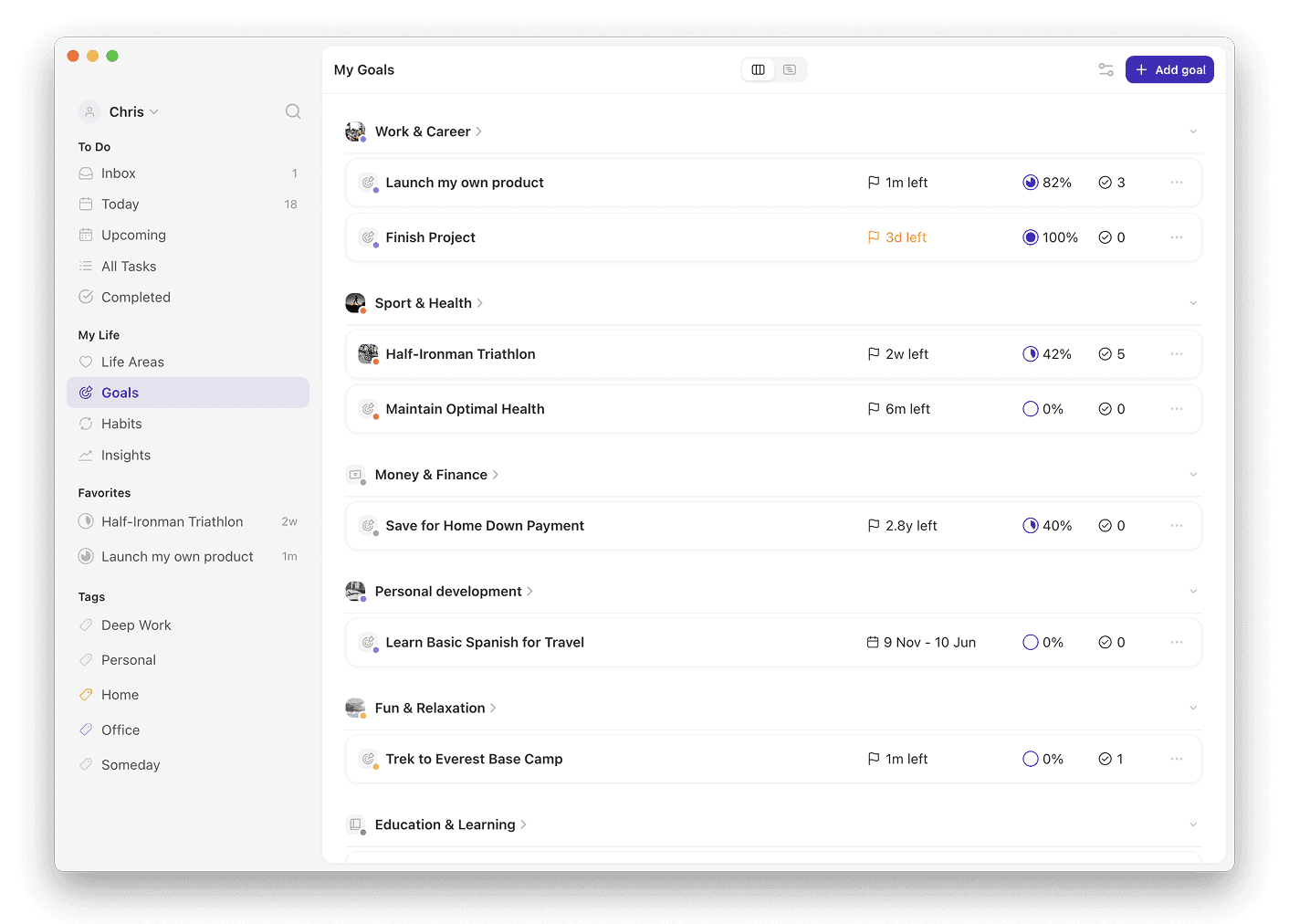
Most productivity tools start at the task. Griply starts at the life area. The Goal-First hierarchy runs Life area to Vision to Goal to Subgoal to Project to Task, so every task you plan is one tap from its "why" and every task you open shows the goal it belongs to. That structural choice is the difference between a to-do list that makes you faster and a system that makes sure you were pointed the right way first.
Every execution surface in the app is downstream of that hierarchy and exists to keep today's work tied to the goal you already chose, rather than letting tools drift into parallel silos.
If you only explore one surface first, start with the Goal Planner. It is the system where selection and execution meet.
Frequently Asked Questions (FAQ)
Goal-first productivity vs GTD: which should you use?
GTD, introduced by David Allen in 2001, does include higher altitudes (the Horizons of Focus), but the day-to-day tooling it is built around, inboxes and next-action lists, surfaces the runway and very little else, which is why most long-term GTD users drift into reactive work. Goal-first productivity inverts the default: the higher altitudes sit on top of the task list every day, so the question "does this trace back to a goal I chose?" is answered before you ever pick a next action. If you only pick one, goal-first prevents the bigger, slower failure of finishing the wrong list efficiently.
What is the fastest way to be more productive this week?
Pick the one task on your list that traces back to your most important goal, and block one protected hour for it tomorrow morning. That single aligned block usually produces more output than a week of rearranged tools.
How is time blocking different from scheduling tasks?
Scheduling tasks puts items on a calendar. Time blocking reserves a defined window for a specific piece of work and treats the block as the commitment, not the task underneath. The difference shows up when something tries to take the slot, because you are defending a block, not shuffling a line item.
What causes productive procrastination?
Productive procrastination happens when reactive work (email, quick wins, tidying) is more visible than strategic work, so the visible tasks get done first by default. The fix is a hierarchy where strategic goals sit above the task list and surface every day, rather than living in a separate planning document you only open on Sundays.
Do productivity apps work?
Apps only help when the system behind them is sound. A goal-first app with no goals defined is the same as a task app. The real question is whether the tool makes your actual priorities more visible than the noise, and whether you can see a task's link to a goal without digging for it.
How long does it take to build a personal productivity system that sticks?
Expect four to six weeks of real use before a system feels stable, and one full quarter before you trust it with anything important. Anything faster is usually a reshuffle rather than a system. The sign it is working is that the hardest decisions feel obvious rather than heroic.
The bottleneck was never speed
Being more productive is less about doing things faster and more about making sure the things you do are the right ones. Every tactic in this guide, from time blocking to eating the frog to picking a procrastination fix that matches the pattern, gets better when it sits under a goal you chose on purpose. Without that, you are just tuning the engine of a car that is pointed at the wrong destination.
The honest version of this advice is simple: name your life areas, pick a small number of goals inside each, and make sure your calendar and your task list both know about them. Then use any tactic you like, because they will all compound in the same direction.
More guides on productivity
📘 Holistic productivity: balancing effort across every life area: how to treat productivity as output across every domain of your life rather than maxing one at the expense of the rest.
📘 Procrastination personas: the types of procrastination and how to fix each: the main patterns of procrastination and a specific, tested fix for each one.
📘 The time blocking method: a goal-first guide: time blocking from first principles, goal-linked planning, deep work, and ADHD-specific adaptations.
📘 Eat the frog meaning: the Brian Tracy method explained: Brian Tracy's original method, the wrong-frog failure mode, and the goal-first correction that fixes it.
📘 Feel-Good Productivity: Ali Abdaal's framework explained: the three energisers, blockers, and sustainers, and how to apply them without turning them into a checklist.
📘 How to build a personal productivity system: why GTD and PARA plateau, and how a goal-first system keeps you from working hard on the wrong list for years.
📘 Slow productivity: what it is and how to apply Cal Newport's framework: Cal Newport's three principles (do fewer things, work at a natural pace, obsess over quality) and how to operationalise them on a goal-first hierarchy.
📘 Eisenhower matrix time management: how to use it: how to sort every task by urgency and importance, why Quadrant 2 is where most high-impact work lives, and how to anchor "important" to goals so the matrix holds over time.
📘 Stop tinkering with your productivity system: why rebuilding your system is the predictable output of infinite-surface-area tools, and how a fixed hierarchy ends the Sunday configuration loop.
📘 Why you can't finish anything: why projects stall once novelty fades, and how goal-linking gives each one a finish line that matters.
📘 The 12 Week Year: how to make it actually work: how compressing the annual cycle into 12-week sprints creates real urgency, and why the system fails when goals, milestones, and tasks live in separate tools.
📘 Getting things done: the GTD method, step by step: David Allen's five-step capture method and weekly review explained in full, and why its Horizons of Focus name goals without ever making them measurable.
📘 Weekly review: how to run one that changes your week: the three questions a weekly review should answer, how long it should take, and why it needs a goal to measure against instead of a task list to tidy.
📘 The 2-2-3 schedule as a weekly planning rhythm: how to borrow the shift-work rotation's alternating rhythm to theme a knowledge-work week around deep work, collaboration, and execution.
Works Cited
Locke, E. A., and Latham, G. P. "Building a Practically Useful Theory of Goal Setting and Task Motivation: A 35-Year Odyssey." American Psychologist, Vol. 57, No. 9, 2002. https://doi.org/10.1037/0003-066X.57.9.705
Gollwitzer, P. M., and Sheeran, P. "Implementation Intentions and Goal Achievement: A Meta-Analysis of Effects and Processes." Advances in Experimental Social Psychology, Vol. 38, Academic Press, 2006. https://doi.org/10.1016/S0065-2601(06)38002-1
Newport, Cal. "Deep Work: Rules for Focused Success in a Distracted World." Grand Central Publishing, 2016. https://www.calnewport.com/books/deep-work/
Mark, G., Gudith, D., and Klocke, U. "The Cost of Interrupted Work: More Speed and Stress." Proceedings of the SIGCHI Conference on Human Factors in Computing Systems (CHI 2008), N=24. https://www.ics.uci.edu/~gmark/chi08-mark.pdf
Drucker, P. F. "The Effective Executive." Harper & Row, 1967. https://www.harpercollins.com/products/the-effective-executive-peter-f-drucker
Hewitt, P. L., and Flett, G. L. "Perfectionism in the Self and Social Contexts: Conceptualization, Assessment, and Association with Psychopathology." Journal of Personality and Social Psychology, Vol. 60, No. 3, 1991. https://hewittlab.sites.olt.ubc.ca/files/2014/11/Hewitt-Flett-1991-Perfectionism-in-the-self-and-social-contexts-conceptualization-assessment-and-association-with-psychopathology.pdf
Wood, W., and Neal, D. T. "Healthy Through Habit: Interventions for Initiating and Maintaining Health Behavior Change." Behavioral Science & Policy, Vol. 2, No. 1, 2016. https://dornsife.usc.edu/wendy-wood/wp-content/uploads/sites/183/2023/10/Wood.Neal_.2016.pdf