

The PARA method is a system for organising your digital notes and files into four categories based on how actionable each item is: Projects, Areas, Resources, and Archives. Tiago Forte introduced it in his book The PARA Method and across his work on building a second brain. The promise of the para method is that every piece of information lives in exactly one place, sorted by how soon you'll act on it.
For organising scattered digital files, it works, and most people who try it stop reinventing a folder scheme for every new app. The four categories are simple enough to learn in a minute, though two of them trip people up and the system carries one blind spot that matters more than its filing rules.
PARA can tell you where a note lives. It cannot tell you whether the work that note supports is actually moving forward, and that gap is where a filing system ends and a goal system begins. For the broader picture of how filing fits alongside execution, see the wider productivity guide.
Key takeaways
The para method sorts information by actionability, so notes change category as priorities change.
Projects have deadlines while Areas are ongoing, and most people get this line wrong.
A single home for every file measurably reduces information overload.
PARA tells you where a note lives but says nothing about whether the goal it supports is progressing, which is the layer a goal hierarchy adds.
What the para method actually is
PARA sorts by one question: how soon will you act on this? It scales from a notes app to your entire file system. Forte lays out the full system in his free guide on Forte Labs.
The four categories run from most actionable to least:
Projects are short-term efforts with a deadline.
Areas are ongoing responsibilities you maintain over time with no end date.
Resources are topics and references you may want later but aren't acting on now.
Archives are anything inactive from the other three, kept for retrieval.
The power of the para method is that these categories apply everywhere. Your notes app, your cloud drive, and your downloads folder can share the same four buckets. One structure across every tool means you stop reinventing a folder scheme for each app you open.
Why organising by actionability beats organising by topic
Most people file by subject, a folder for "Marketing," another for "Health," and so on. The para method rejects that because a subject folder mixes a note you need this week with one you last touched two years ago. Sorting by actionability puts the things you're working on now within reach and pushes dormant material out of sight.
Information overload is a measured drain on attention, and the research review on the problem confirms that structured retrieval reduces the load. A single, predictable home for each file means less time hunting and less mental cost each time you switch context.
Fragmented attention from repeatedly searching and re-filing carries a real focus and stress cost. The para method cuts that by making the destination of any note obvious the moment you create it.
The line between Projects and Areas trips most people up
The most common mistake with the para organization method is confusing Projects with Areas. A Project has a finish line, like "launch the new website by March," while an Area has none, like "maintain the website" or "stay healthy." Areas are the standards you hold indefinitely, and Projects are the finite pushes inside them.
Getting this distinction right is what makes the system usable. When a Project ends, its notes move to Archives, and the Area it served keeps going. File everything as an Area and your active work drowns in standing commitments, but file everything as a Project and your ongoing responsibilities vanish the moment a deadline passes.
Resources and Archives are simpler. Resources hold reference material you might pull from across many Projects, like research notes or templates, while Archives hold completed or inactive items from any of the other three, out of the way but recoverable. The para method keeps the system honest by forcing one question at filing time: am I acting on this, maintaining it, saving it, or done with it?
What the para method has no concept of
PARA organises information, and it does that well. The boundary appears when you ask a different question: is the work these notes support actually moving forward? PARA can tell you a note about your launch lives in the "Website" Project folder, but it cannot tell you whether the launch is on track, because PARA records where a document lives while saying nothing about whether the work behind it is progressing.
Progress on meaningful work is the strongest driver of engagement and motivation, a finding Teresa Amabile documented in her research on small wins. Knowing where a note sits tells you nothing about whether the work is progressing.
Direction is a separate question too. Goals tied to your own values are more likely to be attained when you pair them with a concrete plan, a measure of purpose held over time rather than ease of retrieval. The para method tames information overload, but it does not move a goal forward, and it is often paired with GTD-style capture that leaves the same goal gap.
How Griply adds the progress layer PARA leaves out
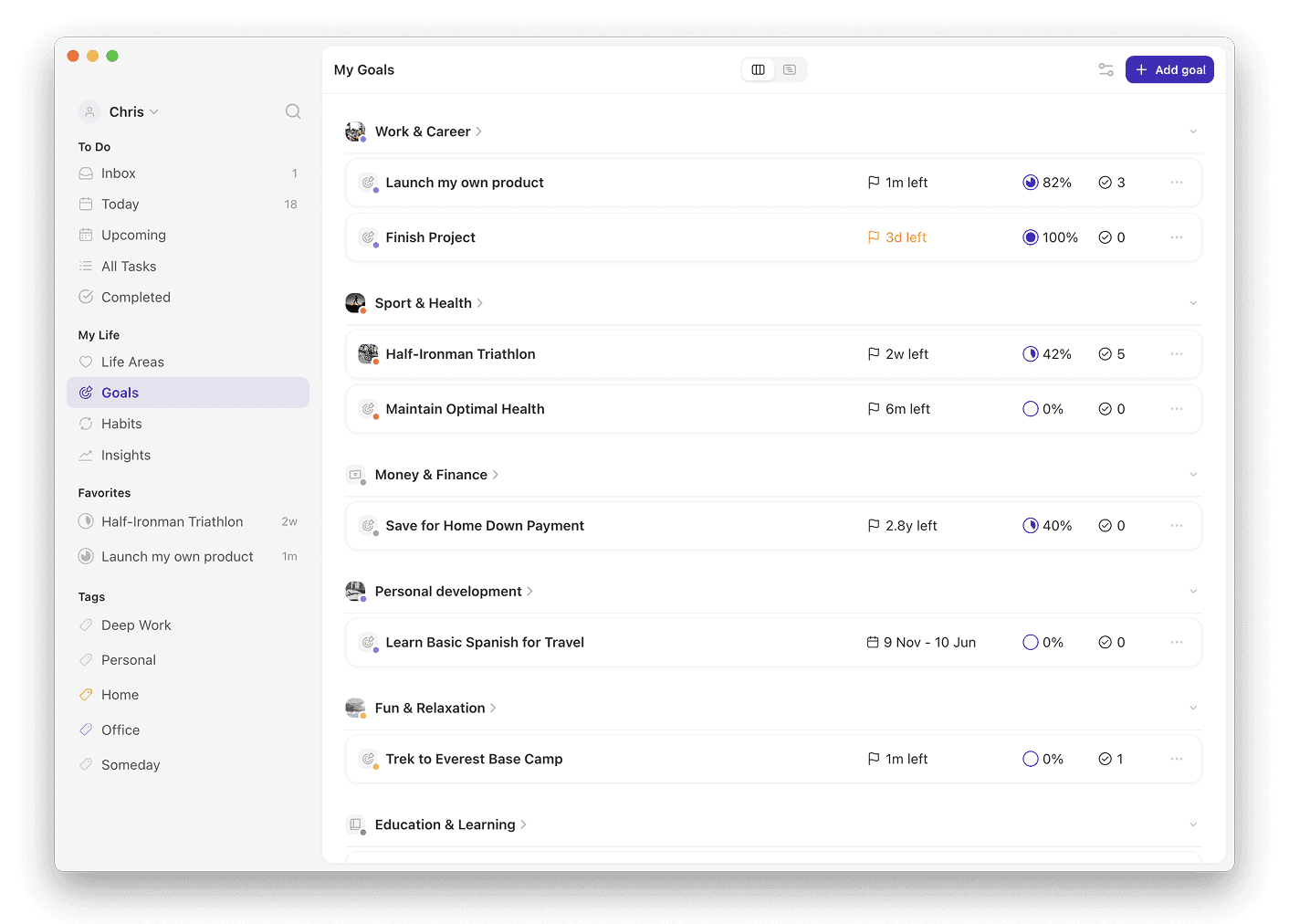
Griply is a goal-first system, so it tracks whether your work is moving toward something. It does not store your notes, and it is not trying to replace your PARA setup. Pair it with your notes app and let each tool do its job.
The structure runs Life Area to Vision to Goal to Subgoal to Project to Task or Habit. Where PARA's Projects bucket is a flat folder, a Griply project sits under a goal that carries real progress: a start value, a target value, a deadline, and a progress chart you log against over time. That answers the question PARA can't: is this moving forward?
Every task can link back to a goal, subgoal, or life area, so the Today view surfaces which goals today's work is serving. The goal connection is offered at capture time rather than required. Open Griply in the morning and you see what to do and why in one place.
Frequently asked questions
Is the para method worth it?
Yes, if you have notes and files scattered across multiple apps with no consistent structure. The para method gives you one filing scheme that works everywhere, sorted by how actionable each item is. It pays off fastest for people who lose time hunting for things they know they saved.
What is the difference between Zettelkasten and PARA method?
Zettelkasten links individual notes to each other to build a web of connected ideas for thinking and writing. PARA sorts notes and files into four actionability-based folders so you can find them. Zettelkasten is for developing ideas; PARA is for organising your whole digital life.
What is the para method of personal life?
It means applying the same four categories to your personal information alongside your work, so one structure covers everything you store.
What is the 3 3 3 rule for tasks?
The 3-3-3 method, popularised by Oliver Burkeman, structures a workday around three hours on your most important project, three shorter urgent tasks, and three maintenance activities. It is a daily focus method, separate from the para method, which organises stored information rather than your day.
A filing system fixes findability while leaving direction to you
The para method solves a real problem: it gives every note and file one predictable home, sorted by how soon you'll act on it, and that cuts the daily cost of information overload. Treat it as the foundation it is.
What it cannot do is tell you whether the work behind those notes is progressing, because PARA records where a document lives and does not track whether a goal is advancing. The honest answer is to run both layers, with PARA for your information and a goal hierarchy with real progress tracking for your direction. Organise your files with PARA, then connect them to goals you can actually watch advance.
Related Guides
Forte, Tiago. "The PARA Method: The Simple System for Organizing Your Digital Life in Seconds." Forte Labs, 2023. https://fortelabs.com/blog/para/
Mark, Gloria; Gudith, Daniela; Klocke, Ulrich. "The Cost of Interrupted Work: More Speed and Stress." Proceedings of the SIGCHI Conference on Human Factors in Computing Systems (CHI 2008), 2008. https://ics.uci.edu/~gmark/chi08-mark.pdf
Amabile, Teresa M.; Kramer, Steven J. "The Power of Small Wins." Harvard Business Review, May 2011. https://hbr.org/2011/05/the-power-of-small-wins
Arnold, Miriam; Goldschmitt, Mascha; Rigotti, Thomas. "Dealing with Information Overload: A Comprehensive Review." Frontiers in Psychology, vol. 14, 2023. https://www.frontiersin.org/journals/psychology/articles/10.3389/fpsyg.2023.1122200/full
Koestner, Richard; Lekes, Natasha; Powers, Theodore A.; Chicoine, Emanuel. "Attaining Personal Goals: Self-Concordance Plus Implementation Intentions Equals Success." Journal of Personality and Social Psychology, vol. 83, no. 1, 2002, pp. 231-244. https://pubmed.ncbi.nlm.nih.gov/12088128/