Guide


Table of Contents
A vision planner is a system for writing and organizing a personal strategic plan across all areas of life, and for translating that plan into goals you can act on. It functions as both a life planner template and an execution layer: you write what you want each area of your life to look like, then work backward from that picture to set goals with deadlines.
Most people who try vision-writing have the same problem: they write something broad, read it once, and never return to it. Without a clear structure connecting the written vision to specific goals and daily work, the document stops influencing decisions the moment it's closed.
A working vision planner solves that specific problem: the gap between having a rough idea of what you want and having concrete goals that move you toward it. For the broader life planning framework, see the full life planning guide.
Key takeaways
A vision is useful when it's specific enough that you can test any goal against it and get a clear yes or no.
Pairing a positive vision with an honest look at obstacles raises follow-through more than positive visualization alone.
Writing when, where, and how you'll take the first step significantly raises the chance you complete it.
In Griply, each Life Area has a Vision field linked to measurable goals and daily tasks, so the connection between long-term direction and today's work stays visible.
Why most visions don't generate goals
The problem with vision-writing is rarely motivation. Most people can describe, in broad terms, what a better version of their life looks like. The problem is specificity: a vision that says "I want to be healthier" or "I want financial freedom" is too vague to generate a measurable goal.
You can't tell whether running three times a week moves you toward it, or whether it's even the right starting point.
A well-written vision for a single life area is two or three sentences. What matters is that it names the concrete outcome you're after and the reason it matters to you.
What a useful vision looks like
A vision for a life area should answer two questions: what does this area look like when it's going well, and why does that version matter to you? The "why" matters. Without it, the vision is a description without a motivation, and the first obstacle tends to knock it out.
Compare these two versions for a Work and Career area. The first: "I want to build a successful business." The second: "I want to be my own boss so I have maximum freedom in my life. I want to build a service that delivers healthy meals to people in my community."
The second version names a specific outcome, a personal reason, and a domain of impact. You can tell from the second version whether a particular goal is relevant to it.
Writing this for each area of your life is the starting point for any vision planner that actually works. The areas themselves matter too. Before writing visions, you need to know which areas of life to set goals in, and which ones are currently most out of alignment.
How to identify which areas need a vision first
Before writing a vision for every life area, it helps to know where the gaps are. The Wheel of Life is a diagnostic exercise for exactly this: you rate each area of life on a scale, and the low-scoring areas are where a clear vision will have the most immediate effect.
Common areas to consider include:
Work and career
Health and sport
Money and finances
Family and relationships
Personal growth and learning
Community and social impact
Home and environment
Rest and recreation
You don't need a vision for every area at once. Start with the two or three that scored lowest on the Wheel, or the ones where the lack of direction is most visible in your daily decisions.
How to write a vision that is specific enough to use
Once you know which areas to work on, the writing itself follows a simple test: can you read the vision back and immediately tell whether a potential goal is relevant? If the answer is unclear, the vision needs more specificity.
Research on mental contrasting shows that pure positive visualization, imagining the desired future without considering what stands in the way, tends to lower energy and follow-through rather than raise it. The technique that works, pairing the vision with a realistic look at the obstacles between here and there, is what activates the motivation to act. This has a direct implication for vision-writing: your vision should include what you want to be true, and you should separately document the main obstacles standing between the present and that picture.
A practical structure for any life area vision:
What does this area look like when it's going well? Name the outcome and who's involved.
Why does that version of this area matter to you personally?
What is the main thing currently standing between your present situation and that picture?
Keep it to two to four sentences per area. Longer visions tend to describe a feeling rather than a state, and feelings are harder to translate into goals.
How to translate a vision into measurable goals
Without measurable goals, you have no way to tell whether you are moving toward the vision. Most vision planners fail at the step between writing a vision and attaching a goal to it.
The method for building that connection is backcasting: starting from the vision you've written and working backward to identify the milestones that lead there. If your vision is to be financially independent within ten years, you backcast to what needs to be true in five years, then in two years, then in the next twelve months, then in the next quarter. Each level becomes a goal with a deadline and a measurable target.
The vision gives you the direction; the measurable goal gives you the feedback signal that tells you whether you're on track.
Implementation intentions apply directly here: write the when, where, and how for the first concrete action before you close the plan.
How a vision planner fits inside a life OS
A vision planner is one layer inside a larger system. If you want to understand how the vision layer fits into a working life OS, the life OS guide covers how all layers of the system fit together. The vision planner covers the planning layer specifically: getting from a written vision to a set of goals with deadlines and metrics.
If the vision is only something you read during annual planning, it can't influence what you choose to do on a Tuesday. The fix is making sure the goals you set from the vision are visible in your weekly and daily view, so the connection between daily tasks and long-term direction is always legible.
How Griply operationalizes a vision planner
Griply is built around the connection between daily action and long-term vision. Each Life Area sits at the top. Each Life Area has a Vision field: a long-text description where you write what that area looks like when it's going well, with the option to add images.
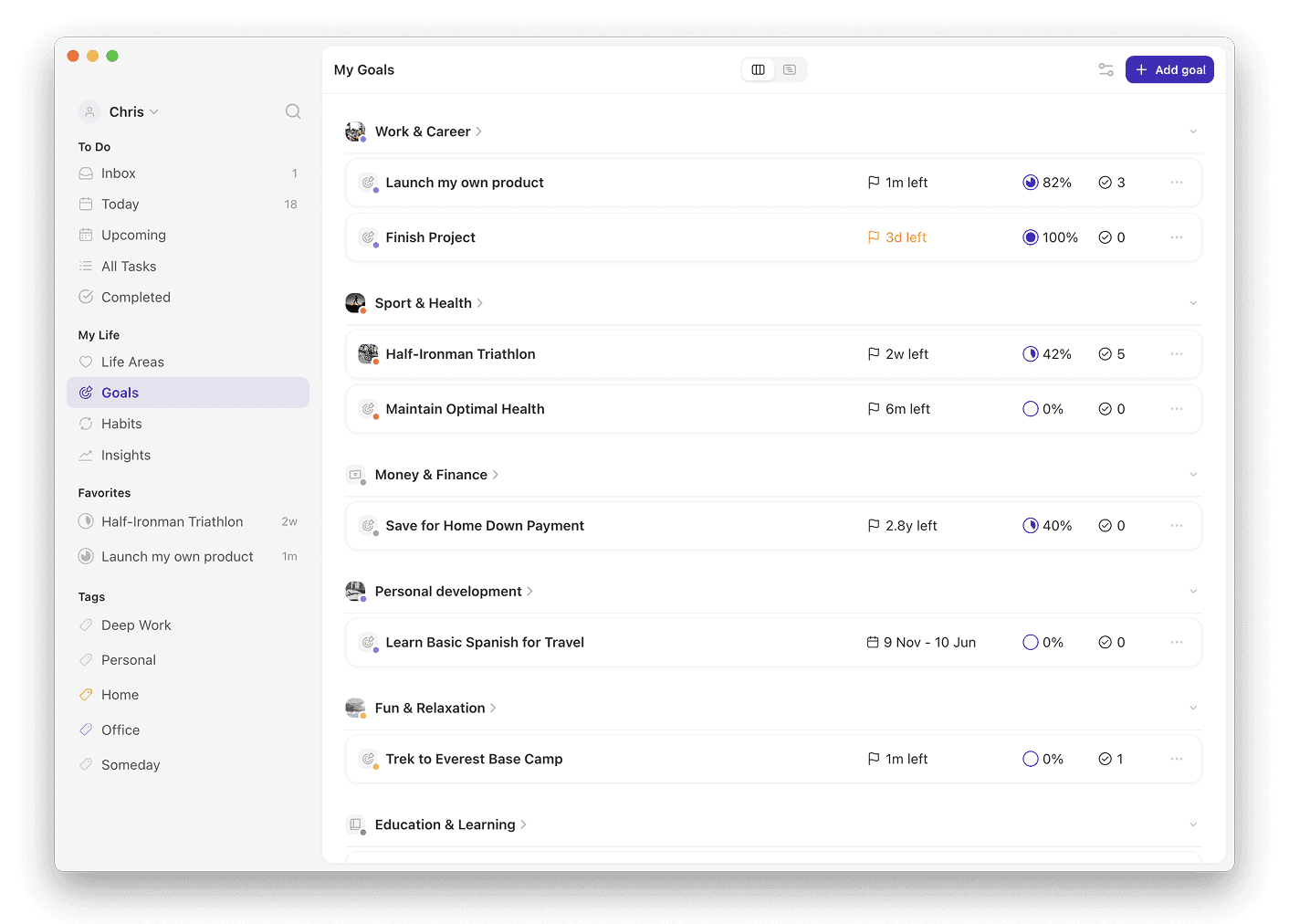
Below the Vision field, each Life Area holds Goals. Each goal has a measurable target, a start value, a deadline, and an impact rating. Each goal in Griply links to a Life Area, so the vision it belongs to is always visible.
From goals, you move down through subgoals to tasks and habits, each level tracing back up the chain.
You write the vision in the Life Area's Vision field, then create goals with deadlines that represent the milestones on the way there. The Today view surfaces which goal each task belongs to alongside the calendar.
Griply's Goal Roadmap, available on premium, shows all goals and subgoals on a Gantt timeline. A multi-year personal strategic plan is visible at a glance.
Frequently asked questions
What is a vision planner?
A vision planner is a system for writing a clear description of what you want each area of your life to look like, and for organizing that description into goals and tasks you can act on. It connects long-term direction to daily work.
How is a vision planner different from a life planner?
A life planner covers the full structure of life planning: goal-setting, task management, habit tracking, and regular reviews. A vision planner focuses specifically on the vision layer: writing a clear picture of the desired future for each life area and deriving goals from it.
How do you write a vision for a life area?
Describe what that area looks like when it's going well, name the reason it matters to you personally, and identify the main obstacle between your current situation and that picture. Two to four specific sentences is usually enough.
How many life areas should a vision planner cover?
Start with the two or three areas where the lack of a clear direction is most visible. Once those visions are connected to active goals, you can add more. Covering too many areas at once often means none get the attention needed.
Can Griply work as a vision planner?
Yes. Each Life Area in Griply has a Vision field where you write your vision for that domain, and all goals in that area connect back to it. The Today view shows which goal each task belongs to.
A vision that generates goals is one you can test against daily decisions
A vision planner is useful when it lets you look at any task or goal and ask whether it belongs: whether it moves you toward the state you described, or whether it's low-priority work pulling in a different direction. That requires a vision specific enough to answer the question.
Writing it with a mental contrasting approach and deriving goals from it using backcasting gives you the direction. Attaching an implementation intention to the first concrete steps gives you the activation. The structural challenge after that is keeping the connection between vision and daily work visible beyond the day you write it.
Related Guides
Gabriele Oettingen. Rethinking Positive Thinking: Inside the New Science of Motivation. Current, 2014. https://www.penguinrandomhouse.com/books/315221/rethinking-positive-thinking-by-gabriele-oettingen/
Peter M. Gollwitzer. "Implementation Intentions: Strong Effects of Simple Plans." American Psychologist, Vol. 54, No. 7, 1999, pp. 493-503. https://www.prospectivepsych.org/publications/implementation-intentions-strong-effects-simple-plans