

A productivity system is a set of structures, habits, and decision rules that connect your daily work to the goals you have committed to pursuing. If you have rebuilt yours more than once in the past year, the system itself was probably not the problem.
The real trap is that most productivity tools come with infinite surface area. You can reorganise the sidebar, redesign the Notion template, colour-code the tags, and add a new view, and call all of it a productive Sunday, because each configuration choice feels like progress even though none of it moves your goals forward. A system with infinite surface area will always generate more configuration to do.
The answer is a hierarchy where the structure is pre-decided, so the question of how to organise everything is no longer on the table every week. Once the structure is fixed, the only work left is filling it in with the goals you are actually trying to reach.
Key takeaways
Tinkering with your productivity system is a documented form of self-regulation failure: the configuration work generates a visible reward while the harder strategic work stays untouched.
An opinionated hierarchy (Life Area to Vision to Goal to Subgoal to Project to Task and Habit) removes the configuration decision entirely. The structure is given once and does not need to be redesigned.
James Clear's argument in Atomic Habits is that the system is what runs your life on any given day: a system built around visible configuration rewards will produce more configuration.
Griply's fixed Goal-First hierarchy gives you the structure pre-built, so any task can connect to a goal or life area, and the tinkering loop has nowhere to restart.
Why you keep rebuilding your productivity system
Tinkering is the predictable output of a certain kind of tool.
Productivity apps like Notion and ClickUp are built on the premise that flexibility is a feature: any database structure, any tag taxonomy, any colour coding. That flexibility is genuinely useful for teams managing complex projects, but for an individual managing personal goals, it creates an open-ended design question that never fully closes.
The configuration problem regenerates itself: you solve the tag structure, then wonder whether you need a new view, then wonder whether the naming convention is right. Each iteration feels like refinement. Most of it is procrastination.
A meta-analysis of over 800 studies concluded that procrastination is a self-regulation failure rooted in the preference for immediate, certain rewards over distant, uncertain ones. Reorganising a Notion database delivers an immediate, visible reward: a tidier system. Writing the quarterly plan or doing the actual strategic work delivers a distant, uncertain one.
What infinite-surface-area tools do to your productivity system
Infinite surface area is what happens when a tool has no opinions about how it should be used.
David Allen's GTD solves one real problem: the anxiety of uncaptured commitments. GTD gives every piece of work a trusted home. What it does not give you is a reason why any of it matters, or an opinion about what your system should look like. The system design is left to you.
PARA, developed by Tiago Forte, categorises information into Projects, Areas, Resources, and Archives. It is an excellent information architecture, but it does not ask whether you are working on the right things. Both GTD and PARA require you to design the setup from scratch, which means the tinkering question is always open.
Cal Newport's argument in Deep Work is that shallow work expands to fill unguarded time. Configuring a productivity system is shallow work: it requires attention without the deep concentration that moves strategic goals forward. A tool with infinite surface area makes it easy to spend Sunday on it and call it planning.
What a productivity system actually needs to work
The research on goal achievement points to a specific mechanism: goals with measurable targets and deadlines outperform vague intentions in roughly 90% of studies. The mechanism that matters is feedback: when you can see current progress against a target, you adjust. When the goal is vague, there is no adjustment signal.
A working productivity system has two layers: the selection layer (what actually deserves time today?) and the execution layer (how do you get that work done reliably?). Most productivity advice only addresses the second. GTD, time blocking, and the Pomodoro technique are all execution tools with no answer for the selection question.
The selection layer requires a hierarchy: a structure where daily tasks trace back to goals, goals trace back to a vision, and vision traces back to a life area you have chosen. Without that chain, every task looks equally valid and priority has to be decided from scratch each morning. That daily re-decision is exhausting, unreliable, and a vector for more tinkering.
The hierarchy that ends the configuration loop
An opinionated productivity system solves the tinkering problem by removing the design question entirely.
When the structure is pre-decided, the only question remaining is what to put inside it. The hierarchy runs: Life Area, Vision, Goal, Subgoal, Task, and Habit. Each life area holds a vision (where you want to be), goals with a metric and deadline, subgoals as milestones, and the tasks and habits that move each subgoal forward.
Every item in the hierarchy has exactly one parent: a task links to a goal or life area, a habit links to a goal. The hierarchy removes the ambiguity that tinkering feeds on, because the answer to every structural question is already decided.
James Clear's point in Atomic Habits is that systems determine results more than goals do. Two people with identical goals will get different outputs depending on the daily structure they operate within. An opinionated hierarchy gives the system a shape that doesn't need to be reinvented.
Why the Sunday configuration loop is really a visibility problem
Most tinkering happens on Sunday because that is when the week ahead feels manageable and the strategic gaps are most visible.
You open your system, notice something that could be better organised, and spend two hours on it. The tinkering feels productive because you are making decisions, but the decisions are structural: you are reorganising the container and leaving the question of what belongs inside it for later.
The visibility problem is that if your goals are buried inside a database that requires three clicks to reach, they will not inform daily decisions. The system you interact with every morning is the one that shapes your choices. A flat task list with no visible goal context defaults to clearing whatever is most urgent and most visible, which is rarely the work that matters most long term.
When goals are at the top of your daily view rather than stored in a document you visit occasionally, every task you pick up is already contextualised. The Sunday configuration session loses its purpose because the structure was decided once and the only work left is filling it in.
For more on how to build the goal-first structure from scratch, see How to build a personal productivity system.
How Griply gives you an opinionated productivity system pre-built
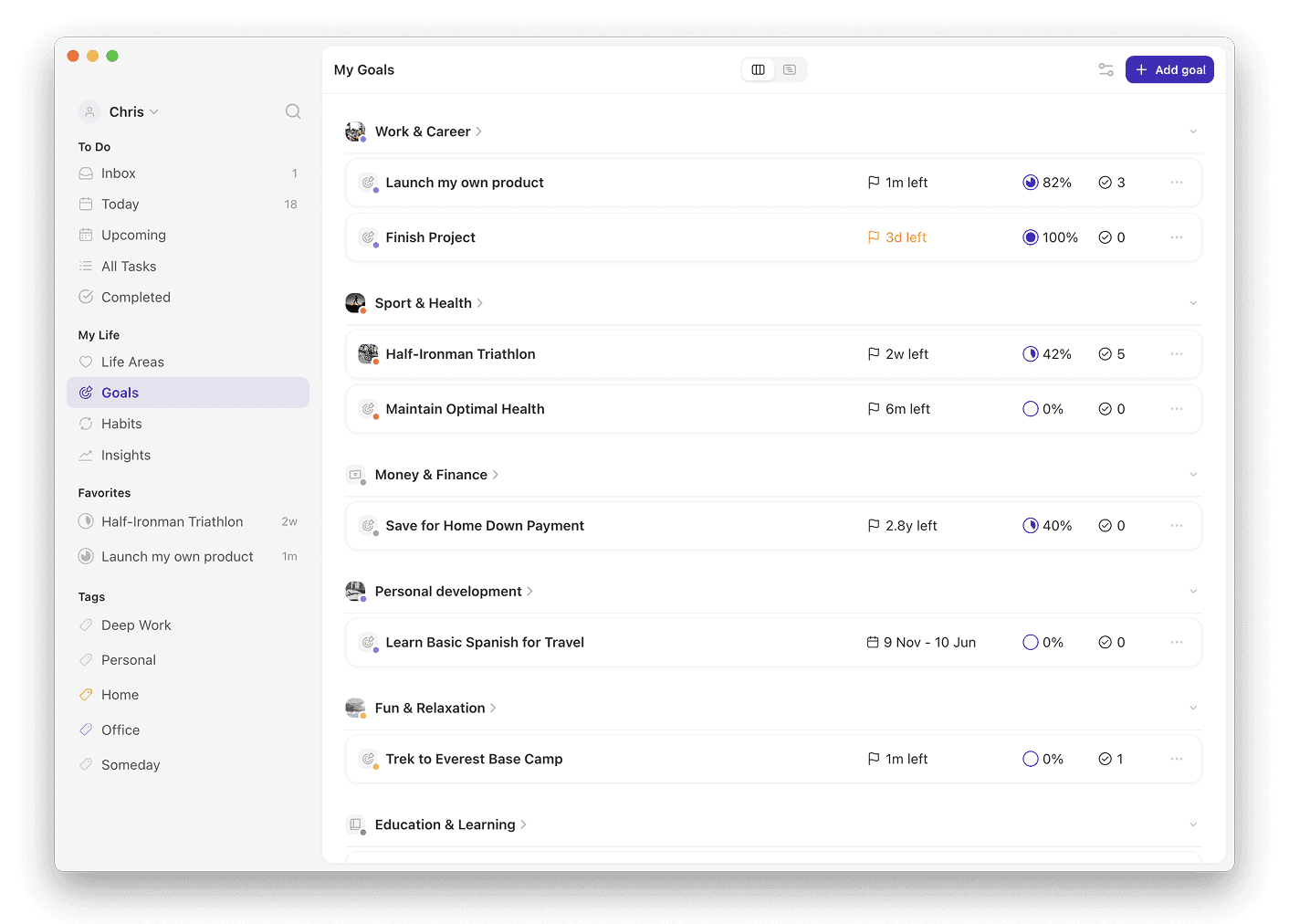
Griply's Goal-First hierarchy runs Life Area to Vision to Goal to Subgoal to Project to Task and Habit. The structure is fixed by design. You fill it in rather than build it.
The Goal Planner is where the selection layer lives. Each goal carries a start value, a target value, and a deadline, with progress logged manually so the connection between today's task and the longer-term outcome stays visible. The Goal Roadmap shows all goals and subgoals on a Gantt chart, your strategy across months in one view, without a Sunday redesign session.
The Task Manager handles the execution layer. A task can connect to a goal, a life area, or a subgoal, and the Today view surfaces that context alongside the calendar so a linked task shows its reason when you open it. Habits connect to goals the same way, keeping the chain from daily action to long-term outcome intact across any planning session.
The tinkering loop ends when the structure is settled. Griply's hierarchy settles it by design. You spend Sunday deciding what to work on next week, with the structure already in place.
Frequently asked questions
What are productivity systems?
A productivity system is the full set of structures, habits, and decision rules that determine how you select and execute work. It includes the tools you use, the hierarchy you work within, and the review cadence that keeps the system calibrated over time. The distinction that matters most is whether the system starts from goals or from tasks.
What is the 3-3-3 rule of productivity?
The 3-3-3 rule, associated with productivity writer Oliver Burkeman, suggests spending three hours on your most important project, completing three shorter tasks, and doing three maintenance items. It is an execution heuristic: a way of shaping the day once you know what to do. Without a goal-anchored hierarchy deciding which project is most important, the rule can become another version of the flat task list.
What is an example of a productivity system?
GTD (Getting Things Done by David Allen) is a capture-and-organisation system built around trusted lists of next actions. PARA (Projects, Areas, Resources, Archives) is an information architecture for knowledge workers. A goal-first system like Griply's starts one layer higher: it derives tasks from goals, goals from visions, and visions from chosen life areas. Each type solves a different problem.
What is the 5 5 5 30 method of productivity?
The 5-5-5-30 method involves five minutes reviewing the day's priorities, five minutes planning focused blocks, five minutes reviewing the previous day, and 30 minutes of focused execution before checking messages. It is a morning execution ritual. Its effectiveness depends on whether the priorities it reviews are connected to goals or sourced from whatever arrived overnight.
Why does my productivity system keep breaking down?
A productivity system breaks down when the design question stays open. If the tool you use has infinite surface area, there will always be a way to reorganise it that seems better than the current arrangement. The fix is a hierarchy where the structure is decided once: your job is to fill in the goals.
The Sunday redesign is a symptom of an open structure question
Every hour spent reorganising your productivity system is an hour not spent on the work the system was meant to support. The redesign session happens because the structure is still a question, and any system that keeps the structure open will keep generating redesign sessions.
When the structure is given, Sunday becomes a planning session rather than a configuration one.
For the execution side of the equation, slow productivity's principle of doing fewer things better is the complement to a fixed hierarchy: the hierarchy tells you what to work on, and capping your active commitments ensures you give those things the attention they need.
Related Guides
Allen, David. Getting Things Done: The Art of Stress-Free Productivity. Viking, 2001. https://gettingthingsdone.com/
Clear, James. Atomic Habits: An Easy and Proven Way to Build Good Habits and Break Bad Ones. Avery, 2018. https://jamesclear.com/atomic-habits
Locke, E. A., and Latham, G. P. "Building a Practically Useful Theory of Goal Setting and Task Motivation: A 35-Year Odyssey." American Psychologist, Vol. 57, No. 9, 2002. https://pubmed.ncbi.nlm.nih.gov/12237980/
Newport, Cal. Deep Work: Rules for Focused Success in a Distracted World. Grand Central Publishing, 2016. https://www.calnewport.com/books/deep-work/
Steel, Piers. "The Nature of Procrastination: A Meta-Analytic and Theoretical Review of Quintessential Self-Regulatory Failure." Psychological Bulletin, Vol. 133, No. 1, 2007. https://pubmed.ncbi.nlm.nih.gov/17201571/