

A personal productivity system is a set of structures, tools, and habits that connect your daily work to the outcomes you actually care about, filtering every task and obligation down to what actually deserves your time today.
Most people have the structure without the connection. They have apps and task lists that capture everything but tell them nothing about whether any of it matters. The calendar is full, the inbox is managed, and yet the goals that were supposed to define the year barely move.
That gap is not a discipline problem. It's an architectural one. The system is processing work without any reference to purpose.
The underlying question is what a personal productivity system is built around, and whether it's built around the right thing.
Key takeaways
Most productivity systems (including GTD and PARA) are capture and organisation systems: they manage information and tasks well, but they do not start from goals.
A goal-first personal productivity system starts with your largest life commitments, then derives projects and tasks from them, so priority is built in rather than decided each morning.
James Clear's work on Atomic Habits shows that systems matter more than goals in isolation: the daily structure you operate in determines what you actually get done.
Griply's hierarchy runs from Life Area to Vision to Goal to Subgoal to Project to Task and Habit, giving you a pre-built structure to fill in rather than a system to design from scratch.
Why GTD and PARA keep you organised but still working on the wrong things
David Allen's Getting Things Done (Viking, 2001) is one of the most widely read productivity systems ever written. It solves a specific and real problem: the anxiety of uncaptured commitments. When every obligation lives in your head, cognitive load compounds.
GTD's answer is to capture every commitment and organise it into trusted lists. That works.
PARA (Projects, Areas, Resources, Archives), developed by Tiago Forte, solves a different problem: where to put the information that accumulates in a knowledge-heavy workflow. The four categories give you a place for everything, and a way to move material from reference to active use.
Both systems are worth knowing. But neither starts from goals. GTD's "next action" is the smallest possible unit of work to move something forward.
PARA's project is whatever you happen to be working on. Neither system asks: is this the right thing to be working on at all?
That question is the missing layer. A productivity system built on capture and organisation will keep you from dropping things. A productivity system built on goals will keep you from working on the wrong things for years.
What a goal-first personal productivity system looks like
Stephen Covey's second habit in The 7 Habits of Highly Effective People (Free Press, 1989) is "begin with the end in mind." The principle is that every role you hold and every commitment you make should trace back to a set of core values and long-term outcomes. That is an orientation, not a system, but it points to what any personal productivity system needs as its foundation.
A goal-first system starts from the largest, slowest-moving layer and works down. You begin with the areas of life you want to develop: career, health, finances, relationships. Within each area, you define a vision: where you are heading and why.
From the vision, you set specific, time-bounded goals. Goals break into subgoals, subgoals break into tasks and habits.
At every level, the layer above gives meaning to the layer below. Each task belongs to a subgoal that pushes a goal that defines a vision in an area of life you care about. Without that chain, priority is arbitrary.
A habit with no goal connection is a practice without a purpose
James Clear argues in Atomic Habits (Avery, 2018) that goals set the direction but systems determine progress. Two people with identical goals will get different results based on the daily structures they operate within. For Clear, the system is not the path to the goal; it is what actually runs your life on a given Tuesday.
This has a practical implication for how habits belong inside a personal productivity system. A habit that floats in isolation, tracked in a standalone app with no connection to a goal, is a practice without a purpose. The tracking continues, the streaks accumulate, but there is no reference point for whether the habit is doing anything important.
When habits attach to goals, the question changes. A daily writing habit connected to a goal of completing a manuscript in twelve months has a visible effect on progress. A morning exercise habit tied to a health goal has metrics attached to it.
The tracking still happens each day, but progress now has a direction.
How to Build Your Personal Productivity System
Start at the top of the hierarchy, not the bottom. Most people begin a productivity overhaul by reorganising their task list or finding a better app. That is the bottom of the structure.
It is where execution happens, and it is the wrong place to start.
Begin by writing down the two or three areas of life where progress matters most to you this year. For each area, write a vision statement: a one-sentence description of where you want to be, not what you want to achieve. "I want to be financially independent by 50" is a vision.
"Save $20,000 this year" is a goal that sits underneath it.
From each vision, set one or two goals with deadlines and measurable targets. Break each goal into subgoals with their own targets and timelines. Within each subgoal, list the tasks and habits that make it real.
At this point, your daily work has a chain of context behind it. The tasks you link trace back to a reason.
The daily layer of the system is where methods like time blocking and eating the frog do their work. Both methods assume you already know which tasks matter most. Your goal-first structure is what produces that knowledge.
Without it, you are applying prioritisation tactics to an undifferentiated list.
The most common failure: tasks get done while goals barely move
Cal Newport describes in Deep Work (Grand Central Publishing, 2016) how shallow work expands to fill unguarded time. Email and meetings are not malicious: they are simply more visible and more immediately rewarding than the slow, difficult work that most goals require. A productivity system that does not actively protect time for goal-connected work will default to shallow work by default.
The failure mode most people experience is not laziness or poor time management. It is a system that processes work at the task level without any reference to goal-level outcomes. Tasks get completed, yet progress on the things that actually matter barely moves.
The structural fix is to make goal-connected work the most visible layer of your system, not the deepest. When your goals are at the top of your daily view rather than buried in a document you review quarterly, every task you pick up carries its purpose with it.
How Griply gives you the goal-first structure pre-built
Designing a goal-first personal productivity system from scratch is harder than it sounds. Most people attempt it once, create a structure in Notion or a notebook, and slowly stop using it as the complexity grows. Griply's hierarchy is the structure. You fill it in rather than design it.
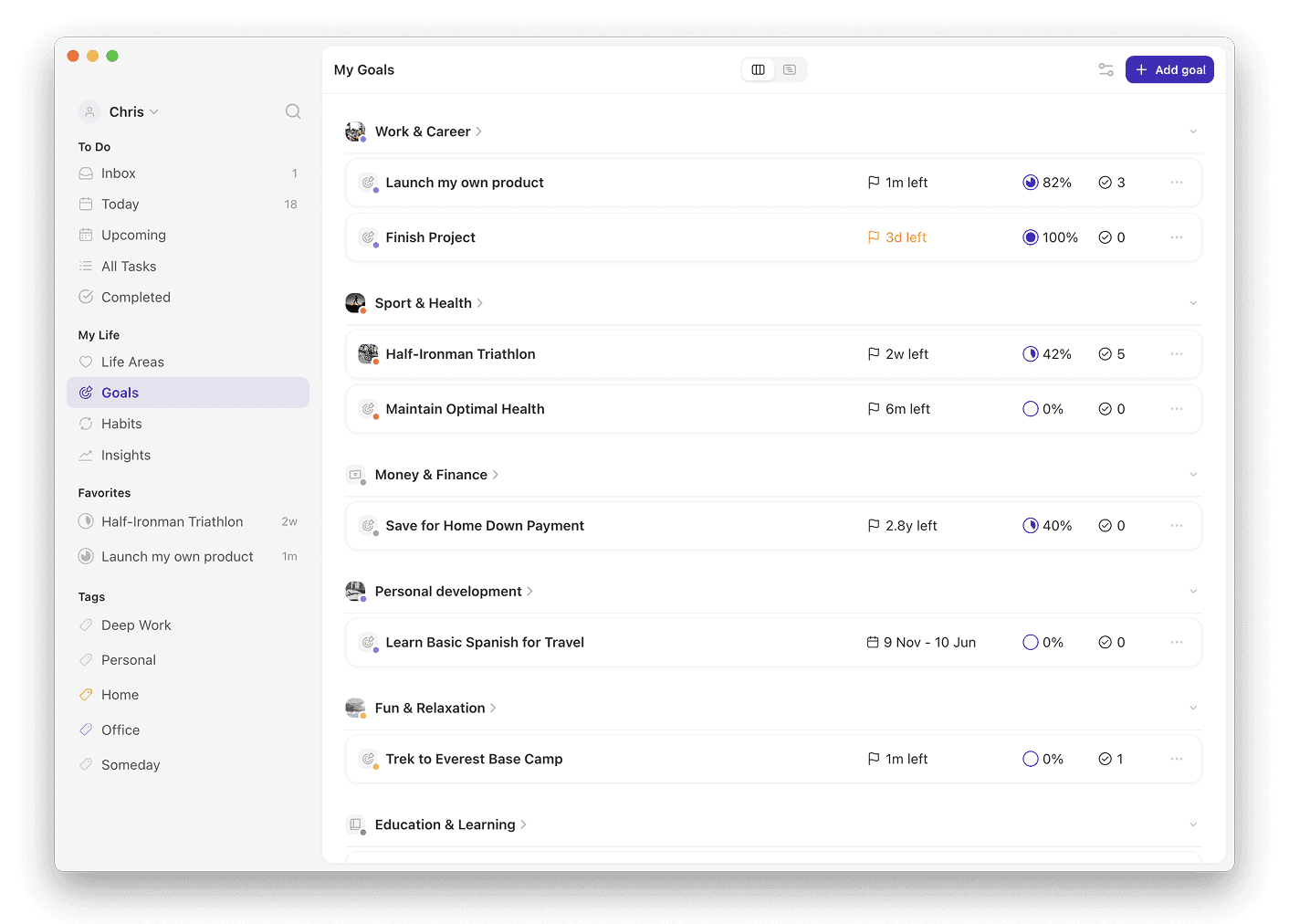
The system runs from Life Area to Vision to Goal to Subgoal to Project to Task and Habit. Every item belongs somewhere in that chain. A task without a goal, a habit without a purpose: Griply surfaces those gaps rather than letting them hide in an undifferentiated list.
Each goal carries a start value, a target value, and a deadline, tracked through a progress chart you update by logging entries manually. That deliberate logging keeps the connection between today's action and the longer-term outcome visible. The Goal Roadmap shows all goals and subgoals on a Gantt chart, your strategy across months in a single view.
A task can link to a goal. When you open the Today view, tasks appear alongside the calendar, each linked one carrying its goal context. You do not have to decide which tasks matter most; the structure has already done that. Habits attach to goals the same way, so the chain from daily action to long-term outcome is never broken.
Frequently asked questions about personal productivity systems
What is a personal productivity system?
A personal productivity system is a structure that connects your daily tasks and habits to the goals and outcomes you care about most. It includes the tools and decision rules that determine what you work on each day and in what order. A system built around goals produces different results than a system built around task capture alone.
What is the difference between GTD and a goal-first system?
GTD is a capture and organisation system: it prevents commitments from falling through the cracks and gives every next action a home. A goal-first system starts one level higher, deriving subgoals and tasks from the outcomes you are working toward. The two are compatible, GTD's capture habits work well inside a goal-first structure.
How do I start building my own productivity system?
Start by identifying two or three areas of life that matter most to you right now, then write a vision for each one. From each vision, set one or two specific, measurable goals with deadlines and break those into subgoals and tasks. The daily layer (scheduling, prioritisation, habit tracking) comes last, once the goal structure is in place.
Do I need a separate app for every part of my system?
No. The problem with fragmented tools is that the connections between layers get lost. Griply holds the full goal-first hierarchy in one place: Life Area, Vision, Goal, Subgoal, Task, and Habit. Every item can connect to the layer above it, so nothing requires manual linking across separate apps.
How often should I review my productivity system?
A weekly check-in to review active goals and plan the coming week is the minimum. A quarterly review to reassess goals and close out completed subgoals keeps the structure from going stale. The daily review, confirming that today's tasks connect to active goals, is what makes the system work at the execution level.
Without goals at the top, your system answers from the inbox up
Every productivity system eventually lives or dies at the daily level: the moment you sit down and decide what to do. If the system does not answer that question from your goals down, it answers it from your inbox up. Those are very different answers.
Start with your life areas and define a vision in each one. From there, goals and subgoals follow, each level deriving its purpose from the level above. The structure gives every piece of daily work a reason to exist beyond the fact that it appeared on a list.
Once that chain is in place, execution methods like time blocking and daily prioritisation have something meaningful to act on.
Related Guides
Allen, David. Getting Things Done: The Art of Stress-Free Productivity. Viking, 2001. https://gettingthingsdone.com/
Clear, James. Atomic Habits: An Easy and Proven Way to Build Good Habits and Break Bad Ones. Avery/Penguin Random House, 2018. https://jamesclear.com/atomic-habits
Covey, Stephen R. The 7 Habits of Highly Effective People. Free Press/Simon & Schuster, 1989. https://www.simonandschuster.com/books/The-7-Habits-of-Highly-Effective-People/Stephen-R-Covey/9781982137274
Newport, Cal. Deep Work: Rules for Focused Success in a Distracted World. Grand Central Publishing, 2016. https://www.calnewport.com/books/deep-work/