

Feel-good productivity is the idea that the most sustainable route to meaningful work is to make that work feel good, not to push through resistance with discipline alone. In his 2023 book Feel-Good Productivity, Ali Abdaal argues that positive emotion is not a by-product of good work; it is the engine of it. The framework rests on three energisers: Play, Power, and People.
Most productivity books assume you already want to do the work. The problem is that wanting to work and doing it reliably are different things, and the gap between them is emotional, not organisational. You can have the perfect system and still sit at your desk dreading what matters most.
Abdaal's framework starts with the dread. His three energisers diagnose what is missing and give you concrete ways to recover it. Each energiser is covered in depth below, along with the blockers and sustainers that complete the framework, and how to build a system that makes these ideas operational rather than aspirational.
Key takeaways
Abdaal's framework identifies three blockers of productivity (uncertainty, fear, and inertia) and argues that procrastination is almost never about laziness; it responds to a specific negative feeling.
Three sustainers (Conserve, Recharge, Realign) complete the framework and address long-term burnout prevention.
The framework is most effective when it is structural, not aspirational: building Play, Power, and People into your daily system matters more than understanding the concepts.
Griply's Habit Tracker maps to the Play energiser by letting you connect every habit to a goal; the Goal Planner maps to the Power energiser through progress tracking and mastery.
What is feel-good productivity?
Feel-good productivity is a framework from Abdaal's 2023 book of the same name. The central argument is that productivity, as most people approach it, is built on the wrong foundation. The standard model treats discipline, willpower, and grit as the primary inputs. Abdaal argues this model leads to burnout faster than it leads to results.
His alternative is to let positive emotion guide the system. When you enjoy what you are doing, you do more of it. When you feel capable, you start more easily. When the people around you energise you, you sustain effort longer.
These are not soft claims. Abdaal draws on the broaden-and-build theory of positive emotions: positive emotional states broaden your cognitive range and build lasting personal resources. The implication for productivity is direct: feeling good is not a distraction from getting things done; it is a precondition for getting the right things done sustainably.
The book divides into three sections: Energise (the three energisers), Unblock (procrastination at its emotional root), and Sustain (long-term energy management). Each section has three chapters, and each chapter ends with a set of practical experiments.
The first energiser: Play reframes effort as exploration
Play is not about turning serious work into a game. Abdaal's definition is more precise: Play means engaging with your work in a way that feels intrinsically motivated rather than externally driven. When you approach a task with curiosity rather than obligation, you work differently.
The research Abdaal cites here found that a playful orientation toward challenges improves problem-solving and reduces stress responses. The mechanism is cognitive: when you reframe a task as exploration, you lower the perceived stakes enough to engage fully.
Practically, this means asking what part of this work could be genuinely interesting, and what you would do differently if you treated the task as an experiment. Abdaal offers a set of prompts he calls "character exercises": picking a role model and approaching the task as that person would. The goal is not pretence but a shift in mental framing that makes starting easier.
Play also involves adventure and novelty. Abdaal argues that seeking small variations in how you do familiar work maintains the sense of discovery that makes effort feel light rather than heavy.
The second energiser: Power builds the self-efficacy that makes starting easier
Power is the sense of confidence and capability you bring to a task. This is not generic self-belief. Abdaal roots this energiser in self-efficacy: the belief that you are capable of completing a specific task, not that you are capable in some abstract way.
The relevance to productivity is direct. Low self-efficacy is a primary driver of procrastination. When you do not feel capable of completing something, you delay it. When you feel skilled and practised, you begin more readily and persist through difficulty.
Abdaal's prescription involves three strategies: building "confidence boosts" by completing small related tasks first, seeking autonomy over how and when you work, and tracking progress in a way that gives you visible evidence of mastery. That third strategy matters more than it might initially seem. The simple act of recording what you have done changes your relationship to the goal. Progress becomes something you can see, not just feel.
The third energiser: People is a productivity input, not a nice-to-have
People is the social dimension of the framework. Abdaal's argument is that the people around you are a direct source of energy: some make you want to work, and others drain the impulse. Curating that social environment is a productivity strategy, not a soft nice-to-have.
This energiser draws on social-network research: emotions and behaviours spread through relationships up to three degrees of separation. The people you spend time with shape your habits, expectations, and drive.
Abdaal's practical recommendations include working alongside others (even asynchronously in a shared co-working session), sharing your goals openly, and treating accountability partners as collaborators rather than monitors. The accountability relationship works best when both parties are genuinely invested in the other's progress, not when one person is reporting to the other.
Beyond the energisers: blockers stop you starting, sustainers keep you going
The three energisers are the core of the book, but Abdaal completes the framework with two more parts. The Unblock section addresses the emotional roots of procrastination, naming three blockers: uncertainty, fear, and inertia. His argument is that procrastination is almost never about laziness; it is a response to a specific negative feeling. Identifying which blocker is active allows you to address the right thing rather than reaching for generic advice about willpower.
Uncertainty (not knowing how to start or what the goal actually looks like) calls for clarity exercises. Fear (of failure, judgment, or imperfection) calls for de-catastrophising. Inertia (the weight of not having started) calls for reducing the activation cost of beginning. Different strategies for different causes.
The Sustain section covers long-term energy management through three sustainers: Conserve, Recharge, and Realign. Conserve means protecting your energy by doing less and delegating more effectively. Recharge means practising rest that genuinely restores; Abdaal introduces the CALM framework, where effective rest makes you feel Competent, Autonomous, Liberated, and Mellow. Realign means periodically reconnecting your work to why it matters. Abdaal's prescription is to build regular reflection into the system, not treat it as something you do only when things feel off. Without it, the system optimises for consistency rather than direction.
If you recognise your own avoidance patterns in the Unblock section, the procrastination personas guide maps eight distinct procrastination types to specific strategies.
How Griply makes feel-good productivity structural
The broaden-and-build research shows that positive emotions compound over time, but only if the daily system creates those experiences reliably, not just once. That is the structural question Griply answers.
The Play energiser requires habits to feel like intentional practice rather than a mechanical checklist. Griply's Habit Tracker lets you connect every habit directly to a goal in the hierarchy. When you check off a morning writing habit, the goal it serves is one level up, always visible. Completion, skip, and fail statistics give immediate, honest feedback rather than a streak number that obscures what is actually happening.
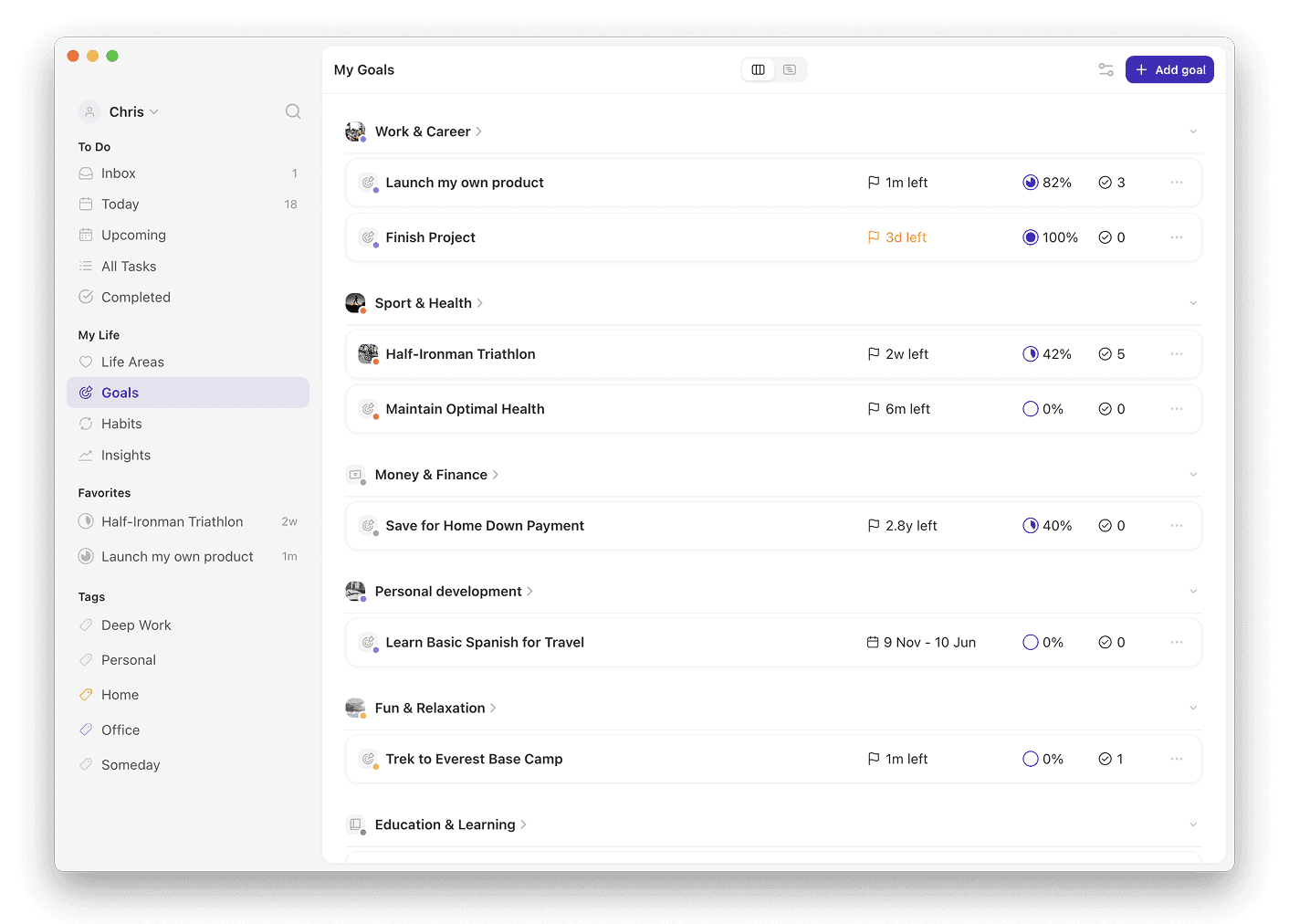
The Power energiser depends on seeing evidence of mastery accumulate. Griply's Goal Planner is built around that signal. Each goal carries a start value, a target value, and a progress chart updated by manual log entries. Logging progress yourself rather than having it calculated automatically creates the deliberate connection between today's action and the longer-term outcome. The Goal Roadmap shows your goals on a timeline, the path from where you are to where you are going is a single view, not an abstraction.
The People energiser is where Griply supports rather than replicates the social environment Abdaal describes. Your logged progress, line chart, and current target position give an accountability partner something concrete to engage with, shifting the conversation from effort to evidence.
Frequently asked questions
What are the three energisers in Feel-Good Productivity?
The three energisers in Feel-Good Productivity are Play, Power, and People. Play means approaching work with curiosity and intrinsic motivation; Power is the sense of self-efficacy that makes starting easier; People is the social energy drawn from others that sustains effort over time.
Is Feel-Good Productivity worth reading?
Feel-Good Productivity is useful for anyone who has tried discipline-based systems and found them unsustainable. Abdaal's argument draws on the broaden-and-build theory of positive emotions, and the practical experiments at the end of each chapter make it actionable rather than theoretical. The Goodreads page has several thousand reviews if you want a sense of how it lands.
What is the Feel-Good Productivity summary?
The book has three parts:
Energise (the three energisers: Play, Power, People)
Unblock (addressing the emotional roots of procrastination through three blockers: uncertainty, fear, inertia)
Sustain (protecting long-term energy through three sustainers: Conserve, Recharge, Realign)
The through-line is that positive emotion drives better work, not the reverse.
Who is Ali Abdaal?
Ali Abdaal is a doctor and productivity author who began his YouTube channel during his final year at Cambridge University. His content covers productivity systems, study strategies, and building a career around work you enjoy. Feel-Good Productivity is his first book, published by Celadon Books in 2023.
How is Feel-Good Productivity different from other productivity books?
Most productivity books start with tactics: time-blocking, task batching, habit streaks. Abdaal starts with why you are not doing the things you want to do, and his answer is that negative emotion is the core obstacle, not lack of organisation. The tools that follow focus on energising and unblocking, not organising.
Abdaal's framework only works when Play, Power, and People are built into your daily system
Feel-good productivity is the argument that sustainable output comes from working with your emotional state, not against it. Abdaal's three energisers give you a lens for diagnosing what is missing when work feels hard. The blockers framework tells you what is stopping you from starting. The sustainers framework tells you how to avoid eroding what you have built.
The hardest part is not understanding the framework. It is building daily systems that make Play, Power, and People show up without effort. If your productivity system does not structure those experiences for you, the insight stays in the book.
Related Guides
Abdaal, Ali. Feel-Good Productivity: How to Do More of What Matters to You. Celadon Books, 2023. https://celadonbooks.com/book/feel-good-productivity-ali-abdaal/
Fredrickson, Barbara L. "The role of positive emotions in positive psychology: the broaden-and-build theory of positive emotions." American Psychologist, 56(3), 2001. https://pmc.ncbi.nlm.nih.gov/articles/PMC3122271/
Bandura, Albert. "Self-efficacy: toward a unifying theory of behavioral change." Psychological Review, 84(2), 1977. https://pubmed.ncbi.nlm.nih.gov/847061/
Brown, Stuart. "Play is more than just fun." TED Talk, Serious Play conference, 2008. https://www.ted.com/talks/stuart_brown_play_is_more_than_just_fun?language=en
Christakis, Nicholas A., and James H. Fowler. Connected: The Surprising Power of Our Social Networks. Little, Brown and Company, 2009. https://www.goodreads.com/book/show/6494620-connected