Life Planning


Table of Contents
Life planning is the practice of deciding what you want across the main areas of your life, then translating those intentions into a structure you actually execute. A life planner is the tool that holds that structure. It can be a printable template, a notebook method like the Wheel of Life, or a dedicated app, as long as it connects annual vision down to today's calendar.
Most people who sit down to build one start with a blank page and end with a blank page. The January notebook gets two good weekends, then drifts into March as a vague memory while daily life reacts to whatever's loudest in the inbox. The gap is usually the handoff between five-year dream and Tuesday afternoon, not a motivation problem.
By the end of this guide you will understand what a life plan actually contains, how to draft one using a working life plan example, and which frameworks (Wheel of Life, life OS, end-of-year reflection) fit different stages. Each section links to a deeper article if you want the full breakdown.
Key Takeaways
A life planner is one place that connects your life areas, a personal vision, measurable goals, and your daily habits and tasks.
The structure runs four layers deep: life area → vision → goal → habit or task. Miss a layer and the plan falls apart between them.
A usable first draft takes about 90 minutes: pick life areas, write a vision for each, set one measurable goal per area, then attach a habit.
The Wheel of Life is the quickest way to see where your life is out of balance, and an end-of-year reflection is the quickest way to check whether your plan is working.
A specific, difficult goal beats a vague "do your best" one in 400+ studies, which is why a good life planner pushes you to set measurable targets.
A new habit takes far longer to feel automatic than people expect, around 66 days on average, so a life planner has to keep working past the first two months.
Writing your goals down and sending a weekly progress update makes you 33% more likely to reach them than just thinking about them.
What a life planner contains
A life planner sits above your calendar and your to-do list. At minimum, it holds your life areas (the domains that matter to you), a vision for each, a set of measurable goals that make the vision concrete, and the habits and tasks that carry those goals forward week by week.
The stationery industry sells "life planner" as a bound notebook with dated pages, which is why the search term is half-polluted by paper products. The underlying concept is older and more flexible. Think of a life planner as an answer to three questions: what do I actually care about, what does "going well" look like in each of those areas, and what will I do this week that moves me closer. A printable life planner template can capture the top two layers; a digital life planner handles the weekly execution layer without re-copying the same data month after month.
Whether you use paper, a spreadsheet, or a dedicated app, the structure should be the same. Life area → vision → goal → habit and task. If your chosen format can't hold all four layers in one place, you'll end up with visions in a journal and tasks in a separate app, which is where most plans quietly die.
Why most life planner templates quietly fail
A life planner template is a useful starting point and a common point of failure. Templates do the visioning layer well (the Wheel, the prompts, the annual review pages), then hand you off to your calendar and task manager for the actual execution, which is where the thread breaks. You end up with a beautiful planner on the shelf and a separate to-do list that doesn't reference it.
Paper templates also don't handle updates well. Your goals change mid-year; your habits get tweaked; a life area you didn't expect suddenly matters more. A life planner that can't absorb those revisions becomes read-only within a quarter. If the "how can I plan my future" question is the one you're trying to answer, a dynamic system beats a static template every time.
The test for any template, paper or digital, is a simple one. Can you see, on a given Tuesday morning, which goal each of today's tasks is serving, and which vision that goal is connected to? If yes, the template is doing its job. If not, the template is decoration.
Which areas of life you need goals in
Most life planning frameworks list six to nine standard areas (health, career, finances, relationships, personal growth, creativity). The list is less important than the diagnostic question: for each area, would staying exactly as you are for the next 12 months be fine? If yes, that area does not need an active goal this cycle. If no, it does. Well-being correlates with breadth of goal pursuit across domains, while goals aligned with intrinsic values rather than external pressure are more likely to be maintained over time. The practical implication is to choose areas where goals are genuinely yours, then keep the active list short: two or three areas per 90-day cycle is a more realistic load than trying to advance all eight at once. For a complete guide, see 📘 Areas of life to set goals: the complete guide.
How to create a life plan: a working life plan example
The most common question in this space is how to create a life plan without spending a whole weekend on it. The short version is a four-step draft you can do in 90 minutes. Pick your life areas, write a one-paragraph vision for each, set one measurable goal per area for the next 12 months, then break each goal into a weekly habit or a short project.
Two workable life plan examples, written as extractable blocks:
Health
Vision: I have consistent energy through the workday and sleep through the night.
Goal: Run a 10K in under 55 minutes by September.
Habit: Run 3 times per week, 30 minutes, on Tuesday, Thursday, Saturday mornings.
Career
Vision: I lead a small team on work I'm proud of, with enough autonomy to shape direction.
Goal: Ship two public case studies and one conference talk by December.
Habit: Block 90 minutes every Wednesday morning for portfolio writing, no meetings.
Each goal has a start value, a target value, and a deadline, which is the structure Locke and Latham's 35-year review consistently shows actually changes behavior.
Do this for three to five life areas and you have a real draft. Anything more is a wish list. The discipline of a good life planner is saying no to the fifteen other things you could pursue this year, and the 📘 goal setting guide covers the mechanics of writing each of those goals so they actually hold up.
For a full breakdown, see 📘 Reflection questions: a list for any life transition.
How to write a vision that generates goals
Writing a vision for a life area is the step most life planners skip past: they move directly from naming the area to listing goals without defining what they're aiming at. A useful vision is specific enough that you can test any goal against it. You should be able to read it and immediately tell whether a proposed goal moves you toward it or doesn't.
Picturing the outcome alone tends to lower your follow-through rather than raise it. What works is mental contrasting: pair the desired future state with a clear-eyed look at the main obstacle standing between here and there. In practice, that means your vision statement should name the outcome you want and the obstacle you'll face.
Once the vision is written, the translation step from vision to goal follows a backcasting approach: start from the outcome and work backward to identify what needs to be true in the next 12 months, then 3 months, then this week. Specifying when and where you'll take the first action significantly raises follow-through. Write the first concrete action before you close the planning session.
For a complete guide, see 📘 Vision planner: how to write and execute your personal vision.
End-of-year reflection: the feedback loop your life planner needs
A life plan without a review cycle is a wish list with dates on it. End-of-year reflection is the moment the plan gets honest about what happened, what didn't, and what you want to carry into next year. Done well, it takes two to three hours, covers every life area, and produces a first draft of next year's goals in the same sitting.
The structure that works is a three-pass review. First pass: what actually happened this year in each life area, looking at evidence (completed projects, logged habits, real outcomes) rather than memory. Second pass: what worked, what didn't, and why. Third pass: what you want the next twelve months to look like, written as a vision before it becomes a goal list.
This review only works if you captured data during the year. If your life planner is a blank notebook you opened twice in July, there's nothing to review. That's the main argument for a persistent system: the reflection at year's end is only as good as the evidence you collected along the way.
For a full breakdown, see 📘 End-of-year reflection, which also links to the full 101-question bank when you want the prompts themselves.
Annual planning and how the best planner for life handles it
Annual planning is the once-a-year event where you zoom out, review the last twelve months, and set direction for the next twelve. The best planner for life (whether paper or app) makes this annual ritual easy to run and easy to connect to the weekly execution that follows. The two halves are a single system. If your annual plan lives in a Google Doc and your weekly tasks live in Todoist, the connection breaks within a month.
A strong annual planning session produces three things: a refreshed vision per life area, two to four measurable goals per area, and a rough quarterly breakdown of which goals get attention when. The quarterly breakdown is what stops you from trying to chase every goal in parallel and then executing none of them.
The discipline is to leave with fewer goals than you walked in with. Specifying when and where you'll act roughly doubles your follow-through, and you can only do that for a small number of goals at once.
The five-year horizon: where your annual plan gets its direction
Annual planning works better when it answers to a longer horizon above it. A 5 year plan sets the direction your yearly goals serve, so each year is a step toward a defined five-year picture rather than a fresh start. The trouble is that a five-year deadline is too distant to guide today: motivation to act on a goal drops as its deadline moves further away. The structural fix is to nest the layers, with the five-year vision above annual goals and annual goals above quarterly subgoals, so a regular review of your goals doubles as a check against the five-year direction. For a complete guide, see 📘 How to build a 5 year plan that stays current.
Why the direction of planning matters
Most life plans start today and work outward: you list what you want to do, assign deadlines, and begin executing. The list ends up shaped by whatever feels urgent rather than by what you want your life to look like. A plan built from tasks up has no fixed endpoint to validate itself against.
Outcome planning reverses the direction. You define the future state first, then work backward to the checkpoints that lead there, then pull the first action back to this week. Forecasting projects today's trends forward; backcasting starts from the future you want and reasons back to now. The checkpoint layer is what keeps a life plan connected to daily work past the first month.
For a complete guide, see 📘 Planning for the future: why backward planning works.
What a working life planner looks like in practice
The failure mode to design against is the handoff break: the annual vision is written once in January, the weekly tasks live in a separate task manager, and nothing structurally forces the two to stay connected. Within weeks, today's task list stops referencing the goals it was meant to serve, and the plan decouples silently. The single structural claim that prevents this is simple: every task has to carry its parent goal's context, so the chain from vision down to Tuesday afternoon can't be broken without you noticing.
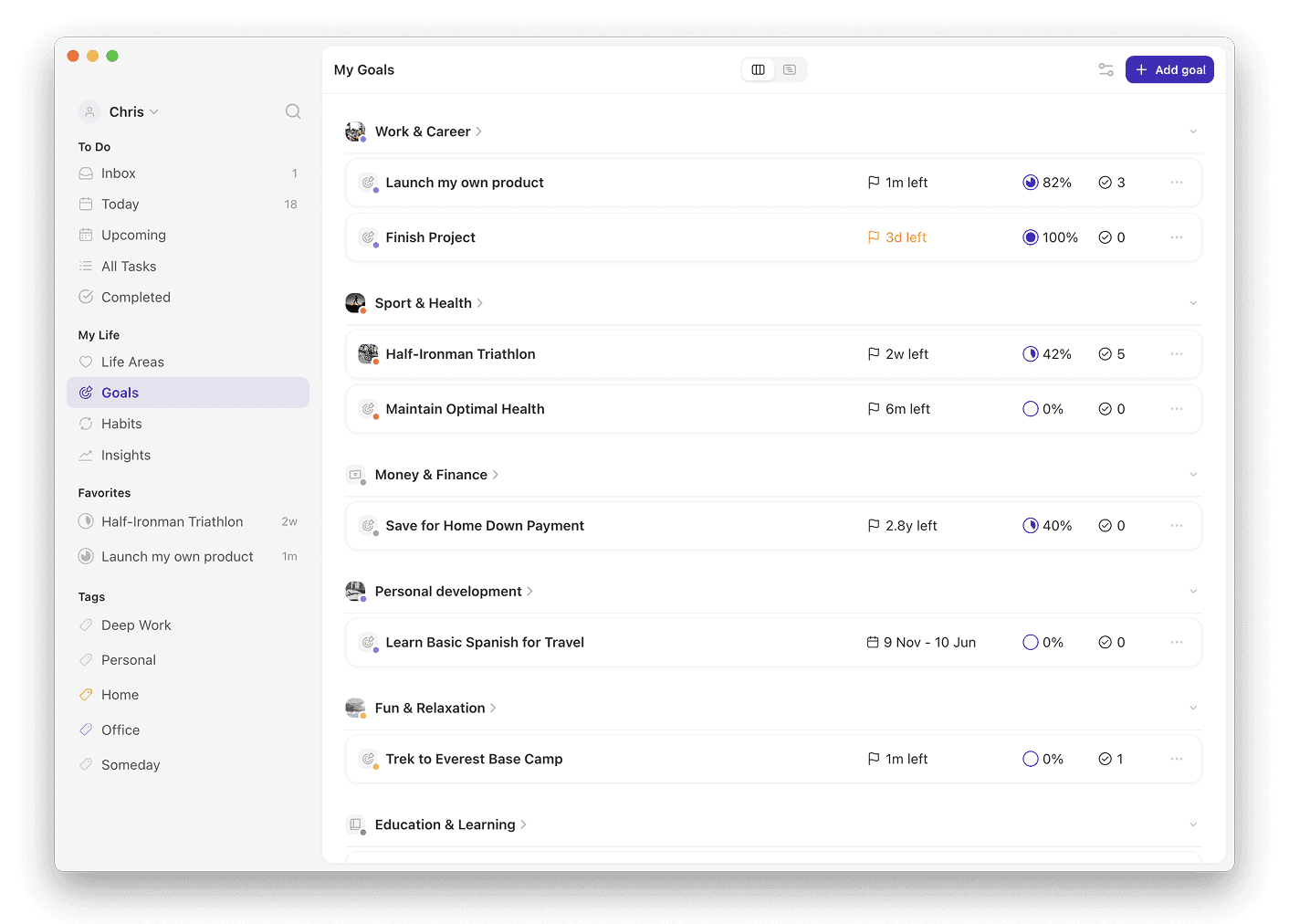
Griply is built around that structural claim. The app is organised by a Goal-First hierarchy: Life Area, then Vision, then Goal, then Subgoal, then Project, then Task or Habit. Every task you create in Griply traces back to a goal, which traces back to a life area and the vision you wrote for it.
You start by defining your life areas (nine come predefined on the free plan; custom areas are premium) and writing a vision for each. You then add measurable goals with a start value, target value, and deadline, and attach habits and tasks underneath. The Today view shows your tasks and time-blocked calendar for the day, with the goal each task is serving visible alongside it. The Goal Roadmap lays out your goals, subgoals, and projects on a Gantt timeline so your annual plan is visible at a glance.
Habit Tracking in Griply is connected to goals rather than floating on its own, which is the difference between tracking habits for their own sake and tracking habits because they move a goal you've committed to (the 📘 habit tracking guide goes deeper on the mechanics). For the full walkthrough, see how Griply's life planner works.
Frequently Asked Questions (FAQ)
Life planner vs goal planner: what's the difference?
A goal planner focuses on the outcomes you want to achieve and the steps to get there, the execution layer that decades of goal-setting research show drives performance. A life planner is broader: it starts with life areas and a personal vision, and treats goals as one layer inside that larger structure. A goal planner works well for a single objective; a life planner is designed to cover every major domain of your life at once.
What is a life planner?
A life planner is a structured system for defining what you want across the main areas of your life and translating that vision into measurable goals, habits, and daily tasks. It can be a paper notebook, a template, or an app, as long as it connects long-term direction to weekly execution. Without that connection, it's a journal, not a plan.
Life planner vs a Notion template: which should I use?
A Notion template can work if you already live inside Notion and want a free-form canvas for the top of your plan. The catch is that Notion shares a failure mode with paper templates: both hold the vision layer well but do not force each day's tasks to reference the goal they serve, so the chain breaks at the weekly-execution layer and you end up running your actual to-do list in a second app. A dedicated life planner enforces vision → goal → habit → task in one place, which is the structure most Notion life-OS builds end up rebuilding from scratch anyway.
How do I create a life plan without spending a whole weekend on it?
Pick three to five life areas, write a one-paragraph vision for each, set one measurable goal per area for the next 12 months, then attach one habit or short project to each goal. This draft takes about 90 minutes and gives you something real to iterate on. A perfect plan that takes ten hours is worse than a rough plan you actually start executing.
How often should I review my life plan?
Weekly for tasks and habits, quarterly for goals, annually for visions and life areas. The weekly review keeps execution honest; the quarterly review catches goals that have stopped being useful; the annual review (end-of-year reflection) rebuilds the top of the plan for the year ahead. Skipping any of the three layers is how a plan goes stale without you noticing.
Life OS vs Wheel of Life: which should I start with?
Start with the Wheel of Life if you don't yet know what you want; it's a 10-minute diagnostic across 8 life areas (usually career, money, health, relationships, family, personal growth, fun, environment) that you rate 1 to 10 and plot as a wheel. Move to a life OS once you have a working life planning practice you want to make permanent across years. The Wheel answers "where am I out of balance," and the life OS answers "how do I keep this plan alive past January."
A life planner is a system, not a worksheet
The reason most life plans don't survive the year is that they're treated as a January worksheet rather than a working system. A life plan is a living connection from the visions you set down to the task you'll complete this afternoon, and it needs a structure that holds up across that full distance.
The Wheel of Life helps you diagnose, annual planning gives you direction, and a life OS or life planner app is what holds it all together the rest of the year. Anthony Grant's research on life coaching shows that structured goal work produces measurable gains in both goal attainment and mental health, which is ultimately what a life planner is for.
More guides on life planning
📘 The Wheel of Life: what it is and how to use it: how to run the classic 8-area coaching assessment and turn low scores into measurable goals.
📘 What is a life OS and how to build one that works: a practical walkthrough of building a persistent digital life OS that holds past the first week.
📘 End-of-year reflection: a structured year-end review framework organised by life area, grounded in actual goal progress data. Links to the full 101-question bank.
📘 Reflection questions: a list for any life transition: reflection prompts for stuck moments, life-area reviews, and major transitions, each ending in a concrete next action.
📘 Vision planner: how to write and execute your personal vision: how to write a specific vision for each life area and translate it into measurable goals using backcasting and implementation intentions.
📘 Planning for the future: why backward planning works: the structural case for outcome planning over task planning, using backcasting to map from a defined future state back to today's actions.
📘 Areas of life to set goals: the complete guide: how to choose which life areas need active goals, what measurable goals look like in each domain, and why intrinsically-aligned goals are more likely to be maintained.
📘 How to build a 5 year plan that stays current: why a five-year plan in a static document loses influence, and how nesting it above annual goals and quarterly subgoals keeps it current.
Works Cited
Matthews, Gail. "Goals Research Summary." Dominican University of California, 2015. https://www.dominican.edu/sites/default/files/2020-02/gailmatthews-harvard-goals-researchsummary.pdf
Locke, Edwin A. and Latham, Gary P. "Building a Practically Useful Theory of Goal Setting and Task Motivation: A 35-Year Odyssey." American Psychologist, Vol. 57, No. 9, 2002. https://pubmed.ncbi.nlm.nih.gov/12237980/
Gollwitzer, Peter M. "Implementation Intentions: Strong Effects of Simple Plans." American Psychologist, Vol. 54, No. 7, 1999. https://www.prospectivepsych.org/publications/implementation-intentions-strong-effects-simple-plans
Lally, Phillippa; van Jaarsveld, Cornelia H. M.; Potts, Henry W. W.; Wardle, Jane. "How are habits formed: Modelling habit formation in the real world." European Journal of Social Psychology, Vol. 40, Issue 6, 2010. https://doi.org/10.1002/ejsp.674
Grant, Anthony. "The impact of life coaching on goal attainment, metacognition and mental health." Social Behavior and Personality, Vol. 31, No. 3, 2003. https://doi.org/10.2224/sbp.2003.31.3.253
Oettingen, Gabriele. Rethinking Positive Thinking: Inside the New Science of Motivation. Current, 2014. https://www.woopmylife.org/en/science
Emmons, R. A. "Personal strivings: An approach to personality and subjective well-being." Journal of Personality and Social Psychology, 1986. https://psycnet.apa.org/doi/10.1037/0022-3514.51.5.1058
Sheldon, K. M. & Elliot, A. J. "Goal striving, need satisfaction, and longitudinal well-being: The self-concordance model." Journal of Personality and Social Psychology, 1999. https://pubmed.ncbi.nlm.nih.gov/10101878/
Steel, Piers and König, Cornelius J. "Integrating Theories of Motivation." Academy of Management Review, Vol. 31, No. 4, 2006. https://doi.org/10.5465/amr.2006.22527462