
Eat the frog means doing your most important, most-dreaded task first thing in the morning, before anything else.
That definition comes from Brian Tracy's productivity book Eat That Frog!, which borrows a phrase commonly (if questionably) attributed to Mark Twain. The concept has been around for decades, and the core logic is sound: your willpower and focus are highest early in the day, so the work that matters most should happen then. When your sharpest thinking and strongest follow-through are available, they should go to the task that matters most, not to whatever appears first in your inbox.
But there is a problem nobody discusses. The method only works if you are eating the right frog. When your task list has no connection to your goals, deciding what your biggest task is each morning becomes guesswork. You end up disciplined and busy at the same time, finishing hard things that were never that important to begin with.
Key takeaways
The phrase comes from a quote popularly attributed to Mark Twain, though researchers at Quote Investigator found no verified Twain source; it was popularised by Brian Tracy's 2001 book Eat That Frog!
The method works because self-control draws on a limited mental resource that depletes through the day.
The most common failure is picking the wrong frog: choosing a task by feel rather than by its connection to your most important active goal.
Griply's goal-first hierarchy lets you link each task to a goal, so you can open your day knowing exactly which task deserves your first hour.
What "eat the frog" means, and where the phrase actually comes from
The saying most often appears like this: "If it's your job to eat a frog, it is best to do it first thing in the morning. And if it's your job to eat two frogs, it is best to eat the biggest one first."
Most references attribute this to Mark Twain, but that credit is almost certainly wrong. Quote Investigator traced the quote extensively and found no verified Twain source. A similar sentiment appears in writing attributed to Nicholas Chamfort, an 18th-century French author, and the Twain attribution appears to have spread through repetition rather than documentation.
None of that changes the advice. Brian Tracy adopted the phrase as the title of his 2001 book Eat That Frog!: 21 Great Ways to Stop Procrastinating and Get More Done in Less Time, which sold millions of copies and brought the concept into mainstream productivity vocabulary. In Tracy's framework, the frog is your most important task: the one you are most likely to postpone, and the one that will have the most positive impact when you complete it.
Brian Tracy's eat the frog method defines the frog by impact, not by discomfort
Tracy's method is often summarised as "do the hard thing first," but the actual rules are more specific.
The frog is defined by impact, not discomfort. Your frog is the task with the highest impact relative to your current goals, not merely the one that sits heaviest in the back of your mind. A ten-minute email that unblocks a stalled project may be a bigger frog than a three-hour task with no connection to anything that matters this quarter.
Tracy's second principle is to identify your frog the night before. You should end each workday by deciding what your most important task is for the following morning. Walking into the day with that decision already settled eliminates the cognitive cost of figuring it out when you are still half-awake.
The third principle is the one people find hardest: start on the frog before anything else. No inbox checks, no quick administrative wins, no warming up with easier tasks. Every small completion before the frog makes the frog feel heavier by comparison, and makes it easier to rationalize deferring it again.
Why the eat the frog method works: cognitive resources are highest at the start of the day
The psychology behind this method is grounded in research on cognitive depletion. Self-control draws on a limited mental resource that diminishes with use, so later decisions require more effort and are more prone to avoidance and shortcuts.
Eating the frog first exploits this asymmetry. When you sit down to work in the morning, that resource is at its most available. Scheduling your hardest, most consequential task for that window means you tackle it at your best, not after hours of smaller decisions have already worn down your reserves.
There is also a relief effect that compounds across the rest of the day. Once the frog is done, the background anxiety of knowing you still have to face it disappears. Your attention on every subsequent task is cleaner.
The problem most people skip: you're probably eating the wrong frog
The eat the frog method is only as good as your ability to identify the right frog. That is harder than it looks.
A flat task list gives you no hierarchy to work from: it is just deadlines, requests, reminders, and ideas, all at the same level. When you ask what your most important task is, you tend to answer based on what feels most urgent or most uncomfortable. Those are reasonable signals, but they are not goal-aligned ones.
You can eat a frog every morning for months and make near-zero progress on what matters if each frog was chosen by feel rather than by its connection to your goals. The "always busy, never forward" frustration that ambitious professionals describe is often exactly this problem, operating consistently. The failure here is structural, not personal.
How to Find the Right Frog
The right frog is the task most directly connected to your most important active goal.
Start with your goals, not your task list. Ask which goal you most need to move forward this week, then find the next blocking task connected to it. That task is your frog.
This process requires that your tasks be connected to your goals in the first place. If your tasks sit in a standalone list with no goal context, you cannot run this identification reliably. For a deeper look at the structural reasons goal-directed work breaks down, why people fail to achieve their goals covers the root causes in detail.
How Griply makes the right frog obvious
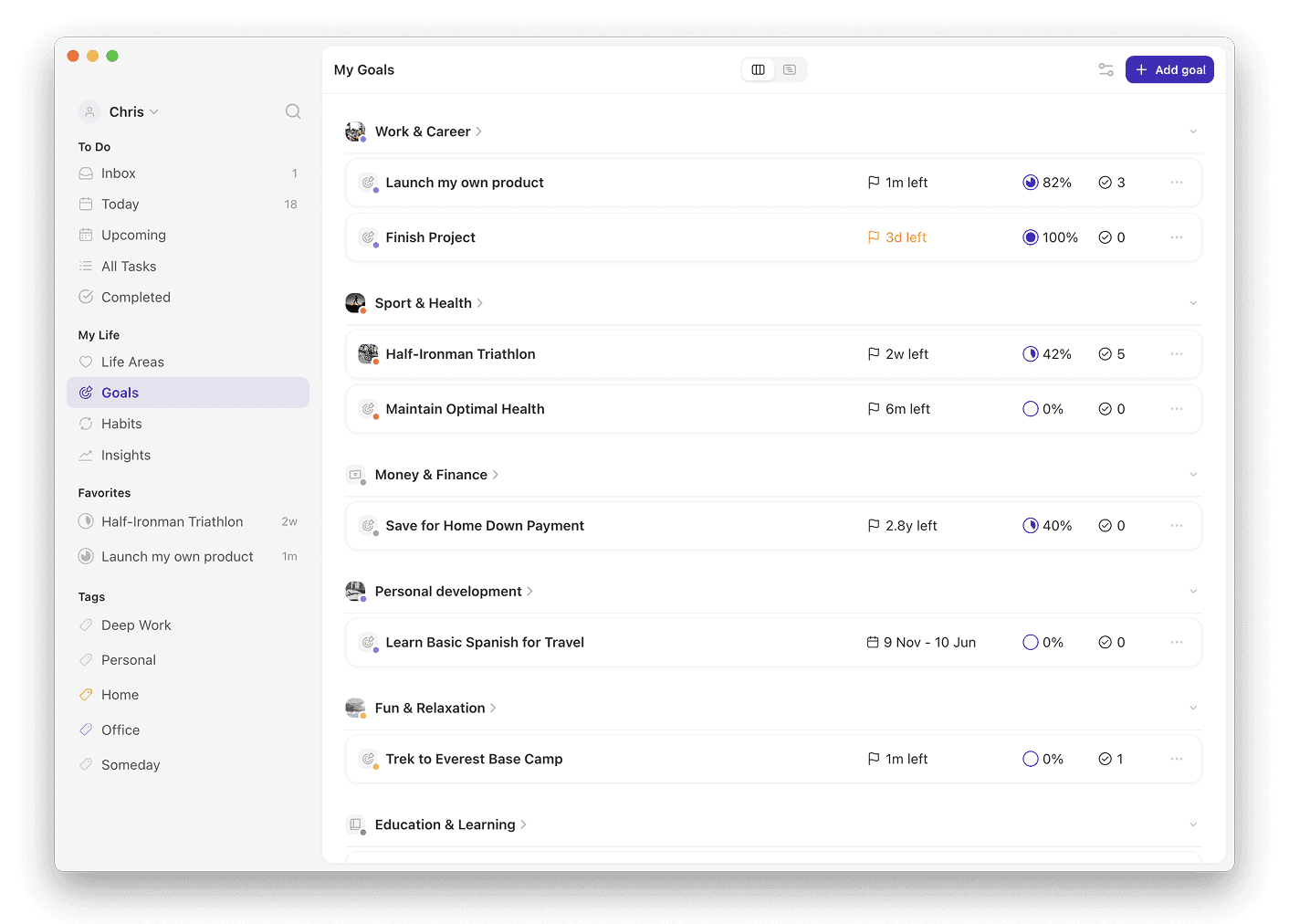
The problem this article describes, picking the frog by feel from a flat list, is a structural failure, not a motivational one. Griply removes the flat list entirely. Every task can belong to a hierarchy that runs from Life Area to Vision to Goal to Subgoal to Project to Task and Habit, so the right frog is visible before you make any decisions.
Each goal carries a start value, a target value, and a deadline. When you open the Today view, tasks appear alongside your calendar with goal context attached. You see not just what to do but which outcome it serves. The question "which task deserves my first hour?" is answered by the hierarchy, not by whatever feels most pressing at 8am.
Tasks carry priority and deadline fields and can be filtered by goal or life area. That means the tasks visible at the start of your day are already narrowed to the ones connected to your active goals, the frog rises to the top rather than hiding in a list of 40 undifferentiated items.
For habit-based morning work, each habit can link to a goal too, so the daily check-in is grounded in strategic intent rather than repetition for its own sake.
Frequently asked questions
What does "eat the frog" mean in productivity?
In productivity, "eat the frog" means doing your most important and most-dreaded task first thing in the morning, before email or reactive work. The phrase was popularised by Brian Tracy's book Eat That Frog! and is based on the principle that completing your hardest task early protects your best cognitive resources for the work that matters most.
Who said "eat the frog first thing in the morning"?
The quote is almost universally attributed to Mark Twain, but that attribution is likely wrong. Quote Investigator found no verified Twain source and traced a similar idea to the 18th-century French author Nicholas Chamfort. Brian Tracy popularised the phrase in his 2001 book, and the Twain credit spread through repetition rather than documentation.
What is the eat the frog method?
The eat the frog method, as described by Brian Tracy, means identifying your single most important task each day (the one with the highest impact relative to your goals) and completing it before anything else. Tracy recommends choosing your frog the night before so you begin the next morning with that decision already made.
What if you have more than one frog?
Tracy's answer is to eat the biggest frog first. If two tasks are genuinely similar in importance, complete the more complex or time-sensitive one first. Regularly feeling you have three or more frogs is a prioritisation signal: your tasks have not been ranked by their actual impact on your goals.
How do you know which task is your frog?
Your frog is the task most directly connected to your most important active goal. Start with your goals: identify the goal that most needs to move this week, then find the next blocking task connected to it. A tool like Griply that lets you link each task to a goal makes this identification fast rather than effortful.
The frog you choose only matters if your tasks connect to your goals
The eat the frog method is one of the most practical pieces of productivity advice in circulation. The logic holds: your best cognitive resources are a morning-limited resource, and the work that matters most should get them first.
The part worth examining is whether the frog you are choosing is actually the right one. Discipline directed at the wrong task is still wasted time. If your daily tasks are not traceable to your most important current goals, you are selecting the frog by feel, even when it feels deliberate.
You need a different system, not a different morning ritual: one where every task you see in the morning already connects to a goal.
Related Guides
Baumeister, R. F., Bratslavsky, E., Muraven, M., & Tice, D. M. "Ego Depletion: Is the Active Self a Limited Resource?" Journal of Personality and Social Psychology, vol. 74, no. 5, 1998, pp. 1252–1265. https://pubmed.ncbi.nlm.nih.gov/9599441/
Quote Investigator. "Eat a Live Frog Every Morning, and Nothing Worse Will Happen to You the Rest of the Day." 3 April 2013. https://quoteinvestigator.com/2013/04/03/eat-frog/
Tracy, Brian. Eat That Frog!: 21 Great Ways to Stop Procrastinating and Get More Done in Less Time. Berrett-Koehler Publishers, 2001. https://www.briantracy.com/catalog/eat-that-frog-3rd-edition