


Holistic productivity is a philosophy of scope: it measures your effectiveness across all major life areas (health, relationships, finances, personal growth, and career) rather than reducing productivity to professional output alone. Most productivity systems are built around work. They track tasks, manage projects, and optimise your output at the office while leaving the rest of your life to chance.
The result is a calendar full of completed items and a life that feels oddly thin. The problem is that your measurement system only counts one kind of progress, so the rest of your life drifts without a plan. Expanding your definition of productivity changes what you plan, what you schedule, and what you consider a good month.
Holistic productivity treats your health, your relationships, your finances, and your personal growth as equally legitimate targets for intentional planning, not just the work sitting in your inbox. The Lifescan is the monthly practice that makes this philosophy concrete: a structured cycle of diagnosis, prioritisation, and review across every area of your life. Work-life balance stops being a vague aspiration and becomes a measurable commitment.
Key takeaways
Focusing exclusively on professional goals is a common cause of burnout, because neglected life areas create a drag that eventually undermines your work performance too.
The Wheel of Life is the most practical diagnostic tool for identifying which areas of your life need attention right now.
Sustained motivation depends on autonomy, competence, and relatedness across domains, not just professional achievement.
Griply structures your goals inside life areas so that every area has an active plan, not just your work projects.
Why optimising only for work eventually erodes the work itself
The standard productivity playbook (prioritised task lists, project management tools, time-blocking) is built around a single assumption: that your job is the main thing worth optimising. This assumption is rarely stated out loud, but it shapes everything from which goals get written down to which areas of life get a calendar block.
Stephen Covey argued in The 7 Habits of Highly Effective People that true effectiveness requires attending to all your major life roles, not just your professional ones. When you ignore that principle, the costs are concrete: health deteriorates because fitness never earns a time slot, relationships weaken because they are perpetually deprioritised, and personal growth stalls because only work-related learning counts as legitimate use of time.
The irony is that neglecting these areas doesn't protect your productivity. It erodes it. The burnout cycle documented across industries is partly a story of people who became very efficient at the wrong scope of life. The Feel-Good Productivity guide covers the argument for enjoyment-driven output in depth.
What holistic productivity means as a philosophy
Holistic productivity means defining "productive" as making meaningful progress across all life areas you care about, on a deliberate schedule, rather than defaulting to whatever demands your attention professionally. Flow and fulfilment require engagement across multiple domains: a life dominated by a single domain tends toward diminishing returns regardless of how much success that domain delivers.
The philosophy has three practical implications. Your definition of a "good week" has to include progress outside work, your goal-setting process has to start from all life areas, and your self-assessment has to be multi-dimensional. A career win that costs your health or your closest relationships is not a net productivity gain.
Self-determination theory provides the psychological foundation here. Sustained motivation depends on three conditions: autonomy, competence, and relatedness. Each of those conditions needs to be satisfied across your life, not just at work, for your motivation to remain durable over months and years.
The Wheel of Life makes imbalance visible in a single view
Before you can practise holistic productivity, you need an honest picture of where you stand across all life areas. The Wheel of Life is the most widely used tool for that assessment. Developed through the Success Motivation Institute, it asks you to rate your current satisfaction in each major life area on a scale of one to ten, then review the pattern of scores as a whole.
The value of the exercise is not the individual scores. It's the gap between areas: a nine in career and a three in health tells you something that neither number communicates on its own. The Wheel of Life makes the imbalance visible in a single view, which is harder to rationalise away than a vague sense that you "should probably exercise more."
For the full breakdown of the Wheel of Life, including its eight standard categories, how to score each one honestly, and what to do with your results, read the dedicated Wheel of Life guide. What comes next is the Lifescan: the practice that converts your assessment scores into active goals.
The Lifescan: Griply's monthly holistic productivity practice
The Lifescan is a structured monthly exercise that takes the snapshot provided by the Wheel of Life and converts it into active goals. It is Griply's practical implementation of holistic productivity, a recurring check-in that prevents any life area from drifting into invisibility while you focus on everything else.
You run the Lifescan in five stages, each with a specific function.
First, list your life areas by writing down every area that matters to you. Do not default to a generic list. The areas should reflect your actual life: if spirituality matters to you, it goes on the list.
Common starting points are:
Health and fitness
Work and career
Money and finances
Relationships and family
Personal growth
Fun and recreation
Physical environment
The list is yours to define. In Griply, these become your Life Areas, and each one holds everything attached to it: your vision, your goals and your tasks.
Second, rate and diagnose each area by giving yourself a score from one to ten for your current level of satisfaction, then writing down the two or three reasons that produced that score, whether positive or negative. This is where most people rush, and rushing defeats the purpose. A score of four in relationships needs a diagnosis: is it a frequency problem, a quality problem, or a communication problem?
The diagnosis determines which action will actually move the number. Recognising a problem and being ready to act on it are two different stages of behaviour change. The diagnostic step in the Lifescan is designed to move you from recognition to readiness.
Third, identify the highest-leverage action per area by asking: what single action, if taken this month, would move my score the most? This is not a brainstorm. You are looking for one answer per area.
A weak execution of this step generates a long wish list. A strong execution generates a short list of specific, uncomfortable actions you have been avoiding. The discomfort is the signal you are looking in the right direction.
Fourth, choose your focus area by selecting one life area to actively prioritise next month. You can maintain progress in other areas, but one area gets concentrated attention. This is not a permanent ranking; it rotates as your Lifescan scores shift over time.
The monthly cadence matters: it is frequent enough to catch problems before they compound, but not so frequent that you are constantly reorganising your priorities. In Griply, you turn your focus area's highest-leverage action into a goal with a start date, a target value, and a deadline. Everything is logged against the relevant Life Area so you can track progress in the goal chart.
Fifth, review at the end of the month by looking at what you committed to and what you actually did before running the next Lifescan. This is a calibration exercise, not a guilt exercise. If you consistently commit to actions in a particular life area and never execute, that is information: the action may be wrong, the scope may be too large, or the area may need to be broken down differently.
Over several Lifescan cycles, you will develop a clearer picture of which areas need structural changes versus which areas just need more time.
Monthly works well for most people as the default cadence. Quarterly is a reasonable minimum if your life changes slowly. Running it more than once a month tends to produce noise rather than signal, because the scores won't move meaningfully in a fortnight.
Without the Lifescan, goals cluster around whatever is most urgent or most visible
The Lifescan produces a specific output: a ranked list of life areas by current satisfaction, a diagnosis for each, and a highest-leverage action for the one you are prioritising. That output is the raw material for goal-setting. Without it, goals tend to cluster around whatever is most urgent or most socially visible, which is usually work.
With it, your goals are distributed across your life intentionally. You are setting a fitness goal because your health score has been below five for three consecutive months, and a relationship goal because your diagnosis identified frequency as the problem. Every goal has a specific origin, not a vague sense that you should do better.
Covey's Roles and Goals framework from The 7 Habits of Highly Effective People operates on the same logic: effectiveness requires attending to each major life role with deliberate goals, not just reactive effort. The Lifescan is the mechanism that makes that principle practical on a monthly cycle rather than a vague aspiration. For a deeper look at how to structure those goals into a complete personal productivity system, the personal productivity system guide covers the goal-first hierarchy in detail.
How Griply makes holistic productivity operational rather than aspirational
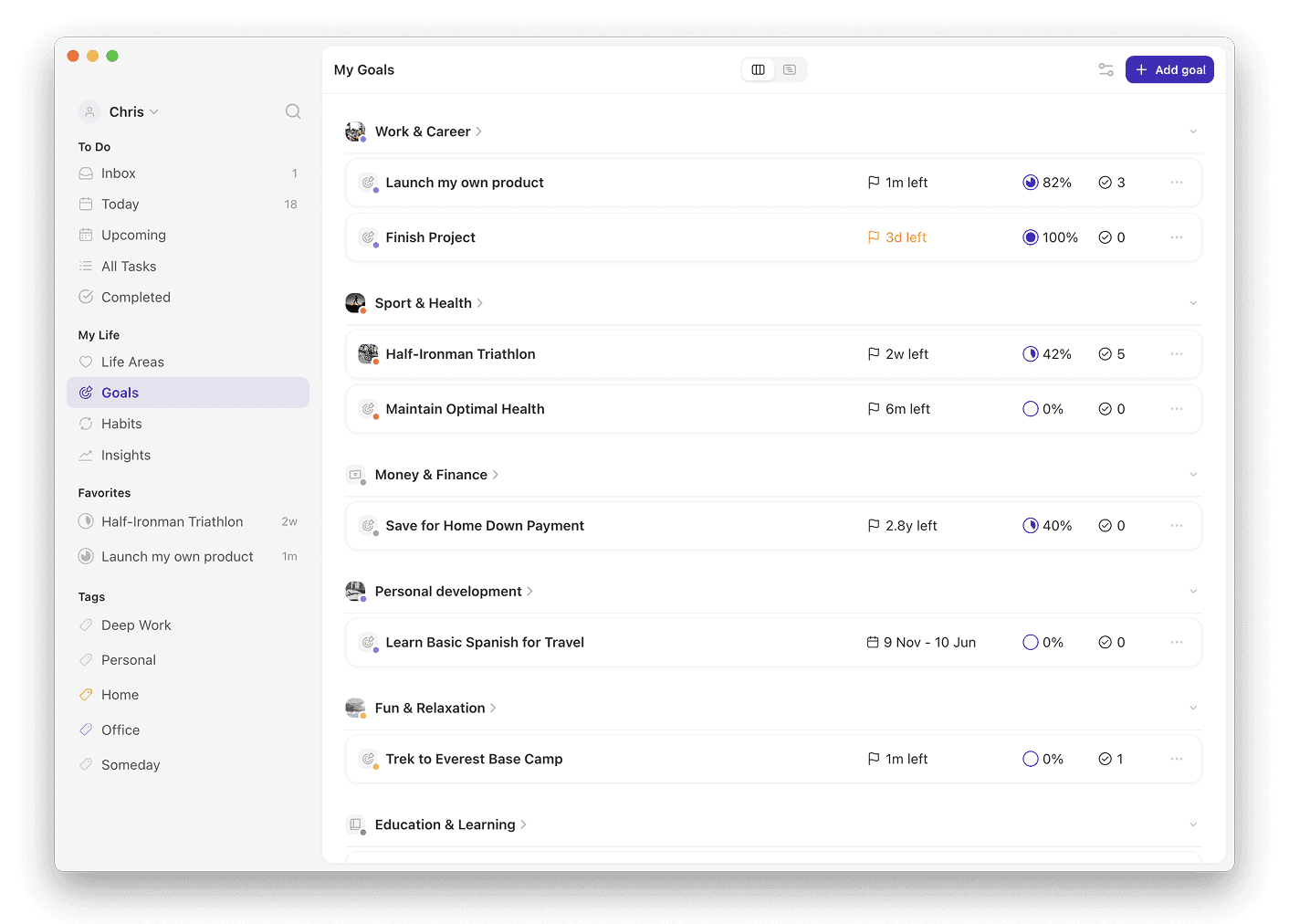
The failure mode of holistic productivity is keeping it conceptual: you know you should develop every life area, but without a structure that makes each area visible, work crowds everything else out by default. Griply's starting point is a set of Life Areas, Work & Career, Sport & Health, Money & Finance, and any others that matter to you. Every goal, task, and habit lives inside a Life Area, so a neglected area is visible as a gap, not hidden in an undifferentiated list.
Inside each Life Area, you write a Vision: where you want to be in that area, defined before any goal is set. This prevents you from setting goals that are efficient but pointed at the wrong outcome.
Once your Lifescan identifies a focus area, the Goal Planner makes it measurable. Each goal carries a start value, a target value, a start date, and a deadline, tracked through a progress chart you update by logging entries manually. The Goal Roadmap shows all goals and subgoals on a Gantt chart, the distribution across life areas in one view.
Habits attach to goals, which belong to a Life Area, keeping the chain from daily action to long-term outcome intact. The Today view shows tasks and habits alongside your calendar, so each morning you can see which goals today's work actually serves.
Frequently asked questions
What is holistic productivity?
Holistic productivity is the practice of measuring and improving your effectiveness across all major life areas, not only your professional output. It treats your health, relationships, finances, personal growth, and career as equally legitimate domains for intentional planning. The goal is a life where progress is distributed deliberately rather than concentrated in whichever area shouts loudest.
How is holistic productivity different from regular productivity?
Regular productivity systems optimise for output within a single domain, typically work. Holistic productivity applies the same discipline of goal-setting, measurement, and review to every life area you care about. The result is goals distributed across your whole life, not just a more efficient professional calendar.
What is the Wheel of Life and how does it connect to holistic productivity?
The Wheel of Life is a self-assessment tool that rates your satisfaction in each major life area on a scale of one to ten. It gives you the diagnostic snapshot you need before setting holistic goals: which areas are neglected and where attention should go next. The dedicated Wheel of Life guide covers the exercise in full.
What is the Lifescan and how often should you do it?
The Lifescan is a monthly five-stage exercise: list your life areas, rate and diagnose each one, identify the highest-leverage action per area, choose a focus area, and review your progress at month end. Monthly is the right cadence, frequent enough to catch drift early, slow enough that scores actually move between sessions.
How do you get started with holistic productivity?
List every life area that matters to you and rate your satisfaction in each on a scale of one to ten. Identify the area with the biggest gap, define one specific action that would move that score this month, and set it as a measurable goal with a deadline. Griply structures this directly: each life area holds a vision, goals with tracked progress, and the habits that serve them. Schedule your next Lifescan for four weeks out.
Measuring only work output leaves the rest of your life without a plan
The question holistic productivity asks is not "how much did you get done today?" It is "which parts of your life moved forward this week?" That shift in measurement changes what you plan, what you schedule, and what you consider a good month.
The Lifescan is the practice that makes the philosophy concrete: a monthly cycle of diagnosis, prioritisation, and review across every area you care about. Run it once, and your goals will look different. Run it for six months, and your life will look different. and set up your first Life Areas today.
Related Guides
Meyer, Paul J. Attitude Is Everything. Paul J. Meyer Communications, 1994. https://www.pauljmeyer.com
Csikszentmihalyi, Mihaly. Flow: The Psychology of Optimal Experience. Harper & Row, 1990. https://www.harpercollins.com/products/flow-mihaly-csikszentmihalyi
Prochaska, James O., John C. Norcross, and Carlo C. DiClemente. Changing for Good. William Morrow, 1994. https://www.harpercollins.com/products/changing-for-good-james-o-prochaskajohn-c-norcrosscarlo-c-diclemente
Ryan, Richard M., and Edward L. Deci. "Self-Determination Theory and the Facilitation of Intrinsic Motivation, Social Development, and Well-Being." American Psychologist, 55(1), 2000. https://pubmed.ncbi.nlm.nih.gov/11392867/
Covey, Stephen R. The 7 Habits of Highly Effective People. Free Press/Simon & Schuster, 1989. https://www.simonandschuster.com/books/The-7-Habits-of-Highly-Effective-People/Stephen-R-Covey/9781982137274