Guide


Table of Contents
A micro habit is a habit shrunk to a version so small you can finish it in about two minutes, like doing two push-ups, reading one page, or writing a single sentence. The size is the point. Most habits fail because they were built for a good day, and then a bad day arrives: a late meeting, a sick kid, four hours of sleep.
Discipline is rarely the real problem. A micro habit is designed to survive that bad day, because two push-ups is still doable when a 45-minute workout is not. That is why starting absurdly small works where willpower fails.
The catch is what happens next. A micro habit only turns into something bigger when it is tied to a goal you actually care about, and doing two push-ups every morning with no goal attached leaves you doing two push-ups a year from now. Building the action small enough to survive any day is half the work, and aiming it at a goal is the other half.
Key takeaways
Shrinking the action matters more than boosting motivation, because an easy action still gets done on the days your motivation drops.
A simple action repeated at the same cue becomes automatic faster than a big, effortful one, so the small version is also the quicker route to a real habit.
Scale a micro habit up only after it runs on autopilot, and keep the two-minute version as your minimum for the days when everything else falls apart.
In Griply a habit is a task you can link to the goal it feeds, and habits are scored by completion rate and perfect weeks, so there is no streak to protect.
What a micro habit is, and why the small size is the point
A micro habit is the smallest useful version of a behaviour you want to make automatic. The micro version of "meditate for 20 minutes" is "take three slow breaths", and the micro version of "write a chapter" is "open the document and write one sentence". The action is deliberately too small to feel impressive, which is exactly why you keep doing it.
The test is simple. If you can talk yourself out of it on a rough day, it is still too big. A true micro habit is small enough that skipping it would feel more absurd than doing it.
Keeping the action that small is what protects the habit during the weeks before it becomes automatic. Most habits are dropped in those first weeks, and our habit tracking guide covers the wider practice of tracking habits in depth.
Why most new habits fail on your worst day
Behaviour happens when three things line up at the same moment: motivation, ability, and a prompt to act. That is the core of BJ Fogg's behaviour model, which he writes as B equals MAP, for behaviour, motivation, ability, and prompt.
Motivation is unreliable. It spikes in January and is gone by February, so a habit that depends on it will not last. Ability is the part you can actually change.
Most habits break down on ability, not motivation. The action was too big for a tired Wednesday, so it did not happen, and one miss became five. Shrinking the action is the direct fix, because a smaller action stays doable on a bad day.
Shrinking also makes the habit form faster, because a simple action repeated in a consistent context becomes automatic faster than a complex or demanding one. Fogg built his Tiny Habits method on this: start absurdly small, and the small version is both the one you can keep doing and the one that becomes automatic soonest.
Micro habits, tiny habits, and atomic habits are three different ideas
The terms get used interchangeably, and they are not the same. Micro habit is the general term for any habit made very small. Tiny Habits is BJ Fogg's method, which pairs a tiny action with a routine you already do, then adds an immediate moment of celebration.
Atomic Habits is James Clear's book, which popularised small habits alongside the two-minute rule and the idea that 1% improvements add up over time. Habit stacking is a fourth term people mix in, and it is about when you do the habit, not how small it is.
Habit stacking attaches a new habit to a routine you already have, while a micro habit shrinks the action itself. You can use both at once: make the habit tiny, then attach it to something you already do every day. If you want the mechanics of cues and rewards, James Clear's four laws of behavior change break down the loop step by step.
Micro habit examples you can start this week
What matters in these examples is the scale, not the specific action. Each one takes under two minutes, so you can still do it on a bad day, and each leaves room to grow.
Do two push-ups after you brush your teeth.
Read one page before you pick up your phone.
Write one sentence in a journal at night.
Drink one glass of water when you sit down at your desk.
Put on your running shoes, even if you do not run yet.
Note one thing you are grateful for over breakfast.
Tidy one surface before you leave a room.
Review tomorrow's top task before you close your laptop.
Notice that several of these are smaller than what you actually want. Putting on running shoes is not a run, and writing one sentence is not a page, and that is intentional.
The tiny version gets you past the hardest part, which is starting. Momentum usually carries you further once you have begun.
How to build a micro habit that survives your worst day
Start by shrinking the full-size version of the behaviour to something you can finish in two minutes. Then pick the cue, the thing that tells you to start. A cue works best when it is an event you already do every day, like making coffee or sitting down at your desk, so you never have to remember the habit on your own.
Then make the action easy enough that starting it takes almost no decision. Give yourself a small moment of satisfaction when you finish, because an action that felt good yesterday is easier to start today.
Keep that two-minute target fixed even as you get stronger. Do more on a good day, but leave the daily target where it is, because the small target is what carries you through a bad week. For the full walkthrough of setting up a new habit in those fragile early weeks, see how to build a habit that sticks.
Why two push-ups a day forever is a trap
Most micro-habit advice stops here, and that is the problem. A tiny action that stays tiny and is connected to nothing gives you a consistent habit and no visible progress. You can hold a 200-day run of two push-ups and be no fitter than when you started, because the habit was never aimed at a bigger result.
Behaviour is maintained when you are satisfied with the outcomes it produces, and a habit that produces no visible result eventually loses the payoff that kept you doing it. The fix is to attach the micro habit to a goal, a bigger result the tiny action feeds, so the habit has somewhere to grow. Two push-ups is the way into a strength goal, and one sentence is the way into a finished draft.
Once the two-minute version is automatic, raise your everyday effort toward the goal and keep the two-minute version for the hard days. This is the same reason habits and goals belong in one system: the habit supplies the repetition, the goal supplies the reason.
How Griply keeps a micro habit tied to the goal it serves
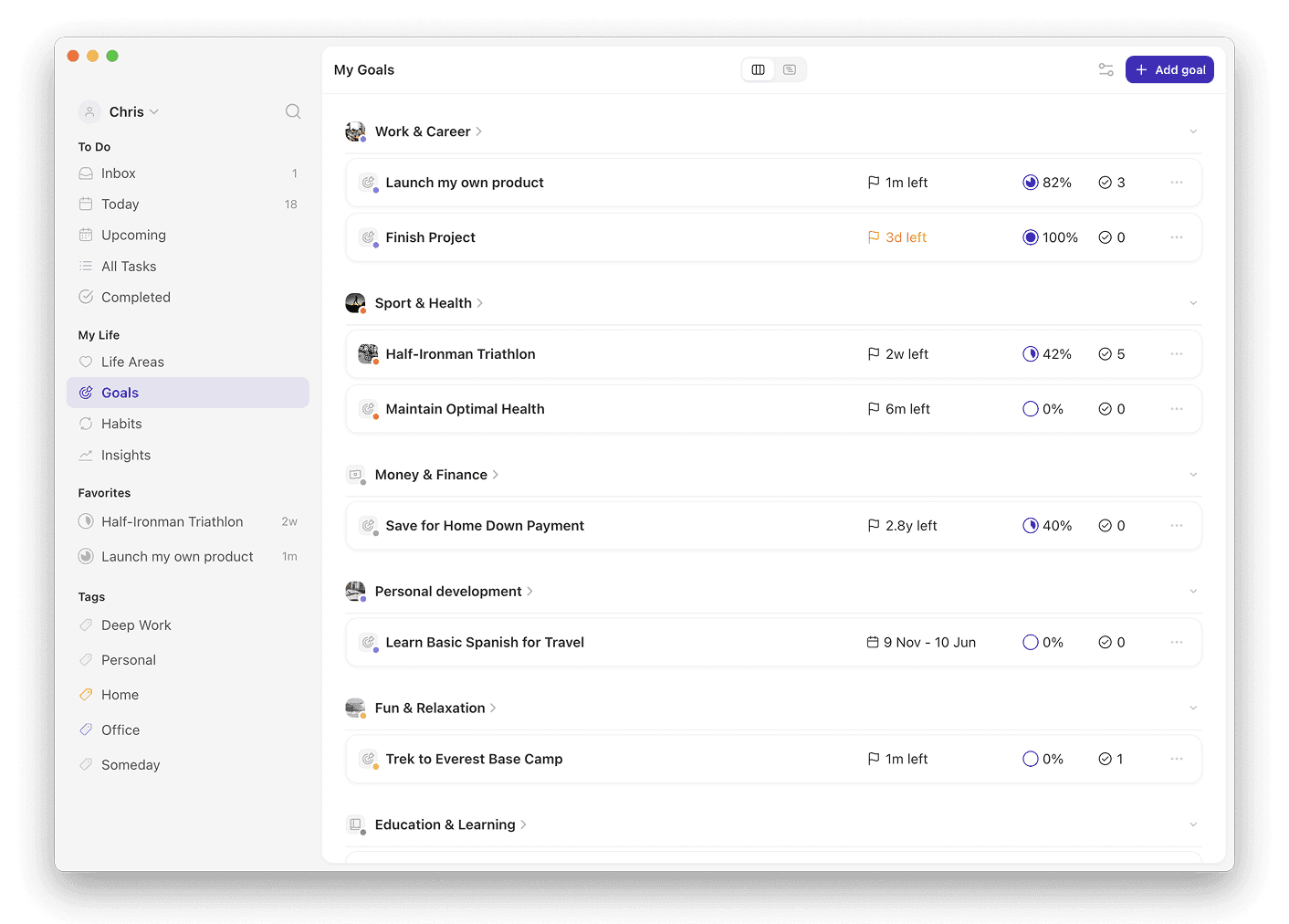
A micro habit gives you the action. It does not give you a bigger result to aim at, which is the problem this guide keeps coming back to. Griply organises your work in one hierarchy, from life area to vision to goal to subgoal and then the task or habit, and a habit in Griply is a type of task, so you can link it to the goal it feeds.
Griply's habit tracker then shows the habit next to the goal you linked it to, in the same Today view where you plan the rest of your day. Completing the habit does not move the goal's number for you. You update the goal yourself, which keeps you honest about whether the small action is actually adding up.
There is no streak counter to protect. You judge a habit by its completion rate and by how many perfect weeks you have had, so one missed day in a hard week barely changes the picture. The habit stays linked to the goal you chose for it, so you can always see what the two minutes are for.
Frequently asked questions
What is a micro habit?
A micro habit is a habit shrunk to a version you can finish in about two minutes, like two push-ups or reading one page. It is small enough that a busy or low-energy day cannot stop you, which is what keeps it going long enough to become automatic.
Do micro habits actually work?
Yes, for building consistency. A small action repeated at a consistent cue becomes automatic faster than a big one, and it survives bad days when a large habit would not. Micro habits stop paying off when they are not attached to a bigger goal, so pair each one with a goal it feeds.
What is the difference between micro habits and tiny habits?
Micro habit is the general term for any habit made very small. Tiny Habits is BJ Fogg's specific method: a tiny action, a routine you already do to attach it to, and an immediate celebration. Every tiny habit is a micro habit, but a micro habit does not require Fogg's exact three steps.
How do I track a micro habit?
Mark it off each day and read the completion rate over a week or a month. In Griply you can link a habit to the goal it feeds, and habits are scored by completion rate and perfect weeks, so one missed day does not reset you to zero.
How small should a micro habit be?
Small enough to do on your worst day without thinking about it. If you can talk yourself out of it, it is still too big. A common rule is two minutes or less, and you scale up only after the small version runs on autopilot.
A micro habit is only as good as the goal above it
The small size is what gets a habit past the first hard weeks, and starting too big is where most people go wrong. Small size on its own only buys you consistency. Two push-ups a day for a year, with no goal attached, leaves you roughly where you started.
The habits that change something are the tiny ones aimed at a goal you care about, where the daily minimum stays small on bad days and the effort climbs on good ones. Build the micro habit so it cannot fail, then give it somewhere to grow, and the two minutes a day start to add up to the outcome you were after.
Related Guides
Fogg, B. J. "Fogg Behavior Model." Behavior Design Lab, Stanford University, 2009. https://behaviormodel.org/
Gardner, Benjamin, Phillippa Lally, and Jane Wardle. "Making health habitual: the psychology of 'habit-formation' and general practice." British Journal of General Practice, 2012. https://pmc.ncbi.nlm.nih.gov/articles/PMC3505409/
Rothman, Alexander J., Paschal Sheeran, and Wendy Wood. "Reflective and automatic processes in the initiation and maintenance of dietary change." Annals of Behavioral Medicine, 2009. https://pubmed.ncbi.nlm.nih.gov/19787308/