

The pomodoro technique is a time-management method that breaks work into 25-minute blocks of focus on a single task, separated by short breaks. Each block is called a pomodoro. Francesco Cirillo built the method in the late 1980s around a tomato-shaped kitchen timer, and it stayed popular because the rules are simple and the ticking clock makes procrastination visible.
Most guides stop at the timer. They teach you to set a timer for 25 minutes and protect that time from distraction, which works once you are already on the right task.
The harder problem is choosing which task to point the timer at. A pomodoro protects your attention for 25 minutes, but it does not tell you whether the task in front of you deserves those 25 minutes. Twenty-five disciplined minutes on a low-impact task is still twenty-five minutes you will not get back.
This guide covers the six steps, the research behind the 25-minute window, and the rules for handling interruptions. It also covers the step the timer leaves to you: deciding which task earns the next pomodoro before you press start.
Key takeaways
A pomodoro is one 25-minute block of single-task focus followed by a 5-minute break.
One task per pomodoro avoids the time cost of switching between tasks.
An interrupted pomodoro does not count; log the distraction and start a fresh 25 minutes.
Griply lets you tie each focus session to a named goal with a deadline.
What the pomodoro technique is and why it is named after a tomato
Pomodoro is Italian for tomato. The name comes from the tomato-shaped kitchen timer Francesco Cirillo used as a university student in the late 1980s, when he could not study for more than a few minutes at a stretch.
Cirillo turned that timer into a repeatable system and later published it as the pomodoro technique, now one of the most widely used time-management methods in the world. The idea is small: pick one task, protect a short fixed window for it, then rest before the next one. Everything else in the method is built on that single 25-minute unit.
The six steps of the pomodoro technique
Cirillo's method runs as a short, repeatable loop. Six steps make up one full cycle:
Choose one task you want to work on.
Set a timer for 25 minutes.
Work on that task, and only that task, until the timer rings.
Mark the pomodoro as done with a checkmark.
Take a short break of about 5 minutes.
After four pomodoros, take a longer break of 15 to 30 minutes.
The breaks are part of the method. The 5-minute pause lets your attention recover before the next pomodoro, and the longer break after every fourth pomodoro keeps you from wearing yourself down over a full day.
Why 25 minutes works, and what makes it good pomodoro time management
Twenty-five minutes is long enough to make real progress on a task and short enough that you can hold full attention the whole way through. It also lowers the bar to starting, since almost anything feels doable for 25 minutes, even work you have been avoiding. The number is a sensible default, and Cirillo has always framed it as a starting point you can adjust.
The fixed window is also what makes this good pomodoro time management, because for 25 minutes you stop switching tasks. Switching between tasks carries a measurable cost in time and accuracy, because part of your attention stays stuck on the task you just left. A pomodoro removes that cost by holding you to one task until the timer rings, so you spend the 25 minutes working.
The breaks do real work too. Short, well-timed pauses keep your focus from sliding over a long stretch, because stepping away and coming back refreshes the task you are holding in mind. So the break resets your focus only when you know which task you are coming back to, and a pomodoro pointed at a vague task gives you nothing to return to.
How to handle interruptions without voiding the pomodoro
Interruptions are the main thing that breaks a pomodoro, and Cirillo splits them into two kinds. Internal interruptions come from you, usually as a stray thought. External interruptions come from other people, such as a colleague at your desk or a message you answer.
Getting pulled away is expensive. After an interruption it takes a noticeable amount of time to get back into the original task, and the work you return to often feels more stressful. Cirillo's rule protects that recovery time: if an interruption pulls you off task, the pomodoro does not count, and you start a fresh one later.
Internal interruptions have a simple fix. Write the stray thought on a list, go back to the task, and deal with the thought after the timer rings. External interruptions get a four-step protocol:
Inform the other person you are in the middle of something.
Negotiate a time to deal with their request.
Schedule that follow-up so it does not get lost.
Call back once your pomodoro is done.
The protocol protects your 25 minutes without ignoring the people around you. Most requests can wait that long, and telling someone when you will come back is what makes the wait acceptable to them.
Planning pomodoros for studying and focused work
Planning is the step that turns the pomodoro method from a timer into a plan for the day. Before the day starts, list the tasks you want to tackle and estimate how many pomodoros each one will take. Cirillo's original method uses two sheets for this: an activity inventory holding everything on your plate, and a To Do Today sheet holding only the tasks you will start today.
As you work, record each completed pomodoro next to its task. Over a week or two, those records show you where your estimates were off, so your planning gets more accurate. If a report you budget at three pomodoros always takes six, budget six next time.
The pomodoro technique for studying suits dense material well. Twenty-five minutes is about as long as you can read or practice a hard subject before comprehension drops, and the breaks give new information time to settle. Students often plan a study session as a set number of pomodoros per topic, which turns a large exam into a countable list of sessions.
At work, the same structure protects focused work from a calendar full of small demands. Blocking two or three pomodoros for a report before you open email keeps your best attention on the task that needs it most, not on whatever arrived in your inbox overnight.
Common mistakes and pomodoro variations that suit different work
A few habits quietly undo the method. Here are the five most common ones, so you can catch yourself doing them:
Running pomodoros on low-impact tasks because they are easy to start.
Treating 25 and 5 as fixed when a different length would suit the work.
Skipping breaks to keep momentum, which burns out your afternoon.
Over-planning the day into more pomodoros than anyone finishes.
Letting the count of finished pomodoros matter more than the work itself.
The interval length is adjustable, and several named variations exist for people who find 25 minutes too short. Four worth testing:
The 52/17 method, 52 minutes of work and a 17-minute break.
The 50/10 split, a straight doubling that suits reading and writing.
Ninety-minute blocks, timed to the body's natural energy cycles.
Flowtime, an open-ended session that runs until a natural stopping point.
Longer blocks suit deep work like coding or writing, where picking the thread back up after a break costs you time. Shorter blocks suit admin and work you have been dreading, where the hard part is starting at all. The right length is the one that keeps you on a single task without drifting off it, so test a few and keep the one that holds your attention.
The pomodoro technique times your work but does not choose it
A pomodoro protects 25 minutes of attention. It never checks what you spend those minutes on. You can run four flawless pomodoros on tasks that did not need doing today and end the morning feeling productive while your real priorities sit untouched.
The fix comes before you start the timer, when you decide which task earns the next pomodoro. Picking the highest-impact task first is the whole idea behind eating the frog, and it is the direct answer to a pomodoro spent on the wrong thing. Ask whether the task in front of you moves a goal you care about, one with a number to hit and a date it is due.
Most focus routines and anti-procrastination apps leave that decision to willpower, and willpower is unreliable first thing in the morning. Attach every focus session to a goal with a name, a number, and a deadline, and you settle what deserves a pomodoro before you sit down.
How Griply helps you choose what each pomodoro is for
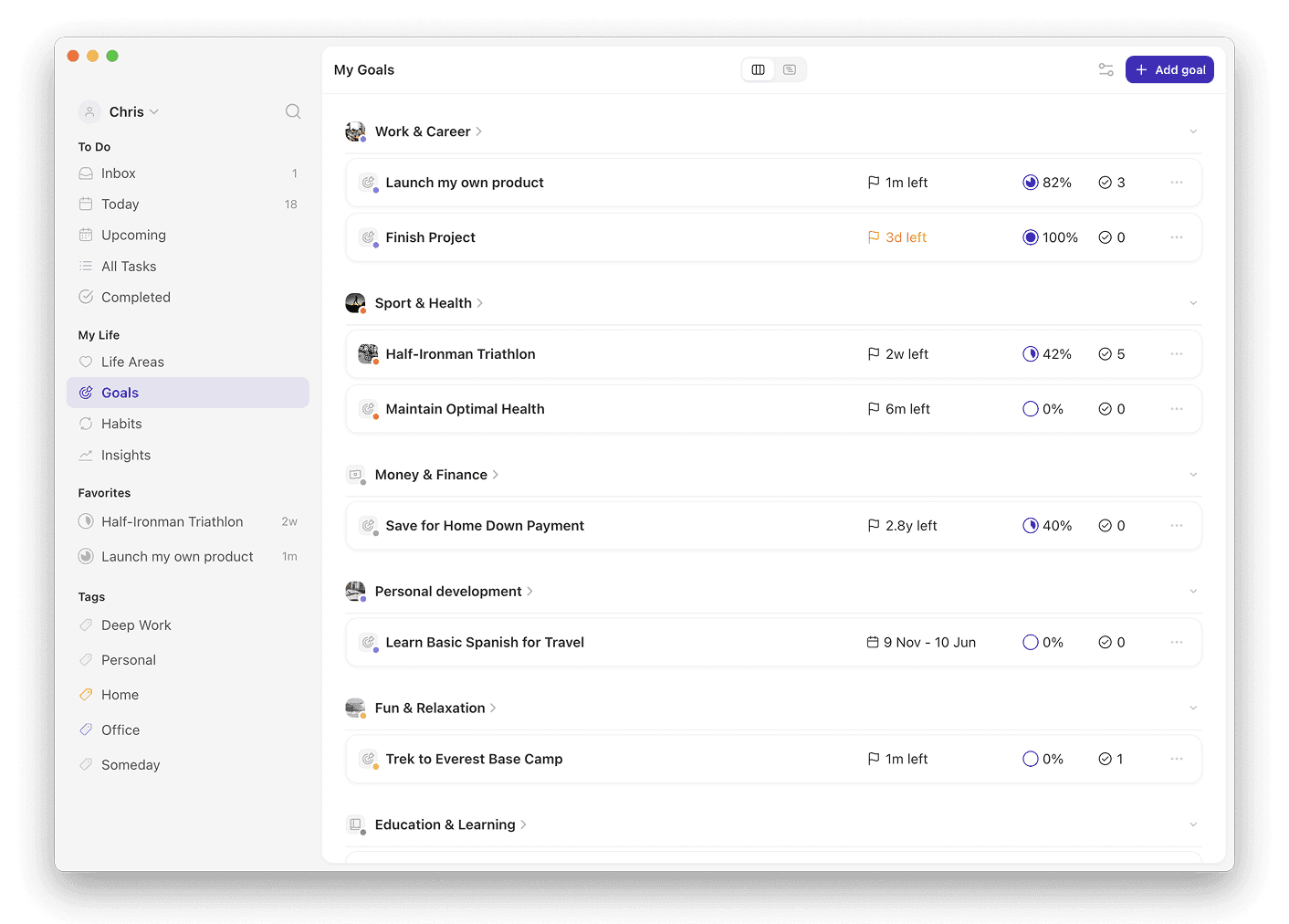
Griply has no built-in pomodoro timer, so you keep running the 25 minutes on whatever timer you already use. The step Griply covers is the one before the timer: deciding the task in front of you is worth those 25 minutes. It is built around a goal with a start value, a target, and a deadline, and the tasks and habits you create sit under it.
That structure means a focus session can be attached to a named goal, so you start the day on work that moves a goal you chose. On desktop, the Today view puts the day's tasks next to a time-blocked calendar column, and you can group those tasks by goal.
You can block time for focused work by dragging a slot on that calendar and reserving it for a goal or a life area. If you run a focus session every day, you can track it as a habit and link that habit to a goal. Griply scores habits by completion rate and has no streak counter.
Frequently asked questions
What is the pomodoro technique?
The pomodoro technique is a time-management method that splits work into 25-minute focus sessions called pomodoros, each followed by a short break. After four pomodoros you take a longer break of 15 to 30 minutes. Francesco Cirillo created it in the late 1980s.
Why is a pomodoro 25 minutes?
Twenty-five minutes is long enough to make real progress and short enough to hold full attention without fading. It also makes starting easier, since almost any task feels manageable for 25 minutes. The length is a default you can adjust to fit the work.
How many pomodoros should you do in a day?
Most people plan somewhere between 8 and 12 pomodoros for a full workday, which is roughly four to six hours of focused work. Start lower than you think, then use your recorded counts to set a realistic daily number over time.
Does the pomodoro technique work for studying?
Yes. Twenty-five-minute intervals match how long you can absorb dense material before focus drops, and the breaks help new information settle. Plan each study session as a set number of pomodoros per topic to keep a big subject manageable.
How do you keep a pomodoro on the right task?
Decide which task earns the session before you start the timer, and pick one that moves a goal you care about. In Griply you attach a focus session to a named goal with a deadline, so the priority is settled before the 25 minutes begin.
Pick the right task, then run the timer
The pomodoro technique is one of the most practical productivity methods you can pick up. The steps are simple, the science behind the 25-minute window is sound, and the interruption rules keep other people from breaking your focus.
None of that decides which task you point the timer at. You make that choice before the timer starts, by picking a task that moves a goal you care about.
Run your pomodoros on whatever timer you like, and keep each session tied to one of your goals, so you can see what those 25 minutes moved forward.
Related Guides
Cirillo, Francesco. "The Pomodoro Technique." Cirillo Consulting / FZCO, 2006. https://www.pomodorotechnique.com/
Rubinstein, Joshua S., Meyer, David E., and Evans, Jeffrey E. "Executive Control of Cognitive Processes in Task Switching." Journal of Experimental Psychology: Human Perception and Performance, 2001. https://www.apa.org/pubs/journals/releases/xhp274763.pdf
Ariga, Atsunori, and Lleras, Alejandro. "Brief and rare mental 'breaks' keep you focused: Deactivation and reactivation of task goals preempt vigilance decrements." Cognition, 2011. https://experts.illinois.edu/en/publications/brief-and-rare-mental-breaks-keep-you-focused-deactivation-and-re/
Mark, Gloria, Gudith, Daniela, and Klocke, Ulrich. "The Cost of Interrupted Work: More Speed and Stress." Proceedings of CHI 2008, 2008. https://ics.uci.edu/~gmark/chi08-mark.pdf