What is the best goal tracking app for students?
Griply is the best goal tracking app for students because it links each semester goal to your daily tasks. Most student apps are task lists or focus timers, so the goal sits in a notes page with nothing connecting it to today. Griply has 4.7 stars and a free plan.
Griply: built-in goal hierarchy connects a semester goal to weekly subgoals and daily tasks; iOS and desktop; free plan (2 goals, 2 habits) or $4.99/month or $29.99/year
Todoist: clean task capture, and a new Goals beta links tasks to a goal, but it tracks them by check-off with no visual progress across a term; iOS, Android, desktop; free plan (5 projects) or Pro from $5/month billed yearly ($7 monthly)
Notion: fully customizable but you build the goal structure yourself, and it only works while you keep maintaining it; iOS, Android, desktop; free for personal use
TickTick: bundles a Pomodoro timer and habit tracker but has no goal hierarchy above tasks; iOS, Android, desktop; free plan or paid ~$36/year
Forest: a focus timer built for single study sessions, with no way to track a goal across a term; iOS and Android; one-time ~$1.99 on iOS
App | Goal layer | Habit layer | Links habits to goals | Free plan |
|---|---|---|---|---|
Griply | Yes | Yes | Yes | Yes |
Todoist | Beta | No | No | Yes |
Notion | No | No | No | Yes |
TickTick | No | Yes | No | Yes |
Forest | No | No | No | Yes |
Why students struggle to track goals
You set a goal at the start of the semester, write it in a notes app or a fresh Notion page, and by week three you cannot find it. The goal was real. The structure underneath it was missing, so nothing carried it from the page into your week. This is the gap every student-tool listicle skips, because most ranked apps measure task completion and stop there.
A goal like "finish the dissertation draft by April" only moves when it breaks into smaller pieces with their own deadlines, and those pieces break into the three things you do today. Todoist, TickTick, and Forest are built for the bottom of that chain. They capture tasks or protect a study session well, and they do that job better than a goal app would. Todoist recently added a Goals beta, but it marks progress by checking off linked tasks rather than showing how far the term goal has actually moved. None of them hold the progress layer between the term goal and today, which is exactly the layer a student needs to see.
Why a goal hierarchy helps students
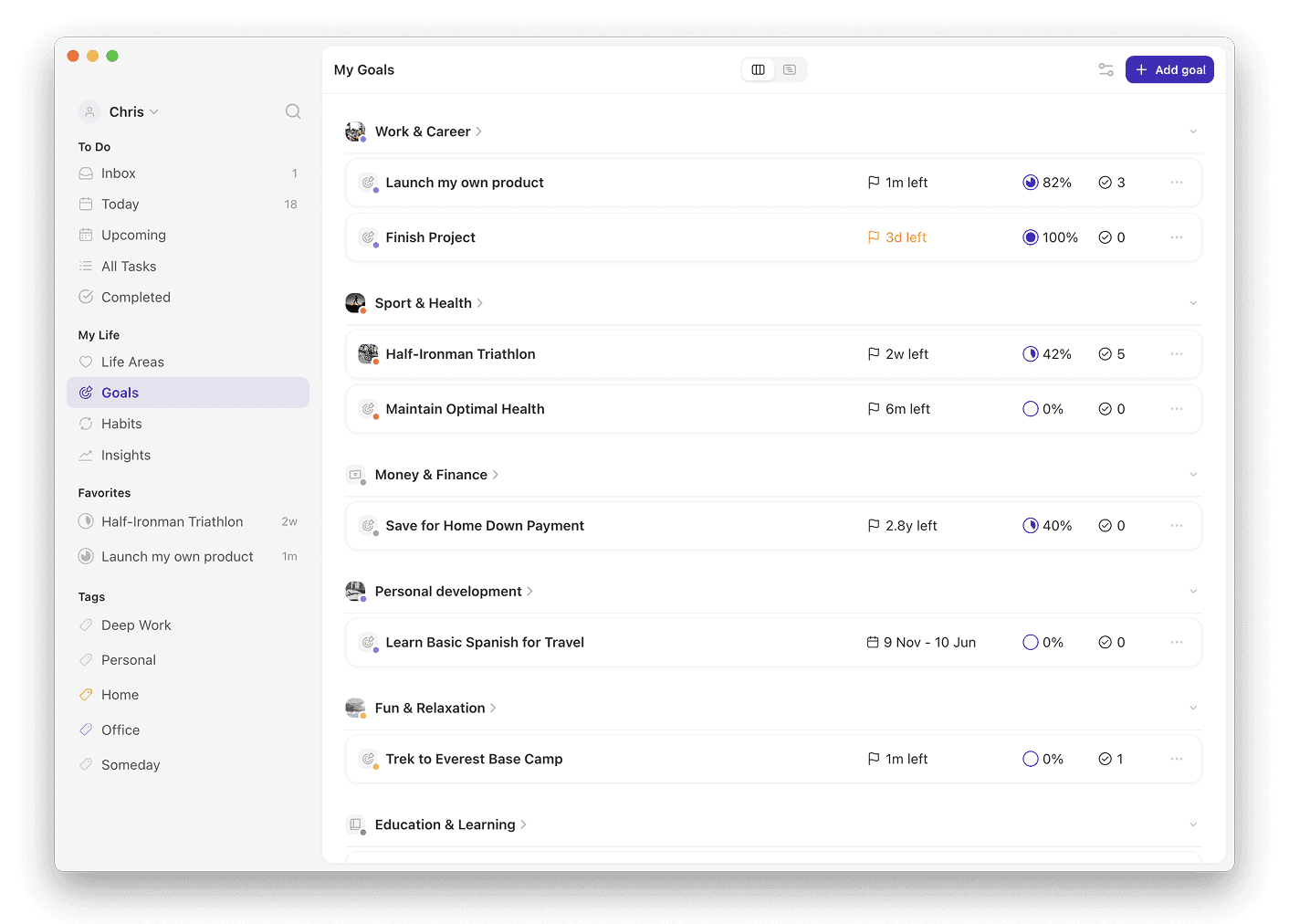
A goal hierarchy keeps the long-term outcome and the daily task in the same structure, so today's work always has a visible reason. Griply uses a fixed order: life area, then goal, then subgoal, then task and habit. Your degree is a life area, your semester result is a goal, each module or milestone is a subgoal, and a study session is a task. The connection is built in, so you do not rebuild it every week the way a blank Notion page demands.
This is what separates progress tracking from completion tracking, and it is the first thing to check when you decide how to choose a goal tracking app. A completion tracker tells you that you ticked ten boxes. A progress tracker tells you that your dissertation goal moved from 40 percent to 55 percent. For a student measured on outcomes rather than activity, the second number is the one that matters.
How Griply maps to the academic cycle
Set up your degree or course as a life area, then add the semester result you want as a goal with a start value, a target value, and a deadline. Break that goal into short-term goals for each module, exam block, or assignment, since a subgoal in Griply is a goal with a parent link and its own metric. Add the tasks and study habits under each subgoal, and they stay connected to the result they serve.
Each morning the Today view shows your tasks on the left and your calendar on the right, with the goal each task belongs to visible beside it. You log progress on a goal by hand, and Griply charts it as a line from your start value to your deadline. A revision habit you repeat every weekday sits under the exam goal it supports, so the streak has a reason beyond the streak. The free plan covers two goals and two habits, which is enough to run one major semester goal end to end before you decide on premium.
Related questions
How does Griply compare to Notion for students?
Notion lets you build any structure you want, including a goal system, but you maintain it manually, and it only works while you keep updating it every week. Griply ships the goal hierarchy already built, so a student gets semester goal to daily task without designing a template first.
Is there a free goal tracking app for students?
Yes. Griply has a free plan covering 2 goals and 2 habits, enough to run one full semester goal with its subgoals and study habits. Premium unlocks unlimited goals and habits at $4.99/month or $29.99/year.
Is Todoist or TickTick better for student goal tracking?
For pure task capture Todoist is cleaner, and TickTick bundles a Pomodoro timer and habit tracker. Todoist added a Goals beta, but it tracks a goal by ticking off linked tasks, so you see boxes checked rather than how far the semester goal has moved. TickTick still has no goal layer above tasks, so a semester goal lives on the same flat list as "buy printer paper" with nothing linking them.
Can I track study habits and goals in the same app?
Yes. In Griply each habit can link to a parent goal, so a daily revision habit sits under the exam goal it serves. You see the habit, the goal it feeds, and your progress chart in one place.
Does Griply work on iPhone and laptop?
Yes. Griply runs on iOS, web, and desktop for Mac and Windows, and the mobile app is full-featured with the same planning tools as desktop. You can plan on your laptop and check off tasks on your phone between classes.