What is a quarterly review?
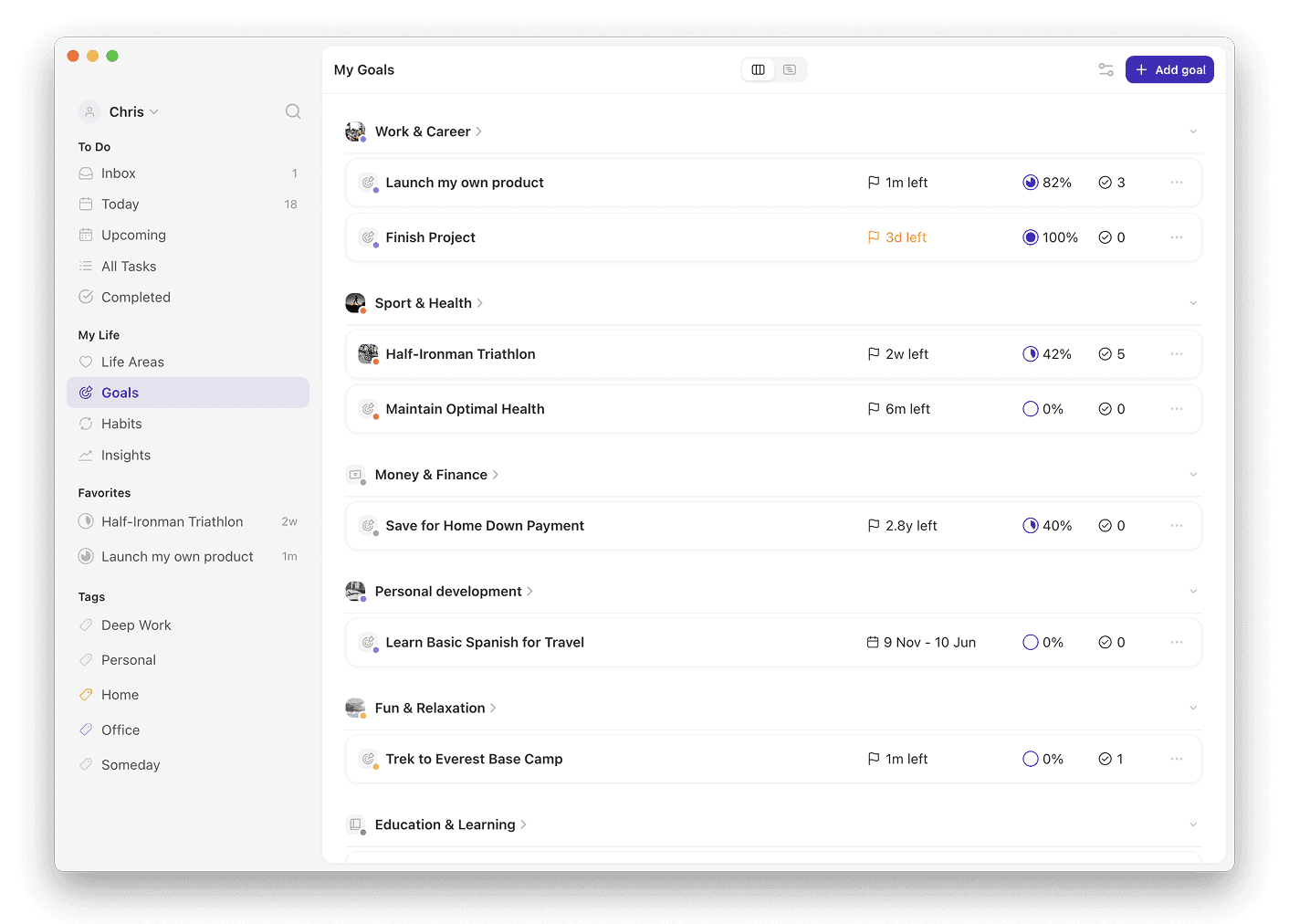
A quarterly review is a structured self-assessment you run every three months to check goal progress and plan ahead. Griply's Goal Progress Tracking and Goal Roadmap make that check concrete: you see exactly where each goal stands against its target, then update your plan before the next quarter starts.
Why a quarterly review works differently from a weekly review
The weekly review is a short operational reset: you clear the inbox and confirm the week ahead. A quarterly review operates one level up. You step back from day-to-day execution and ask whether the goals themselves are still right, whether progress is on track, and whether anything in the plan needs to change.
That distance is what makes the quarterly cadence useful. Over three months, patterns become visible that a single week cannot surface. A goal that looked reasonable in January may have hit a structural block by March. A habit you built in Q1 may have unlocked a goal you hadn't considered. The quarterly review is where you catch that and respond.
Most productivity guides treat the quarterly review as a reflection ritual: write down wins, note what you'd do differently, set intentions. That works as journalling. It changes behaviour only when the review connects to goals that still live in your system.
The frameworks most associated with a quarterly review
Two personal productivity frameworks have made the quarterly review their structural core.
Brian Moran and Michael Lennington's 12 Week Year (2013) collapses the annual planning horizon into 12-week cycles. Each cycle ends with a review that scores goal completion as a percentage and feeds directly into the next cycle's plan. Moran and Lennington's argument is that the annual calendar diffuses urgency: you can fall behind in March and feel fine because December is still nine months away. A 12-week year removes that buffer.
Sahil Bloom's Reflect, Reset, Adjust framework from The Curiosity Chronicle approaches the quarterly review from an energy perspective. He uses an "Energy Calendar" method to identify which activities and relationships energised you versus drained you during the quarter, then restructures the next quarter around the energising ones.
Both frameworks share the same structural requirement: the quarterly review must connect back to a live plan. Observations that stay in a separate document have no effect on what you do next.
How to run a quarterly review in Griply
Open the Insights screen and select the Q (quarterly) period. Griply shows goal progress against each target with a mini line chart, along with habit completion rates for the full quarter. You can step back through past quarters using the period navigation to compare.
For each goal below its target, open the goal detail and check the progress log. You will see exactly when progress stalled. From there you can revise the target or add a subgoal to break down the remaining gap.
The Goal Roadmap view puts all your goals and subgoals on a Gantt timeline so you can see the full quarter at a glance. If a goal's subgoals are bunched at the end of the quarter, that is a sign the plan is optimistic rather than structured.
When the review is done, your goals in Griply reflect the actual plan for the next quarter.
Related questions
How long should a quarterly review take?
Most people complete a quarterly review in 60 to 90 minutes. The goal check takes about 20 minutes if your goals have measurable targets. The planning step for the next quarter takes the rest. Longer reviews are usually a sign that goals were not measured well enough to assess quickly.
How is a quarterly review different from an annual review?
An annual review looks at the full year and sets goals for the next 12 months. A quarterly review checks whether those goals are on track at the 3-month mark and adjusts the plan so problems surface early.
What should you do if you missed a quarterly goal?
Log the actual progress in your goal tracker, then check whether the target was realistic or whether execution was the gap. A missed goal produces useful information only when you can point to the specific week progress stalled. Griply's progress log gives you that entry-by-entry record.
Do you need a separate tool to run a quarterly review?
No. If your goals, habits, and tasks already live in one system, the review is a read-and-update session in that system. A separate doc creates the problem the review is meant to solve: observations that never connect back to the plan.
How does Griply compare to a spreadsheet for quarterly goal reviews?
A spreadsheet lets you log progress manually, but it has no hierarchy connecting goals to tasks and no habit data for the quarter. Griply's Insights screen shows quarterly goal and habit data in one view, and the Goal Roadmap puts your full plan on a timeline.