Guide


Table of Contents
Planning for the future is the practice of defining a specific future state you want to reach, then building the path from that endpoint back to today's calendar. Most people do the opposite: they start with a list of things to do and assume that enough forward motion will eventually produce the life they want. The direction of travel is the difference between the two approaches, and it determines almost everything about whether the plan survives contact with month two.
The insight is structural, not motivational. A task list moves from today outward in a chain of reactions to whatever's urgent. An outcome plan starts from a defined future and works backward through checkpoints to the week you're in.
One of those gives you a reason to be working on a particular thing today; the other gives you an inbox. Generic self-help content treats "planning for the future" as a mindset topic. This guide treats it as an architecture problem.
Key takeaways
Planning for the future works when it starts from a defined outcome and maps backward to today, a method known as backcasting.
Specifying when and where you'll act on a goal roughly doubles follow-through (d = .65 across 94 studies) compared to intention alone.
Specific, difficult goals consistently outperform vague "do your best" intentions across laboratory and field settings.
Griply's Life Area and Vision fields give each future state a named home, and the Subgoal layer on the Goal Roadmap turns the backward path into a set of timed checkpoints you can review weekly.
The direction problem with forward planning
Most planning fails for a structural reason: it starts with tasks. You write down what you want to do, arrange them by deadline or priority, and begin executing. The problem surfaces at the end of the first week, when the completed items on your list have produced activity but not necessarily progress toward anything you actually care about.
Forward planning compounds this problem over time. Each week's list is shaped by whatever was left over from last week, whatever came into your inbox, and whatever felt urgent this morning. Without a defined future state pulling the work, the list becomes self-referential.
The alternative is to treat planning for the future as a directional problem rather than a scheduling one. You start by defining where you want to end up, specifically enough that you could evaluate any task against it, and work backward from there to the first action you can take today.
What outcome planning actually looks like
Backcasting is distinguished from forecasting by the direction of the reasoning. Forecasting extrapolates current trends forward to project a probable future. Backcasting defines a desired future and reasons backward to determine what must change to reach it.
The method was first introduced in 1982 energy policy research, then adapted for personal planning.
Applied to planning for the future in your own life, it means four steps. First, write a future state specific enough to be testable: not "I want financial security" but "I have no consumer debt and six months of expenses saved." Second, identify the gap between that state and where you are now.
Third, work backward to the intermediate checkpoints: what would need to be true six months before the endpoint, three months before, next month. Fourth, pull the first concrete action back to today.
The checkpoints are what separate outcome planning from vision boarding. A vision without checkpoints gives you nothing concrete to review at the monthly check-in. Checkpoints with a review cadence are the mechanism by which a future state actually changes today's behavior.
Why thinking about and planning for the future fails without structure
A 1999 study on mental simulation tested two approaches on college students preparing for a midterm. Students who visualised the outcome (getting a good grade) showed no improvement in study behaviour or results. Students who visualised the process (the specific study steps) studied more and scored higher. The difference was not motivation; it was whether the mental image gave the brain a path to follow or just a prize to want.
The implication for planning your future is specific: a vision of where you want to end up needs a structural companion. The relevant question is not "what does the destination look like?" but "what specifically will I do between here and there, and when will I do it." That sequence of future state, then identified obstacle, then concrete next step is the mechanism by which a vision changes today's behaviour.
Most personal planning frameworks stop at the vision. They give you prompts for writing what you want and advice on breaking it into tasks, but skip the step where you identify what's actually between you and the outcome. Without that step, thinking about and planning for the future stays a reflection exercise rather than a working system.
The checkpoint layer: subgoals as the path back from the future
Research on implementation intentions found that specifying when and where you'll take a goal-directed action roughly doubles follow-through compared to forming the intention alone. The effect held across 94 studies with a standardised mean difference of d = .65, which is a medium-to-large effect in behavioural research terms.
The implication for planning for the future is specific: a goal without a named first action at a named time is weaker than the same goal with an implementation intention attached. The checkpoint layer of an outcome plan is what creates the opportunity to form those intentions. If your path from the future back to today includes a checkpoint for three months out and another for next month, you have natural places to ask: what will I do, and when exactly will I do it.
Checkpoints that are too sparse produce the same problem as no checkpoints: you review once a year, discover the gap, and start over. Checkpoints that are too granular become a project management exercise. A quarterly cadence for major milestones and a monthly cadence for the sub-steps tends to hold up in practice.
How to start planning for the future: a working method
Start with life areas rather than goals. Life areas are the domains that matter to you. Listing them first forces a scope conversation before you start making commitments.
Most people try to plan too many goals across too many areas at once, which is why the plan collapses by March.
For each life area that needs attention, write a future state. The Wheel of Life exercise is a useful diagnostic here: rate your current satisfaction in each area, identify the two or three lowest scores, and write a future state only for those. You do not need to plan every life area in the same cycle. The Wheel of Life: what it is and how to use it covers this in detail.
Once you have a future state per area, work backward to one measurable goal per area for the next 12 months. The evidence is consistent: specific, difficult goals with measurable targets consistently outperform vague intentions across the goal-setting literature. A number is the mechanism by which you know whether you're on track at the monthly review.
Then break each goal into quarterly subgoals. Each subgoal is a checkpoint: what needs to be true at the end of this quarter for the 12-month goal to be on pace. Pull the first action from each subgoal back to this week.
For a deeper walkthrough of writing and executing a vision for each life area, see Vision planner: how to write and execute your personal vision.
What makes planning for the future stick past month two
The plans that survive past month two share two structural features. They have a review cadence built in. And they live in the same system as the tasks they generate.
The second feature is the one that fails most often. If your future states live in a journal, your goals live in a spreadsheet, and your tasks live in a separate task manager, the connection between the three breaks within weeks. The review at month two finds a journal full of intentions and a task list that has quietly stopped referencing any of them.
This is not a discipline problem. A system that requires manual reconciliation between three separate tools will eventually lose to the friction. The solution is a single system where the vision, the goal, the checkpoint, and today's task exist in the same hierarchy, so the connection is structural rather than remembered.
Building that system from scratch is possible. For the theory, how to build a personal productivity system covers the architecture. For a pre-built version, see the Griply section below.
How Griply structures planning for the future
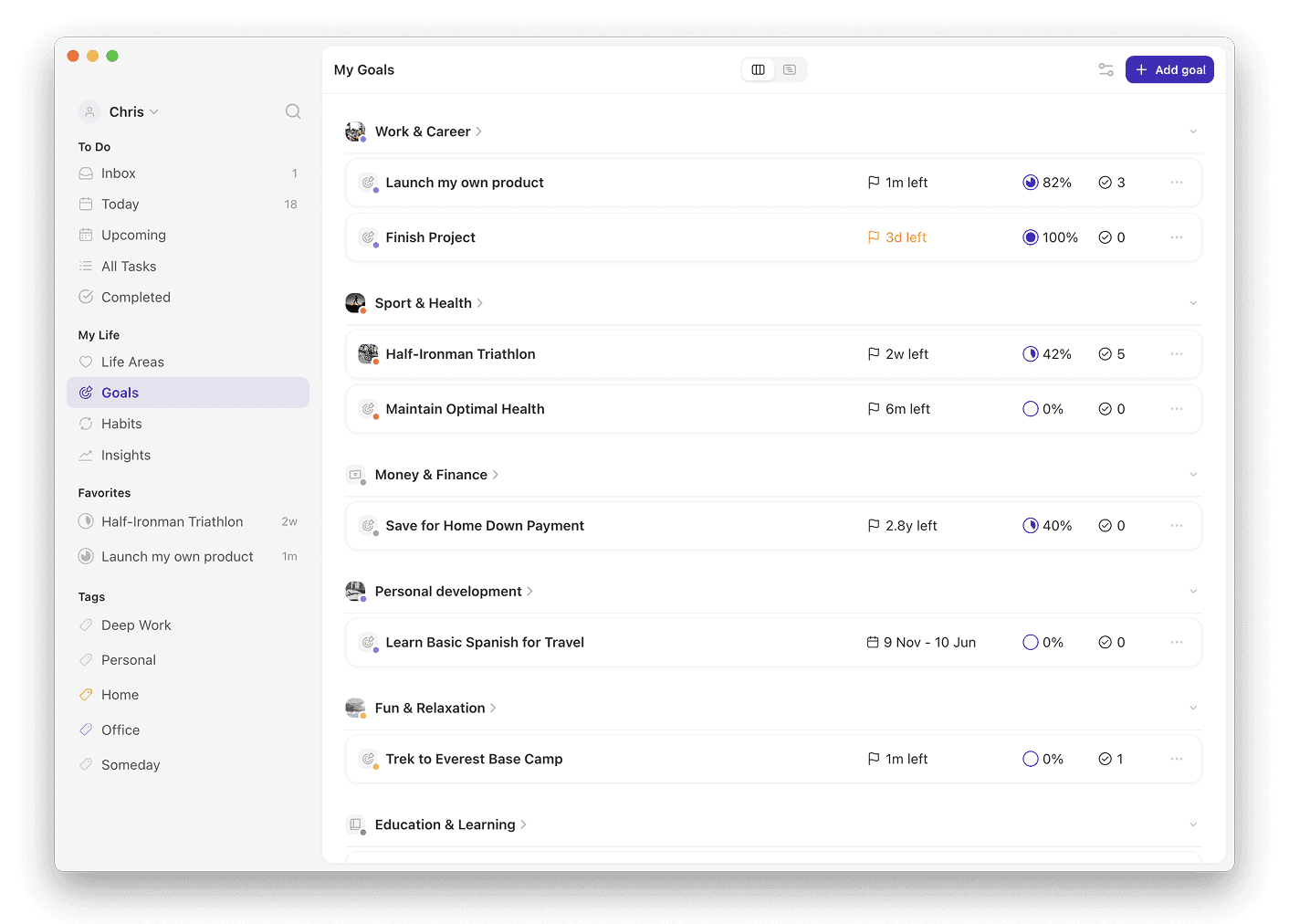
Griply is built around the direction insight: the hierarchy starts from the future and works down to today, not the other way around. The structure is Life Area, then Vision, then Goal, then Subgoal, then Task or Habit.
You start by defining your life areas and writing a vision for each: a description of what that domain looks like when it's going well. That vision is the future state your outcome plan is built around. Under each vision, you add a measurable goal with a start value, target value, and deadline.
Subgoals sit under the goal as timed checkpoints with their own metrics and deadlines, forming the backward path from the 12-month target to next month's action.
The Goal Roadmap lays out goals, subgoals, and projects on a Gantt timeline. The Today view shows your tasks alongside the goal they serve, so the connection from today's work to the future state is visible each morning rather than remembered. You can explore the full structure at Griply's life planner, and see how goal setting and progress tracking work at Griply's goal planner.
Frequently asked questions
What is planning for the future, exactly?
Planning for the future is the practice of defining a specific future state you want to reach and building the path from that endpoint back to your current week. It differs from scheduling or task planning in that it starts from an outcome rather than a list of things to do.
Why does planning for the future feel pointless after a few weeks?
Most plans stop working because the goals live in a separate document from the tasks. When the two are not in the same system, the connection breaks at the first busy week and the plan becomes irrelevant to daily work. The fix is structural: put the vision, goals, checkpoints, and tasks in a single hierarchy.
How far ahead should you plan your future?
Plan your vision at the 1-to-5-year horizon, your goals at 12 months, your checkpoints quarterly, and your tasks weekly. Longer horizons need more flexibility; shorter horizons need more specificity. Planning all four layers in the same sitting produces a plan that is both ambitious and executable.
What is the difference between planning for the future and goal setting?
Goal setting defines a measurable target. Planning for the future is the broader process of deciding which targets matter and building the structure that connects them to daily work. Without that planning layer, goals tend to float in isolation without the checkpoint structure that creates follow-through.
How do you plan for the future when your situation keeps changing?
Write the future state as an outcome, not a method. "I have six months of savings" is more robust than "I contribute 15% of my salary to savings every month" because the outcome stays true even if the method changes. Quarterly checkpoints absorb change better than annual ones because you adjust more frequently and earlier.
The structural claim planning for the future depends on
Forward planning and outcome planning both produce a list of things to do. The difference is what generates the list. In a task plan, the list is shaped by whatever arrived recently; in an outcome plan, by the gap between where you are and a future state you already defined.
The implementation intentions research and the broader goal-setting literature both point to the same structural requirement: the future state must be specific, the path must have checkpoints, and the first action must be named. Without all three, planning for the future stays a reflection exercise.
Related Guides
Gollwitzer, Peter M. "Implementation Intentions: Strong Effects of Simple Plans." American Psychologist, Vol. 54, No. 7, 1999. https://www.prospectivepsych.org/publications/implementation-intentions-strong-effects-simple-plans
Tubbs, M. E. "Goal Setting: A Meta-Analytic Examination of the Empirical Evidence." Journal of Applied Psychology, Vol. 71, No. 3, 1986. https://psycnet.apa.org/doi/10.1037/0021-9010.71.3.474
Robinson, John B. "Energy Backcasting: A Proposed Method of Policy Analysis." Energy Policy, Vol. 10, No. 4, 1982. https://www.osti.gov/etdeweb/biblio/6633353
Dreborg, Karl Henrik. "Essence of Backcasting." Futures, Vol. 28, No. 9, 1996. https://doi.org/10.1016/S0016-3287(96)00044-4
Pham, Lien B. and Taylor, Shelley E. "From Thought to Action: Effects of Process- Versus Outcome-Based Mental Simulations on Performance." Personality and Social Psychology Bulletin, Vol. 25, No. 2, 1999. https://journals.sagepub.com/doi/abs/10.1177/0146167299025002010