Guide


Table of Contents
A planner with habit tracker is a system that combines daily scheduling with a log of recurring actions in one place, so your plans and your habits are visible together. Most people already own one in some form: a paper planner with a habit grid, a calendar app next to a habit app, or a task manager with a habit section bolted on. The problem is that neither side knows whether the habits and plans are working toward anything.
You check off your morning run every day this week and miss every planning session for the project that actually matters. The habit streak says you're consistent; your quarterly goals say you're behind. The two sides of your planner-with-habit-tracker have no shared language.
The fix is a structural connection between every habit and the goal it's supposed to serve. When that link exists, your daily planning surfaces it every morning. When it doesn't, you have a checklist next to a calendar and nothing more.
Key takeaways
A planner with habit tracker works when every habit is anchored to a specific goal, so the streak is evidence of progress toward something measurable.
Forming specific when-where-how plans makes goal-directed actions more immediate and automatic, even when cognitive resources are stretched by competing demands. A planner that pre-links each habit to a goal creates exactly this structure.
Combining self-concordant goals with specific implementation plans significantly predicts goal attainment. Monitoring progress toward a goal you actually care about is what drives results, not tracking completion alone. A habit tracker that shows only completion rate, with no goal progress above it, captures half the data the research says you need.
In Griply, the Today view shows both what to do and which goal each linked action is serving, because you can link a habit to its parent goal at capture.
Why a planner and habit tracker in separate apps both fail you
The most common version of this problem is not obvious. You have a habit tracker app that shows streaks and completion percentages, and a planner or task manager where you schedule your day. Both are well-designed. Both give you data.
The gap is that neither app knows what the other is doing.
Your habit tracker sees that you meditated six times this week. Your planner sees that the project milestone is overdue. There is no view that shows both, and no way to ask whether the habits you are hitting are connected to the outcomes you care about.
This is the same problem that appears when people run their tasks in Todoist and their habits in Habitify. Both apps are on the same phone; the data is not. The habit list and the task list are separate worlds.
See what separates a habit tracker from a task manager for a breakdown of where each tool's job description ends. For a broader look, the habit tracking guide covers the science of how habits form and which frameworks hold up under research.
What goal monitoring research says about the tracker-planner gap
Goal-attainment research has found that goals only drive attainment when two conditions are met: the goal needs to be self-concordant (personally meaningful, not externally imposed) and paired with a specific implementation plan. The more frequently you track progress toward a goal you have genuinely committed to, the more likely you are to reach it. This is consistent with one of the most replicated findings in goal-setting research.
The detail that most habit tracker apps miss: the finding is about monitoring progress toward a goal, not monitoring whether a habit was completed. Marking a habit complete is a proxy for goal progress, but only if the habit was actually designed to move that goal. A morning journaling habit is not a proxy for writing a book, and a gym habit is not a proxy for losing ten kilograms, unless you have made that connection explicit.
When your daily planner shows a list of tasks without goal context, and your habit tracker shows completion rates without a goal above them, you have a monitoring system with no object to monitor.
This also explains why monthly habit trackers outperform daily checklists. A 30-day view shows whether a habit's completion rate is matching the pace required by the goal above it. A single-day view shows only whether today happened.
Why goal-linked habits outlast generic streaks
Research on implementation intentions found that forming specific when-where-how plans makes goal-directed actions more immediate and automatic, even when cognitive resources are stretched by competing demands. An implementation intention is the structure "When I finish my morning coffee, I will write for 30 minutes toward my Q2 launch goal." The habit has a trigger, a goal, and a link between them.
Most habit trackers store the trigger and the action but not the goal. Most planners store the goal and the schedule but not the habit. The implementation intention that the research measures requires all three to be in one place.
The practical implication is that habit stacking onto an existing anchor is only half the equation. The stack gives you the cue. But the habit also needs a destination (a goal it belongs to), or the motivation to maintain it disappears when the novelty of the new stack fades.
See the habits vs goals guide for a direct argument on why a habit without a goal above it is a free-floating behaviour with no finish line.
What to look for in a planner with habit tracker
Most apps marketed as "planners with habit trackers" offer the two features in the same interface without connecting them. The habit section lists habits. The task or calendar section lists plans. The two live in separate tabs.
Four architectural questions separate a real planner-habit-tracker from a feature bundle:
Can every habit be assigned to a specific goal?
Does the daily view show which goals today's habits and tasks are serving?
Does the review screen show goal progress alongside habit completion rate in the same period?
Can you see a yearly habit tracker view that maps against the goal's target timeline?
If the answer to any of these is no, you have two tools in one app rather than one integrated system. The first two questions matter most: goal assignment at capture and goal context in the daily view. Without those, the app cannot produce the monitoring effect the goal-attainment research describes.
How a monthly habit tracker becomes a goal tracking tool
A monthly habit tracker is more than a 30-day grid. When each habit in the grid is linked to a goal, the monthly view becomes a pace check: are you completing this habit often enough to reach the goal by its deadline?
Consider a goal to run a 5k in under 30 minutes by the end of the quarter. The associated habit is running three times a week, and at month end the tracker should answer two questions: did you hit the frequency, and is your pace improving at a rate consistent with the timeline? A tracker that only answers the first question is recording effort, not measuring progress.
A yearly habit tracker extends this logic to the full goal horizon. If the goal has a one-year deadline, the yearly view shows whether the habit's completion rate has held across seasons and schedule changes. The yearly view also makes visible which habits were quietly abandoned in month three, which is often where the progress that matters was expected to happen.
See how to build a productive morning routine connected to goals for a practical guide to designing habits that hold across a full year when they are connected to specific outcomes.
How Griply connects the planner and habit tracker
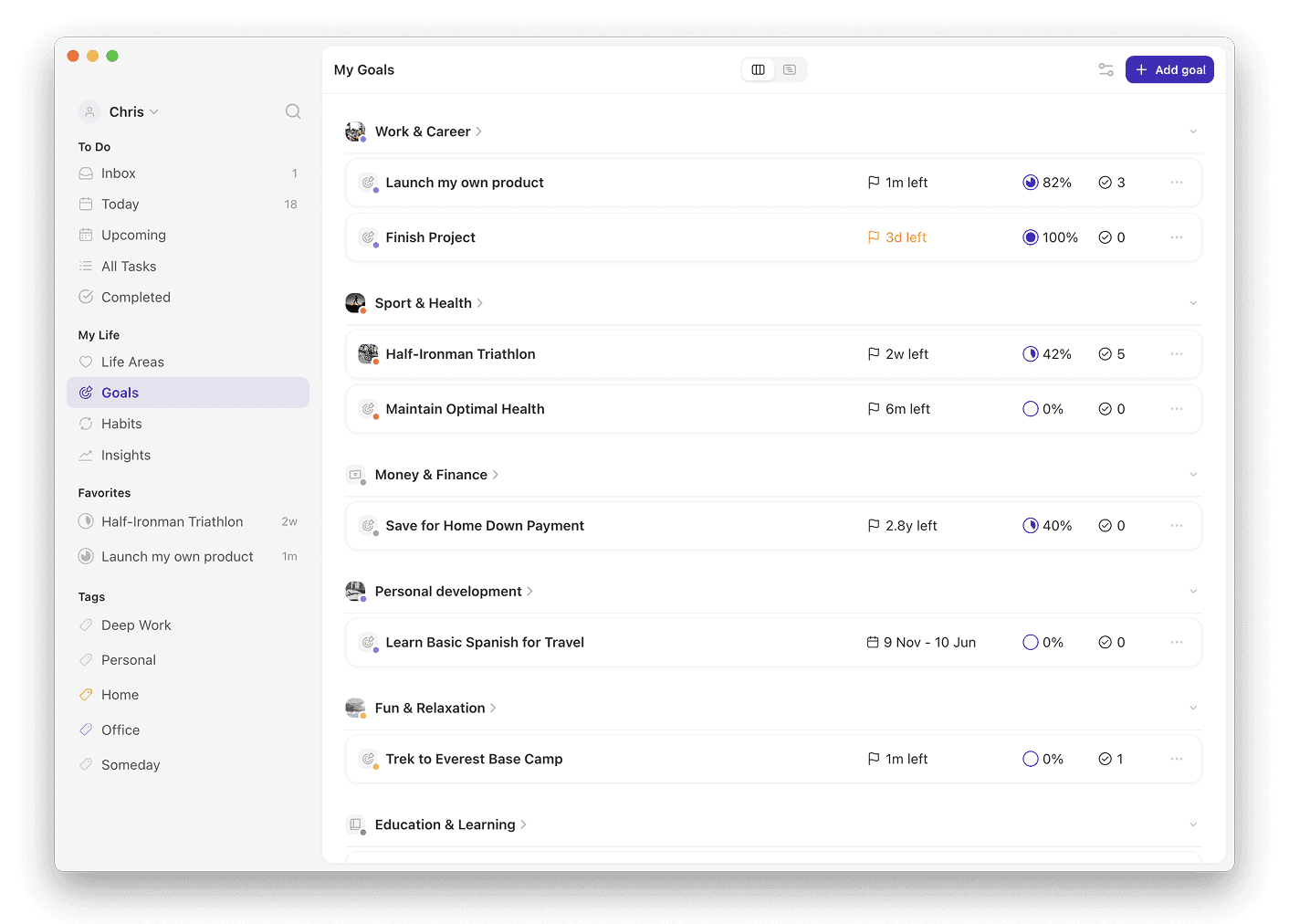
Griply is a goal-first daily planner where every habit and task can belong to a parent goal. The hierarchy runs: Life Area to Vision to Goal to Subgoal to Project to Task and Habit. Griply surfaces the goal connection at the moment you create each habit.
The Today view is where the planner and habit tracker meet: tasks and habits on the left with their parent goal visible, and the calendar on the right. When you open Griply in the morning, you see what is planned for today and which goal each item is serving. This is the implementation intention structure the research describes, with the when, the what, and the why in one view.
The Habits and Goal Planner Insights screen closes the monitoring loop by showing goal progress against target and habit completion rate for the same period. You can review that data from a single month to a full year.
Frequently asked questions
What is the best planner with habit tracker?
The best planner with habit tracker is one where every habit is linked to a specific goal and the daily view shows both. Apps that keep habits and plans in separate tabs give you two tools in one interface, not an integrated system. Griply lets you connect every habit to a parent goal and surfaces that connection each morning in the Today view.
Does a habit tracker count as a planner?
A standalone habit tracker is not a planner. It records whether recurring actions happened but does not connect them to goals, deadlines, or a daily schedule. A planner with habit tracker combines both, but only becomes a planning tool when the habits are anchored to the outcomes they're meant to serve.
How do I use a monthly habit tracker to improve goal progress?
Assign each habit in your monthly tracker to a specific goal with a measurable target. At the end of the month, check two things: whether your completion rate was high enough to hit the goal's pace, and whether the goal's metric actually moved. If the habit rate was strong but the goal metric did not move, the habit was not the right proxy for that goal.
Why do habit streaks fail to predict goal success?
A habit streak measures consistency, not direction. You can maintain a perfect streak on a habit that has no connection to any of your goals and make zero progress toward what matters. Goal success requires both the habit and a measurable goal above it that the habit is designed to serve.
What is the difference between a habit tracker planner and a task manager?
A task manager captures things to do, a habit tracker logs recurring actions, and a planner organises time. A habit tracker planner combines the latter two, but most versions still operate separately from any goal layer. In a goal-first system like Griply, every item traces back to an outcome you have committed to measure.
The link between the habit and the goal is the system
Most people looking for a planner with habit tracker already have one. They have a journal with a habit grid, or a calendar app open next to a habit app, or a task manager with a habit section in the sidebar. The checklist is not the gap.
The gap is that the planner side and the habit tracker side do not share the same goal. When they do, the morning planning session is not a separate ritual from checking your habits. Both are a single question: what goal is today serving?
Related Guides
Koestner, R., Lekes, N., Powers, T. A., & Chicoine, E. "Attaining personal goals: Self-concordance plus implementation intentions equals success." Journal of Personality and Social Psychology, 83(1), 231–244. 2002. https://pubmed.ncbi.nlm.nih.gov/12088128/
Brandstätter, V., Lengfelder, A., & Gollwitzer, P. M. "Implementation intentions and efficient action initiation." Journal of Personality and Social Psychology, 81(5), 946–960. 2001. https://pubmed.ncbi.nlm.nih.gov/11708569/