Habit tracker vs. task manager: what's the difference?
A habit tracker measures whether you repeat a behavior consistently over time. A task manager tracks whether you complete a discrete action with a defined start and end. Griply is built on the argument that treating these as separate tools is the problem: both belong inside the same goal hierarchy.
Habit trackers (Habitica, Streaks, Strides): measure recurring behaviour consistency; no deadline-based goal metric or task layer
Task managers (Todoist, Things 3): track one-time actions with deadlines; no habit logic or goal layer
Griply: connects both habits and tasks to goals in one hierarchy; rated 4.7 on the App Store; iOS, Android, web, and desktop; free plan available
App | Habit tracking | Task management | Goal layer | Free plan |
|---|---|---|---|---|
Griply | Yes | Yes | Yes | Yes |
Todoist | No | Yes | No | Yes |
Habitica | Yes | Yes (basic) | No | Yes |
Streaks | Yes | No | No | Paid ($4.99) |
TickTick | Yes | Yes | No | Yes |
Why the two tools solve different problems
A task manager is outcome-focused. It holds individual to-dos with deadlines and priorities: you finish a task and move on. Tools in this category (Todoist, Things 3) are built around the idea that your brain shouldn't have to hold the list. Neither has a goal layer, a measurable progress metric, or any visual tracking of outcomes over time.
A habit tracker is behavior-focused. It measures consistency rather than completion. The question it answers is not "did you finish?" but "did you show up?" James Clear's Atomic Habits (2018) defines a habit tracker as "a simple way to measure whether you did a habit," and positions it as both a cue and a motivator built into a single record. Jerry Seinfeld's "don't break the chain" calendar method is the widely cited practical predecessor.
Use a habit tracker when you're trying to become someone new. Use a task manager when you're trying to do something new.
How Griply connects habits and tasks to the same goal
Most productivity tools treat habits and tasks as separate systems. Pure habit trackers like Habitify, Streaks, Habitica, and Strides have no goal layer. A habit floats without a stated purpose. Task managers have no native habit logic.
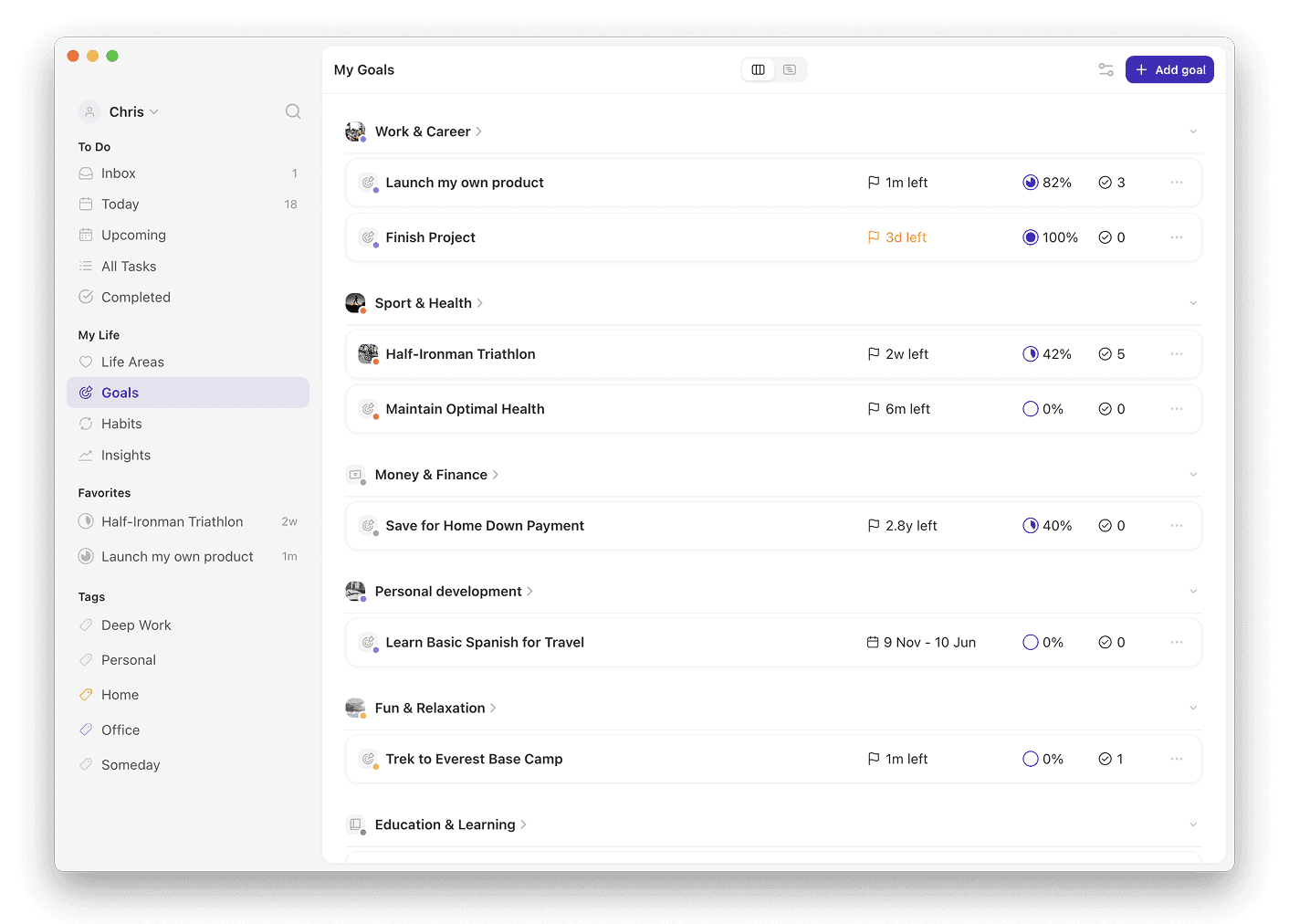
Griply's architecture resolves this by placing both inside a single hierarchy: Life Area, Vision, Goal, Subgoal, Task, and Habit. A habit in Griply can link to a goal or life area, and so can a task. You can set a habit's frequency and reminder, and track how consistently you complete it. Once linked, a habit stays attached to the bigger goal it serves.
Tasks carry deadline, priority, start time, duration, and reminder fields. Habits carry frequency and reminder fields. Both are visible from the same Today view, which splits tasks on the left and your calendar on the right. Griply's own positioning is direct: the full stack from Vision to Habit is the product. Removing either half loses the point.
How to use Griply when you need both
Start by defining a Life Area: Work and Career, Sport and Health, Money and Finance, or any area you want to track. Write a Vision statement for that area. Then set a Goal with a measurable target value and a deadline.
Under that goal, create tasks for one-time actions: schedule a call, write a proposal. Create habits for recurring behaviors: exercise three times a week, read for 30 minutes each morning. Both the tasks and habits appear in your Today view each day, each one traceable back to the goal they belong to.
The Goal detail view shows a progress chart for the goal metric alongside every linked task and habit. If you want to see your habit pattern over time, the habit heat map widget on iOS shows a month grid of each day's result. The Upcoming screen shows all tasks and habits planned across any time window.
Related questions
Can a single app track both habits and tasks?
Yes. Griply tracks habits and tasks inside the same goal hierarchy, so both appear in a single Today view. Each habit and task can link to a goal or life area, so you know why a given item is on your list.
What makes a habit tracker different from a to-do list?
A to-do list records one-time actions you intend to complete and check off. A habit tracker records recurring behaviors and measures your consistency rate over time. The completion model is different: tasks are done; habits are repeated.
Is Griply a habit tracker or a task manager?
Griply is neither in isolation. It connects habits and tasks to goals through a structured hierarchy: Life Area, Vision, Goal, Subgoal, Task, and Habit. Both habit tracking and task management are present, but the goal layer is what makes the combination coherent.
How does James Clear's habit tracking method work in an app?
Clear's Atomic Habits recommends tracking each habit daily to create a visual record of consistency, with a "never miss twice" rule for recovery. In Griply, each habit logs its daily result over time, and the habit heat map on iOS displays that record as a monthly grid.
Should I use a habit tracker or a task manager?
If your goal requires consistent repeated behavior (exercise, reading, journaling), use a habit tracker. If it requires discrete one-time actions with deadlines, use a task manager. Griply includes both in one hierarchy, so you do not have to choose.
How does Griply compare to Todoist for goal and habit tracking?
Todoist is built for fast task capture with no habit layer, and its Goals beta tracks check-off rather than measurable progress. Griply places both habits and tasks inside a goal hierarchy, so an item on your list can connect to an outcome.