Guide


Table of Contents
A monthly habit tracker is a calendar view that records whether you completed a habit on each day of the month, so you can see a full 30-day pattern in one glance instead of a single number. It gives you context a streak counter cannot: which weeks you completed, where you slipped, and whether the month added up to anything. That wider frame is the whole point of monthly tracking.
Most habit trackers stall because nothing connects this month to where you are trying to get. You mark the boxes, but the month has no destination. A monthly view fixes the visibility problem, and linking it to a goal fixes the direction problem.
This guide covers the digital, app-based version of the monthly habit tracker. If you want the hand-drawn paper spread, the analog bullet journal habit tracker guide owns that ground. Here you will learn why a 30-day view beats a streak, and how a month of completions becomes measurable progress on a goal.
Key takeaways
A monthly habit tracker shows every day's status across the whole month, so one missed day reads as a blip rather than a broken streak.
More consistent self-monitoring tracks with better outcomes, which is why a recurring monthly check-in beats a once-and-forget log.
A month of completions only becomes progress when each habit links to a parent goal you can measure.
In Griply, every habit can sit under a goal, so each month's completions are visible against the goal you set them for.
What a monthly habit tracker actually is
A monthly habit tracker is a calendar grid where each cell holds one day's status for a habit: done, skipped, missed, or not scheduled. You read it by the row or by the column. A row shows one habit across the month; a column shows one day across all your habits.
The format answers a question a streak counter never can: what does a normal month look like for you? A streak is a single number that resets to zero the moment you miss. A monthly grid keeps the other 29 days visible, so a single gap stays in proportion.
This is why the calendar view sits at the center of a monthly tracker. You are watching a pattern across weeks, which shows how habits actually behave.
Why a 30-day calendar view beats a streak counter
A streak rewards perfection and punishes one bad day. Miss once and the number drops to zero, which often ends the habit entirely because the score no longer reflects the effort you put in. The calendar view removes that all-or-nothing trap.
The discrepancy-reducing loop behind self-monitoring needs a visible current state to function. A streak counter shows only the count, not that state; a 30-day grid shows it.
Frequency of checking in matters too. More consistent check-ins predict better results. For you, that means a monthly view you actually open keeps the loop running, where a streak you stopped trusting after one miss does not.
What habits to track on a monthly view
A monthly tracker suits habits you measure by accumulation rather than by an unbroken daily chain. Things like "10 workouts this month" or "read 20 days out of 30" read naturally as a monthly count, where forcing them into a streak only sets you up to fail.
Good candidates for monthly tracking include:
Frequency targets like exercising a set number of times per month
Habits with rest days built in, where missing a day is expected
Slower routines you do a few times a week, not daily
Anything you would rather measure as "most days" than "every day"
Keep the list short enough to scan in one screen. For a fuller menu organized by life area, the habit tracker ideas guide has the complete set, so you can pull the few that fit your month and leave the rest.
How a month of completions rolls up to a goal
A monthly tracker on its own tells you what you did. It becomes a progress tool only when each habit sits under a goal you are trying to reach. Without that parent goal, a perfect month of boxes still answers nothing about whether you are getting closer to anything.
Maintaining a behavior over time rests on self-regulation and an ongoing reason to continue, not on the streak itself. A systematic review of maintenance theories found that the motive behind a habit is what sustains it once novelty fades. The goal above your habit is that motive made concrete.
This is the natural bridge from a habit tracker calendar to a goal tracker. When you set a monthly goal and attach the habit to it, the month you log finally has a reason behind it, and you can see your completions next to the goal they serve.
How to make a monthly habit tracker that lasts
Start with the goal, then choose the habit that feeds it, then pick how you will count the month.
A simple monthly setup looks like this:
Name the goal and its target for the month or quarter
Choose one or two habits that move that goal
Decide whether to count daily check-marks or a monthly total
Review the calendar once a week to catch a slipping pattern early
The same logic scales up. A yearly habit tracker is twelve monthly views stacked under a longer goal, and a weekly view zooms into the current seven days. The month is the unit that balances enough history to spot a pattern against a horizon short enough to act on. Habit tracking in general, and how it fits a goal-first system, is covered in the main habit tracking guide.
How Griply connects your monthly tracker to a goal
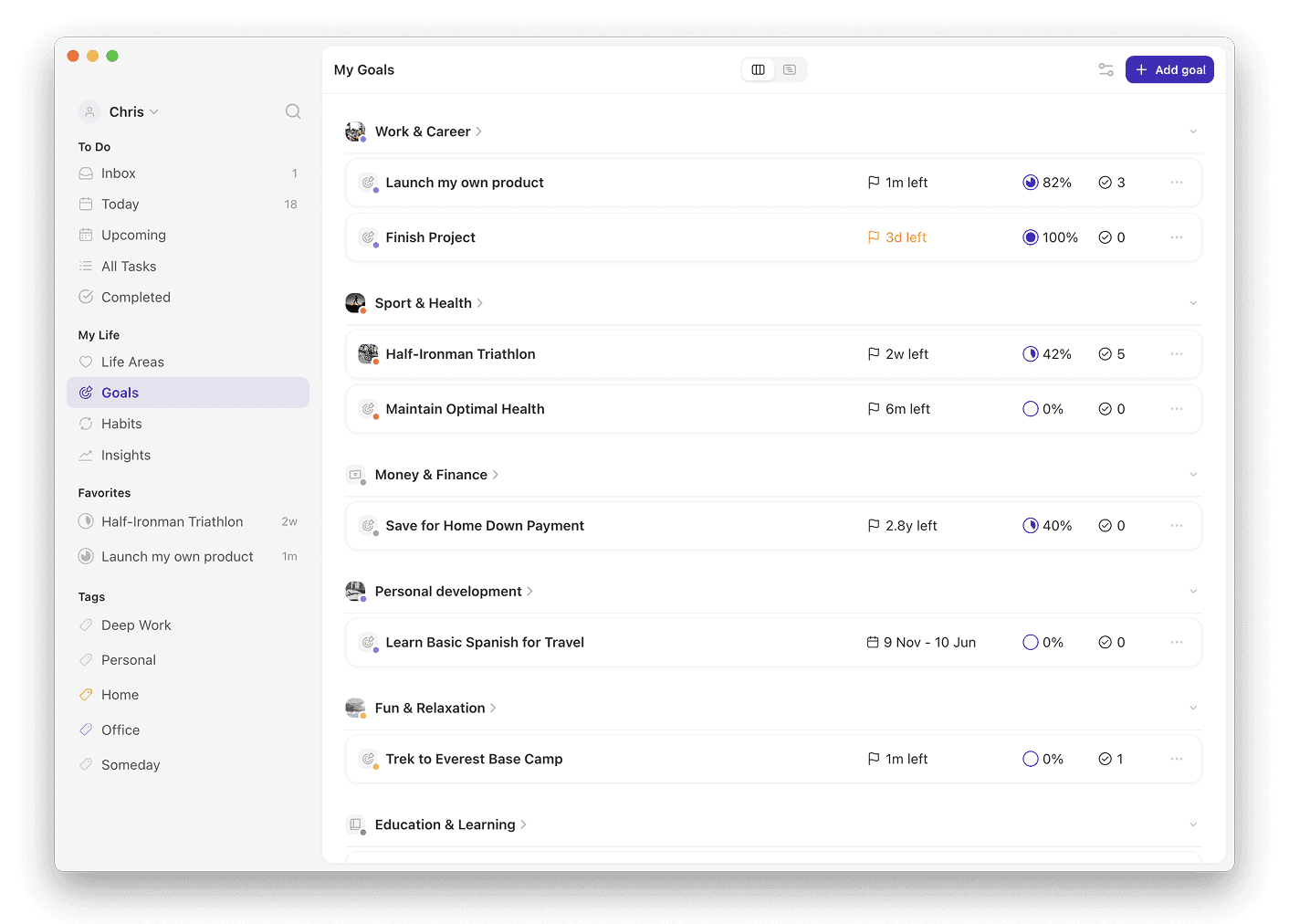
The common failure is tracking without a destination. In Griply, you can link each habit to a goal, so the month you log has somewhere to belong. The hierarchy runs Life Area to Goal to Subgoal to Task or Habit, which keeps each habit traceable to why you are doing it.
For the monthly view itself, the habit tracker shows a calendar of each day's status and monthly stats: completion rate, completions, skips, and perfect weeks for the month. You can schedule a habit "X times per month" as a target count, which suits accumulation habits better than a daily streak. The iOS habit card uses a monthly grid layout so the pattern reads at a glance.
A habit linked to a goal shows up in that goal's task list, so a month of completions stays visible next to the outcome you set it for. The goal planner tracks the goal's own progress line separately, with the premium Insights screen putting your habits and goals on one monthly review screen. Linking the habit gives the month its "why"; you still log the goal's progress yourself, which keeps you deciding what the month actually moved.
Frequently asked questions
What is a monthly habit tracker?
A monthly habit tracker is a calendar grid that records each day's status for a habit across a full month. It lets you see the whole pattern at once instead of a single streak number, so one missed day stays in proportion.
Is a monthly habit tracker better than a streak?
For most habits, yes. A streak resets to zero after one miss and often ends the habit, while a monthly calendar keeps the other days visible and shows your real completion rate. Use a monthly view for anything you measure as "most days" rather than "every single day."
How do I make a monthly habit tracker connect to a goal?
Set the goal first, then attach the habit so the month you track has a reason behind it. In Griply, a linked habit shows up under its goal, so a month of completions stays visible next to the outcome you set them for.
What habits work best for monthly tracking?
Habits you measure by accumulation rather than a daily chain: a set number of workouts per month, reading on most days, or routines with built-in rest days. Frequency targets like "10 times this month" fit a monthly count far better than a daily streak.
Can I track habits monthly for free in Griply?
The free plan includes basic habit tracking with two habits and the Today view. Monthly targets, charts, and the Insights review are premium, so a full monthly tracker with goal roll-up needs the premium plan.
Why the month is the right tracking unit
The reason a monthly habit tracker works is that it matches how habits actually behave. Daily life produces missed days and busy weeks, and a 30-day view shows the pattern without a reset streak dropping you to zero. You see a completion rate.
Pair that honest view with a goal above it, and the month stops being a wall of boxes and becomes progress you can point to. Each completion you log sits under a goal you chose, which is the reason to open the tracker again tomorrow.
Related Guides
Carver, C. S., & Scheier, M. F. "Control theory: A useful conceptual framework for personality-social, clinical, and health psychology." Psychological Bulletin, 1982. https://pubmed.ncbi.nlm.nih.gov/7134324/
Burke, L. E., Wang, J., & Sevick, M. A. "Self-monitoring in weight loss: A systematic review of the literature." Journal of the American Dietetic Association, 2011. https://pmc.ncbi.nlm.nih.gov/articles/PMC3268700/
Steinberg, D. M., Bennett, G. G., Askew, S., & Tate, D. F. "Weighing every day matters: Daily weighing improves weight loss and adoption of weight control behaviors." Journal of the Academy of Nutrition and Dietetics, 2015. https://pmc.ncbi.nlm.nih.gov/articles/PMC4380831/
Kwasnicka, D., Dombrowski, S. U., White, M., & Sniehotta, F. "Theoretical explanations for maintenance of behaviour change: a systematic review of behaviour theories." Health Psychology Review, 2016. https://www.tandfonline.com/doi/full/10.1080/17437199.2016.1151372