What are stretch goals? Definition and how they work
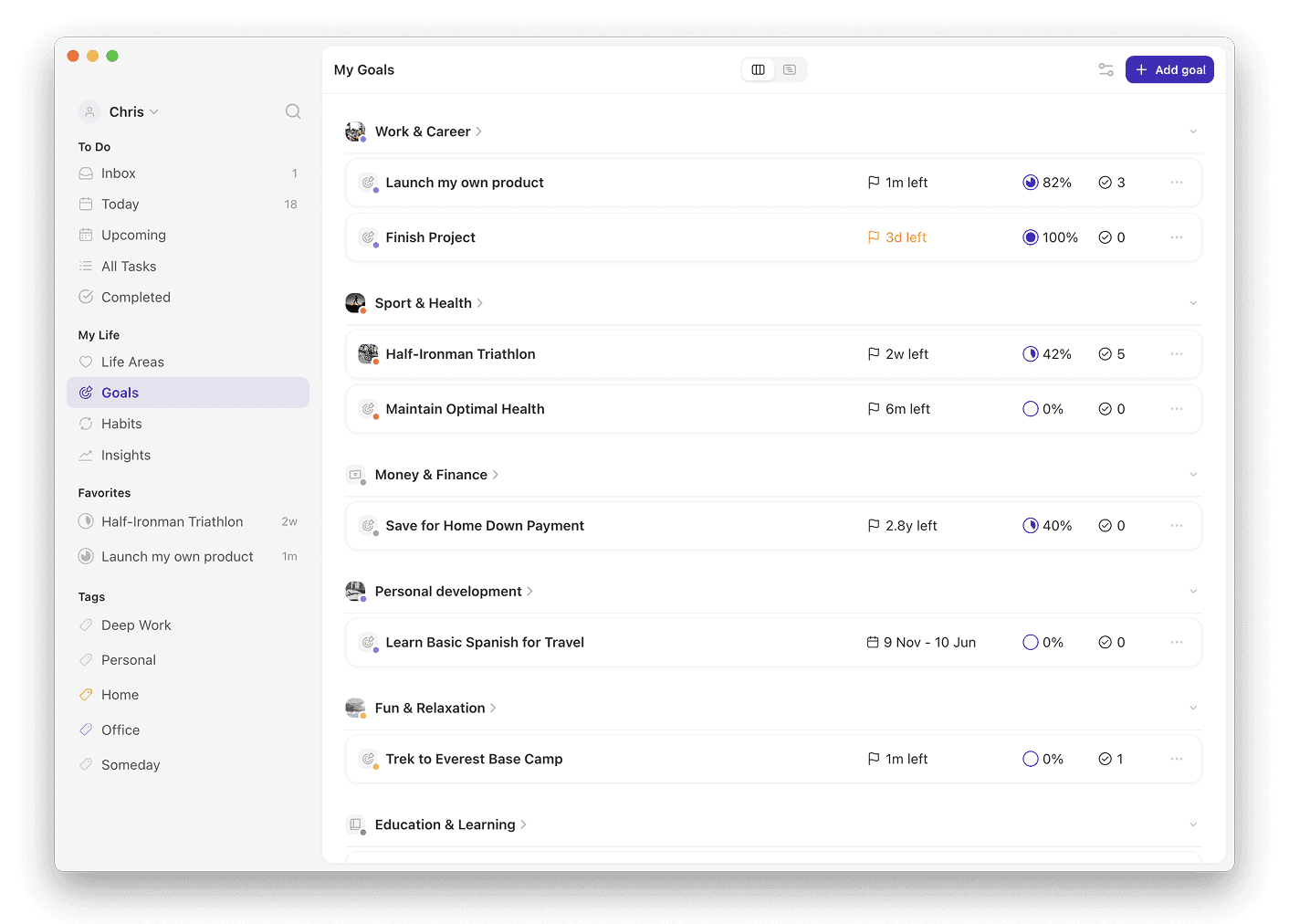
Stretch goals are ambitious targets set beyond your current capacity. They pull your effort higher than a comfortable target would, even when you fall short of the full number. In Griply, you set a stretch goal with a measurable target and break it into quarterly subgoals on a roadmap.
Why stretch goals fail without a structure
Setting a target three times your current output is motivating on day one. By month three, the only thing you can see is how far you are from the finish line, and that gap works against you. Research published in Harvard Business Review by Sim B. Sitkin, C. Chet Miller, and Kelly E. See found that stretch goals are "widely misunderstood and widely misused." They narrow focus, distort how you weigh risk, and erode the intrinsic motivation you started with. That happens because there are no checkpoints in between.
Edwin Locke's foundational goal-setting research showed that ambitious objectives coupled with constructive feedback outperform easier targets roughly 90% of the time. The feedback part is what most people skip. A stretch goal with no intermediate review points gives you no feedback until the deadline, which is too late to adjust course. You do not review the path; you stare at the gap.
The fix is architectural. A stretch goal needs quarterly subgoals that sit between the starting point and the final target. Each subgoal becomes a checkpoint where you ask: am I on pace? What needs to change? That review loop is what keeps ambition intact and anxiety in check.
How Griply structures stretch goals
Griply's goal hierarchy runs from Life Area down to Vision, Goal, Subgoal, and Task. A stretch goal sits at the Goal layer: you give it a start value, a target value, and a deadline. That is the ambition.
The subgoal layer is where the structure comes in. Each subgoal has its own target and deadline, and it links back to the parent goal. A yearly stretch goal of doubling your revenue becomes a Q1 subgoal, a Q2 subgoal, a Q3 subgoal: each has its own metric, its own deadline, and its own progress chart. Griply's Goal Roadmap shows all of them on a timeline at once, so the path from now to the final target is visible at a glance.
Progress is logged manually, which is intentional. The act of logging is part of staying connected to a goal over the months it takes to reach an ambitious target.
How to set a stretch goal in Griply
Start with your life area and Vision field. Write what success in that domain looks like at its most ambitious. That is the destination.
From there, create a Goal under the life area. Set your target value well above your current baseline. The gap is the point. Give it a deadline one to three years out. Then add subgoals, one per quarter, each with a target that represents the progress you need by that checkpoint. Connect tasks and habits to each subgoal so daily work traces back to the stretch target.
Open the Roadmap view on Desktop to see all subgoals on the Gantt timeline. From that view, you are looking at the path from where you are now to where you want to be. At each quarterly review, you check the subgoal, not the final target. That is how you stay on pace without the gap becoming demoralising.
Related questions
What is a stretch goal example?
A stretch goal is a target set well above your current level. If you earn $80k, a stretch income goal is $150k within three years. You break it into quarterly subgoals: $95k by Q4, $115k by year two, $150k by year three. For more examples, see personal goals examples.
What is the difference between a goal and a stretch goal?
A standard goal targets what is achievable with consistent effort. A stretch goal targets what is just beyond your current ceiling. Even partial progress toward a stretch goal typically outpaces what a realistic target would have produced. See how measurable goals drive results for the tracking layer.
What is the difference between stretch goals and SMART goals?
SMART goals are designed to be fully achievable: specific, measurable, achievable, relevant, and time-bound. Stretch goals are designed to exceed what is currently achievable. The two work together: set a stretch goal to define the direction, then write SMART subgoals as the quarterly checkpoints. Learn more in goals vs objectives.
How does Griply compare to Lattice or OKR tools for setting stretch goals?
Lattice and similar OKR platforms are built for company performance reviews and team goal cycles. Griply is built for individual planning: your stretch goal connects to daily tasks and habits in one app, with no IT setup or manager approval cycle required.
Can you set stretch goals on a free plan?
The free plan in Griply includes up to 2 goals. To set a stretch goal with multiple quarterly subgoals and view them on the Goal Roadmap, you need a Premium account. The Roadmap view and unlimited subgoals are both Premium features.