Guide


Table of Contents
A smart goal generator is a step-by-step process that takes a vague intention and converts it into a written goal with a specific outcome, a number to measure it, and a deadline. Most people skip this process entirely, which is why goal-setting research consistently shows that good intentions rarely translate into changed behaviour.
You already know what you want. The gap is between "I want to get fitter" and a written goal precise enough to act on today. Crossing that gap takes six specific questions applied in a fixed order, each one removing a layer of vagueness until what remains is a goal you can track.
This guide works as a free smart goal generator you can run right now, without any tool or app. Each step builds on the previous one. Work through them in order and you will leave with a finished SMART goal, not just a better understanding of one.
Key takeaways
The single most important step is the Measurable filter, because attaching a number to your goal is what makes progress trackable and keeps you honest.
People who write down their goals are 42% more likely to achieve them than those who do not, per a Dominican University of California study.
Writing a goal is only the start. A strong goal also needs to survive a pressure test against your values and current life circumstances.
Griply's Goal Planner maps directly onto the SMART structure with dedicated fields for start value, target value, and deadline.
Step 1: Start with the raw idea (pre-SMART input)
Before you touch any of the five criteria, write your idea in plain language without worrying about precision. "I want to run more." "I want to save money." "I want to read more books." The vaguer the better at this stage: you are capturing the intention, not the goal.
This matters because most SMART goal generators skip the input phase and drop you straight into the S of SMART, which is disorienting. Your raw idea is the raw material you will refine through each step. Keep it in front of you in writing as you work through the rest of this generator.
One rule: write it as something you want, not something you want to avoid. "I want to build a consistent morning routine" is a usable input. "I want to stop wasting mornings" is harder to make specific because it is framed around absence rather than action.
Step 2: Make it specific
Take your raw idea and ask: who does this involve, what exactly needs to happen, and in what context? A specific goal narrows the field from a general direction to a concrete target.
If your raw idea was "I want to run more," a specific version might be: "I want to run three times a week in the mornings before work." You have now named the behaviour, the frequency, and the context. That is enough specificity to move forward, and you can always add more detail later.
A common mistake here is over-specifying too early. You do not need to plan the exact route on day one. Specificity at this stage means removing ambiguity about what success looks like, not writing a training plan.
Step 3: Attach a number: the measurable filter
This step is where most goals either succeed or fail. Without a number, you cannot tell whether you are on track, falling behind, or already there. Specific and challenging goals lead to significantly better performance than vague or easy ones, and measurability is what makes a goal specific in practice.
Ask two questions: what is the number that defines success, and what is my starting number? For a running goal, the target might be three sessions per week and the starting point is whatever you currently average; for a savings goal, the target is the amount and the starting point is your current balance. Writing both numbers down locks in the definition of progress, and the article on how measurable goals drive real results covers the evidence behind why that matters.
The start value matters as much as the target. Without it, you cannot see how far you have come, which is one of the biggest motivational levers available to you. Research on self-efficacy shows that visible progress toward a goal directly increases your confidence in your ability to continue.
Step 4: Test it for achievability
An achievable goal is not a small goal. It is a goal that is genuinely within reach given your current resources, time, and constraints, while still being challenging enough to require real effort. Harder goals consistently produce better results than easy ones, as long as the person genuinely commits to them.
The test here is honest, not modest. If you are currently saving $200 a month and your goal is to save $10,000 in three months, the timeline is the problem: adjust the deadline, not the aspiration. If you have never run before and your goal is to run a half-marathon in four weeks, the goal itself needs scaling before the deadline moves.
Ask yourself: do I have the time, the physical capability, and the resources to do this right now? If the answer to any of those is no, revise the goal before you set it, not after you miss it.
Step 5: Connect it to something that matters (the relevant filter)
A goal is relevant when pursuing it actually moves your life in the direction you want to go. This filter is easy to pass too quickly. "Get fit" sounds relevant because health is universally valued, but ask a more pointed question: is this goal relevant to your specific situation right now?
If your biggest source of stress is financial instability, a fitness goal may be the right thing eventually, but a savings goal might be more relevant to where you actually are. If your career is in a period of rapid growth, a goal that demands 15 extra hours a week of personal time may conflict with what you are already trying to do. Relevance is about fit, not value in the abstract.
This is the step where a goal either connects to your broader vision for your life or sits in isolation. Isolated goals are easier to abandon. For more on what separates a goal worth keeping from one that only sounds good, the characteristics of a good goal article covers this in full.
Step 6: Add a deadline and complete the SMART goal generator
A goal without a deadline is a wish. The deadline creates the decision point that forces prioritisation. Without it, there is always time to start later, and "later" consistently becomes never.
Choose a deadline that creates genuine pressure without being arbitrary. Three months is a useful default for most personal goals because it is long enough to see real progress and short enough to stay motivated. If your goal is larger, break it into a primary goal with a one-year deadline and a subgoal with a three-month deadline: that structure keeps the long arc visible while giving you something immediate to act on.
Write the deadline as a specific date, not a duration. "By June 30, 2026" is a deadline. "In three months" is not, because it moves every time you read it.
Once you have worked through all six steps, you should have a single sentence that contains a specific behaviour or outcome, a number that defines success, a starting point, a connection to something you care about, and a date. Here is an example: "I will save $5,000 by September 30, 2026, starting from my current balance of $800, by transferring $750 per month into a separate savings account." That sentence is fully actionable.
Research at Dominican University of California found that people who share a written goal with a friend and send weekly progress updates achieve significantly more than those who keep the goal private. Writing the goal in this format gives you something concrete to share.
A finished SMART goal needs a home where it can't be ignored
Once you have a finished SMART goal from this generator, the next step is putting it somewhere it cannot be ignored. Griply's Goal Planner is built around exactly the structure you just created.
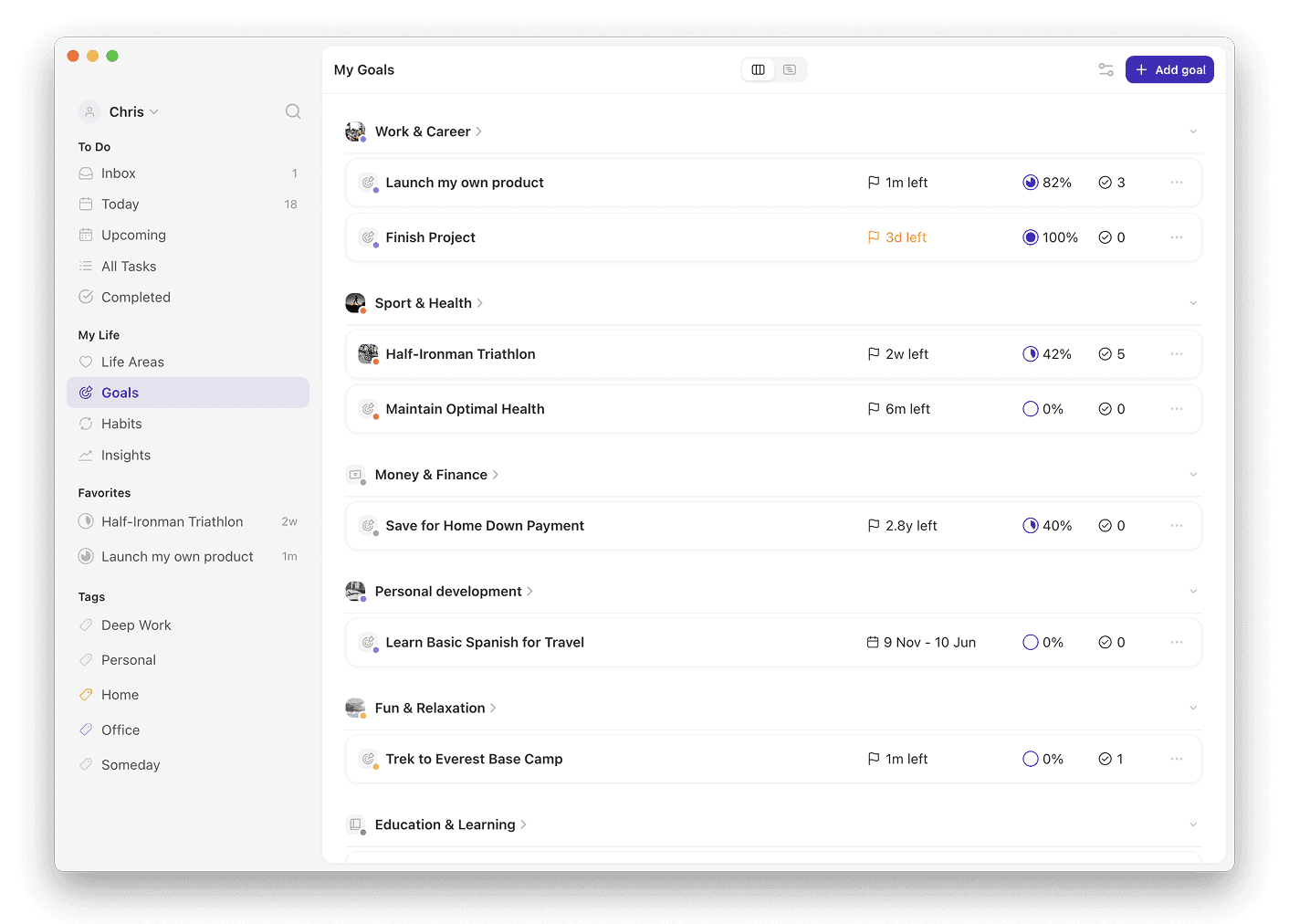
When you create a goal in Griply, you enter the goal name, a start value, a target value, a start date, and a deadline: these fields map directly onto what you built in steps 3 and 6 of this generator. As you log progress over time, Griply displays your trajectory as a line chart in the goal detail view, so you can see whether your pace puts you on track for the deadline you set.
Griply's hierarchy places every goal inside a Life Area and a Vision, where you assign it to an area (Work & Career, Sport & Health, Money & Finance, and so on) and connect it to the Vision statement for that area. This is the relevance check from step 5 made structural: the goal does not sit in isolation, it sits inside the larger picture of what you are working toward. Below the goal, you can create subgoals, projects, tasks, and habits, so the daily work you do is always visibly connected to the goal it is meant to advance.
Frequently asked questions
What is a SMART goal generator?
A SMART goal generator is a structured process that takes a vague intention and converts it into a written goal meeting five criteria: Specific, Measurable, Achievable, Relevant, and Time-bound. You can run the process yourself using a series of questions, or use a tool that walks you through each criterion in order.
How long does it take to generate a SMART goal?
Running a raw idea through all six steps of this generator takes between five and fifteen minutes for most goals. The step that takes longest is usually the Measurable filter, because finding the right number and starting point requires honest reflection on where you currently stand. Goals involving financial or health metrics often take longer than career or habit-based goals.
Do I need an AI tool to generate a SMART goal?
No. The six-step process in this article produces the same output as any AI-powered smart goal generator. An AI tool can help you think about factors you missed, but the core work is identical: answering specific questions about what you want, how you will measure it, whether it is realistic, why it matters, and when.
What is the difference between a goal and a SMART goal?
A goal is any stated intention. A SMART goal has been made specific enough to act on, attached to a measurable number, tested for realism, connected to something you value, and given a firm deadline, so you have already decided what counts as success and when you need to get there.
What should I do after writing a SMART goal?
Put it somewhere it cannot be ignored. Griply's Goal Planner has dedicated fields for start value, target value, and deadline, and shows your progress as a line chart so you can see at a glance whether you are on track. Set a weekly check-in to log your current number and compare it against where you need to be.
Six questions remove the vagueness that keeps goals from starting
A smart goal generator is a set of six questions applied in order, each one removing a layer of vagueness until what remains is a written goal you can act on today. Research puts the advantage of written goals at 42% higher achievement rates, which means the most important thing you can do right now is write the goal down and put it somewhere you will see it.
Related Guides
Locke, Edwin A. and Latham, Gary P. "Building a Practically Useful Theory of Goal Setting and Task Motivation: A 35-Year Odyssey." American Psychologist, 2002. https://pubmed.ncbi.nlm.nih.gov/12237980/
Matthews, Gail. "Goals Research Summary." Dominican University of California, 2007. https://www.dominican.edu/sites/default/files/2020-02/gailmatthews-harvard-goals-researchsummary.pdf
Bandura, Albert. "Self-efficacy: Toward a Unifying Theory of Behavioral Change." Psychological Review, Vol. 84, No. 2, 1977. https://pubmed.ncbi.nlm.nih.gov/847061/