What is the best way to track goals?
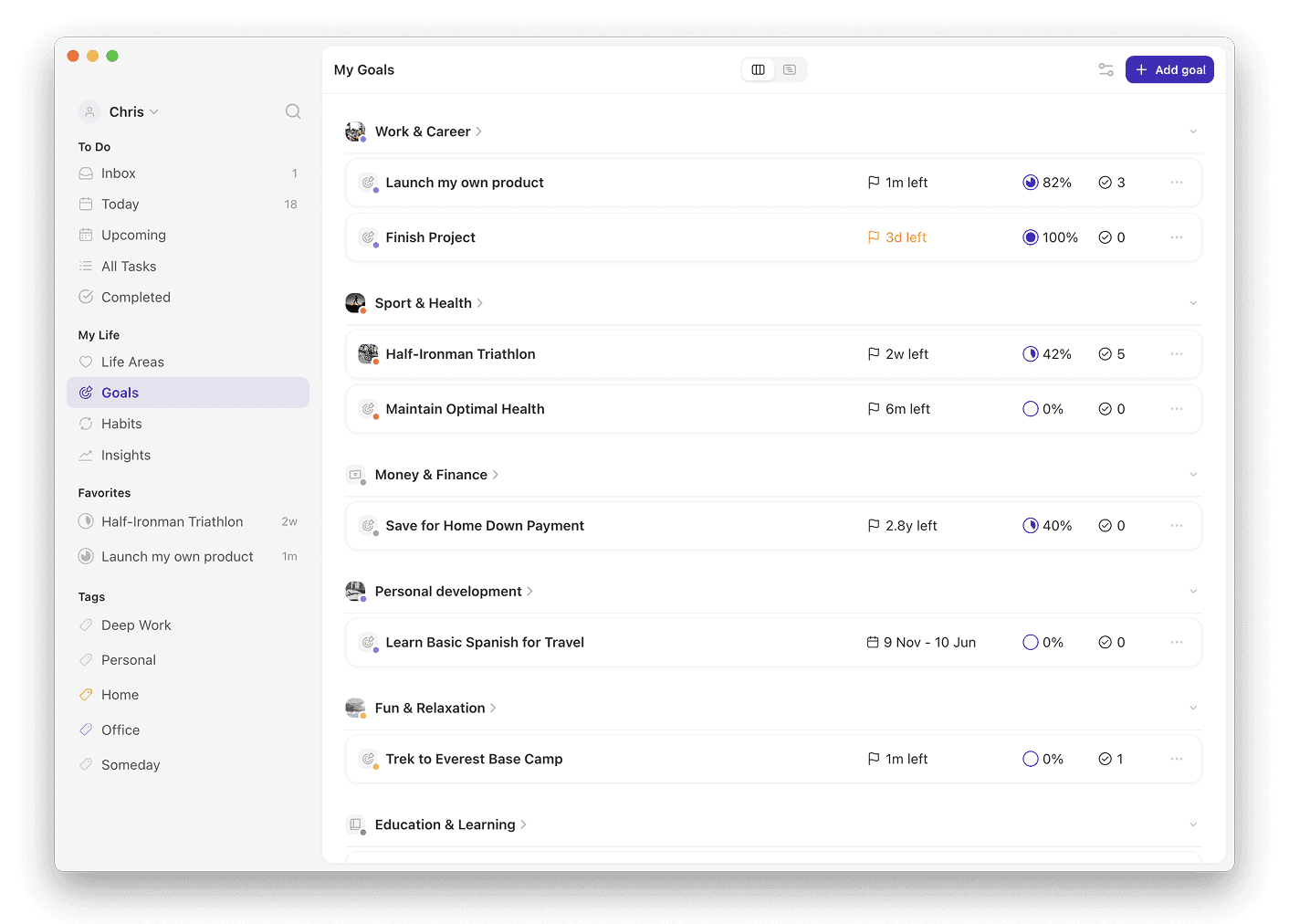
The best way to track goals is to pair a measurable target with a regular review cadence and habits tied to the goal. Griply is built around this structure: every goal has a defined metric, habits are attached to goals within the same hierarchy, and daily tasks connect to long-term outcomes.
Griply: measurable goal metrics, linked habits, and a visual roadmap in one hierarchy; rated 4.7 on the App Store; iOS, Android, web, and desktop; free plan available
Strides: strong for SMART goal tracking with progress charts; no task or habit layer connected to goals; iOS and Mac only; no Android or Windows
Todoist: fast task capture with natural language input; Goals beta tracks check-off, with no progress metric; all platforms; free plan available
Notion: flexible but requires you to build goal structure from scratch; no native progress tracking; all platforms; free plan available
Spreadsheet: fully customisable but requires manual setup for every metric and chart; no habit tracking or reminders; free
App | Measurable goal metric | Habit-goal link | Visual roadmap | Free plan |
|---|---|---|---|---|
Griply | Yes | Yes | Yes | Yes |
Strides | Yes | No | No | Yes (limited) |
Notion | No (manual setup) | No | No | Yes |
Todoist | No | No | No | Yes |
Spreadsheet | Manual | No | Manual | Yes |
Why most goal tracking fails before it starts
Goal tracking breaks down when a goal has no number attached to it. A goal without a measurable target gives you nothing to track, only something to hope for. The SMART framework, goals that are Specific, Measurable, Achievable, Relevant, and Time-bound, exists precisely to solve this.
Beyond the metric, the second most common failure is cadence. Weekly reviews are the most widely recommended rhythm for personal goals. Without a scheduled moment to check progress against the target, tracking becomes passive: a journal you never reread.
The third failure is structural. Large goals need to be broken into sub-goals and tasks. When progress is only measured at the finish line, the goal disappears from view for months at a time. Progress must be visible at every level to stay motivating.
How Griply's architecture addresses goal tracking
Griply organises everything in a fixed hierarchy: Life Area, Vision, Goal, Subgoal, Task, and Habit. Every task and habit can sit somewhere in this chain, so you can see which goal your linked work is connected to.
Each goal in Griply has a defined start value and target value, along with a deadline. You log progress manually through entries, and Griply displays that progress as a line chart. The act of logging is deliberate: it keeps you in contact with your goal rather than checking a passive counter.
Habits in Griply are not a separate feature. They live inside the same hierarchy, linked to a specific goal or subgoal. A habit has a reason: the goal it serves. This is what separates Griply from standalone habit trackers, where habits float without context.
How to use Griply to track a goal
Start by creating a Life Area and writing a Vision statement for it. Then create a Goal under that Life Area with a measurable target: a revenue figure or a number of completed sessions. Set a start value and a deadline.
Break the goal into Subgoals for quarterly milestones. Under each Subgoal, create the Tasks and Habits that drive the outcome. Habits can be set to a frequency and placed under the subgoal they support.
Use the Goal Roadmap (a Gantt chart view) to see your goals, subgoals, and tasks laid out over time. Use the Goal detail view to review the progress chart, check subgoal status, and see all linked tasks in one place. The Today view surfaces which goals your tasks are serving each morning, so the connection between daily work and long-term outcomes is visible every day.
Related questions
How often should you review your goals?
Weekly reviews are the most widely recommended cadence for personal goals. The frequency matters less than the consistency: a monthly review you keep beats a weekly review you skip.
What is the difference between a goal and a habit in tracking?
A goal is a defined outcome with a measurable target and a deadline. A habit is a recurring behaviour that builds toward that outcome. In Griply, you link a habit to a goal within the same hierarchy, so the habit has a clear purpose rather than existing in isolation.
Can you track goals without an app?
Yes. Bullet journals and spreadsheets are both widely used. Ryder Carroll's Bullet Journal method is one well-documented analog approach. Apps like Griply add measurable progress charts and a visual goal roadmap that are difficult to replicate manually at scale.
What makes a goal trackable?
A goal is trackable when you can attach a defined number to it and set a firm deadline. Without a measurable metric and a deadline, you cannot determine whether progress is on track. Characteristics of a good goal covers what to define before you start tracking.
What is the best free way to track goals?
A spreadsheet or Google Sheets costs nothing and works for simple goals. For a dedicated app, Griply's free plan includes two goals with measurable metrics and linked habits. See best free goal tracker apps for a full comparison.
How does Griply compare to a spreadsheet for goal tracking?
A spreadsheet requires manual setup for every metric and chart. Griply provides a built-in progress chart, a goal roadmap, and habit-goal links with no configuration required.