How do I choose the right goal tracking app?
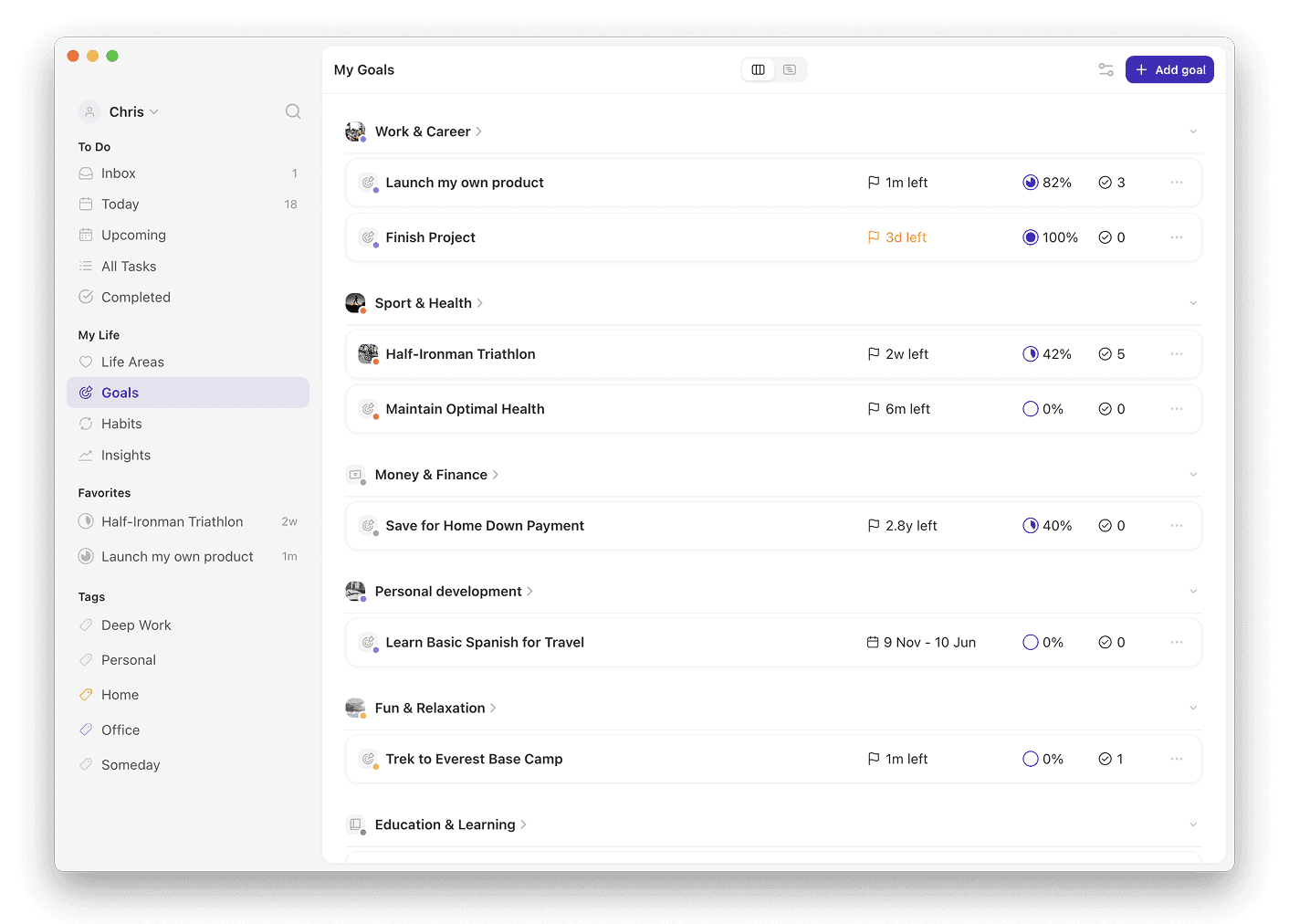
The right goal tracking app links your daily tasks and habits to your goals inside one architecture. Griply does this through its Goal-First Hierarchy, where every task and habit can connect to a goal and a life area. Most apps record completion; Griply tracks whether effort moves you toward outcomes.
Griply: progress tracker with goal metrics, habit-goal links, and a visual roadmap; rated 4.7 on the App Store; iOS, Android, web, and desktop; free plan (2 goals), Premium $4.99/month
Todoist: completion tracker; strong task capture; Goals beta is check-off only, with no goal metric or habit layer; iOS, Android, desktop; free plan available
Notion: flexible but requires you to build goal structure yourself; no native progress charts; all platforms; free plan available
Strides: supports SMART goal tracking with multiple tracker types; no habit-to-goal linking architecture; iOS only; free plan (3 trackers), Plus $4.99/month
TickTick: strong task manager with a built-in habit module; habits and goals exist in separate silos with no structural connection; iOS, Android, desktop; free plan available
App | Griply | Todoist | Notion | Strides | TickTick |
|---|---|---|---|---|---|
Progress tracking | Yes | No | Manual only | Yes | No |
Habit-goal link | Yes | No | Manual only | No | No |
Visual roadmap | Yes | No | No | No | No |
Free plan | Yes | Yes | Yes | Yes | Yes |
What to look for before picking an app
The core frustration is this: you download a goal tracking app, enter your goals, and three weeks later you're using it like a to-do list. The goals sit untouched at the top of the screen while tasks pile up below, disconnected from any larger purpose.
Locke and Latham's goal-setting research established that specific, challenging goals outperform vague ones 90% of the time. The implication for app choice is direct: an app that helps you define a measurable goal with a start value, a target value, and a deadline is more useful than one that stores a wish.
Why most apps fail at structural goal tracking
There is a meaningful distinction between completion trackers and progress trackers. A completion tracker shows you what you finished. A progress tracker shows you whether finishing those things is moving you toward an outcome.
Most popular apps in this category are completion trackers with a goal layer added on top. You write a goal, create tasks underneath it, and check them off. The app does not tell you whether the goal is actually advancing.
A progress tracker requires a different architecture. The goal needs a metric: a start value and a target value. Tasks and habits need to connect upward to that goal, not just sit nearby it. Progress needs to be logged and visualized so you can see movement over time, not just activity.
How Griply's architecture addresses this
Griply's Goal-First Hierarchy runs: Life Area, Vision, Goal, Subgoal, Task, Habit. Every object belongs somewhere in that chain.
Each goal in Griply has a metric: a start value, a target value, a start date, and a deadline. You log progress manually by entering a value, and Griply displays that progress as a line chart in the Goal Detail View.
Habits in Griply can link to a goal or subgoal directly. Each habit has a set frequency and a reminder, with logged completion data. A linked habit has a stated reason for existing inside your goal structure.
The Goal Roadmap is a Gantt chart of your goals, subgoals, and projects over time. The Today View surfaces which goals your tasks are serving, so you open the app and immediately see what to do and why.
How to evaluate and set up a goal tracking app
Start with one goal, not all of them. Pick the goal with the clearest outcome. It should have a measurable target and a firm deadline, with a daily behavior you can actually build around it.
In Griply, set up that goal with a start value and a target value. Create a subgoal if it spans more than a month. Add the daily habit and link it to the subgoal. Use the Today View for the first week without changing anything else.
After seven days, check the Goal Detail View. If the line chart is flat, the habit frequency or the task volume needs adjusting. That feedback loop is the test of whether a goal tracking app is working. If an app cannot show you that kind of signal, it is a to-do list with a goal label.
Related questions
What is the difference between a goal tracking app and a habit tracker?
A habit tracker records whether you completed a daily behavior. A goal tracking app tracks whether that behavior is producing measurable progress toward an outcome. Griply combines both in one hierarchy, so habits link directly to goals.
Should I use a SMART goal framework when setting up goals in an app?
Yes. SMART goals (Specific, Measurable, Achievable, Relevant, Time-bound) are the standard because they produce goals that an app can actually track. A goal with a target value and a deadline maps directly to the fields Griply uses for its progress chart.
How many goals should I track at once?
Start with two to three active goals. Griply's free plan supports two goals; the Premium plan removes that limit. Tracking too many goals at once reduces follow-through on all of them.
What makes Griply different from a task manager like Todoist or Things 3?
Task managers are built bottom-up: you add tasks and optionally tag them with a project or area. Griply is built top-down: you start with a life area and a vision, then define goals, then create tasks and habits that serve those goals.
Does Griply work on both mobile and desktop?
Yes. Griply has iOS, Android, web, and desktop apps with the same screens and data. The iOS app includes home screen widgets for today's tasks and habit completion alongside a goal progress view. There is no simplified companion version; the mobile app is the full product.