Guide


Table of Contents
The wheel of life is a coaching assessment that asks you to score your current satisfaction in eight life areas on a scale of 1 to 10, so you can see at a glance which parts of your life feel balanced and which are being neglected.
Most people who feel unfocused or vaguely dissatisfied are not failing across the board; they are quietly neglecting one or two areas while pouring everything into the others. The wheel of life makes that pattern visible. The problem most guides skip is what comes next: a low score in Finances tells you nothing useful unless it connects to a specific goal you are willing to act on.
How to complete the wheel of life exercise, how to read your results honestly, and how to turn what you find into a plan that holds are all covered below.
Key takeaways
The wheel of life was developed by Paul J. Meyer at Success Motivation Institute in the 1960s and has become a standard opening exercise in life coaching because it surfaces neglected areas before they become crises.
The eight standard categories are Health & Fitness, Career & Work, Finances, Relationships & Family, Personal Growth, Fun & Recreation, Physical Environment, and Spirituality & Purpose.
You should complete the wheel of life whenever a major life transition prompts a re-evaluation, and at minimum once a year during an end of year reflection.
After scoring, each low-scoring area needs a written vision and at least one measurable goal attached to it; otherwise the diagnosis produces no change.
Why the wheel of life has endured as a standard coaching tool since the 1960s
Paul J. Meyer developed the wheel of life in the 1960s through his Success Motivation Institute, founded in 1960. His framework appeared in his book Attitude Is Everything and in the broader SMI personal development programs, which were among the first systematized life coaching curricula.
The wheel spread into mainstream coaching in the 1980s and 1990s when Tony Robbins and others brought it into their seminars. Robbins featured it in Awaken the Giant Within (Simon & Schuster, 1991) as part of a broader framework for taking stock of every domain of life before committing to change. By the time the personal development industry had fully scaled, the wheel of life had become a standard opening exercise in life coaching.
The reason it endures is not novelty. Mihaly Csikszentmihalyi's research on subjective well-being, collected in Flow: The Psychology of Optimal Experience (Harper & Row, 1990), found that people report higher life satisfaction when they experience engagement across multiple domains, not just peak performance in one. The wheel gives that insight a diagnostic structure.
What each of the eight wheel of life categories actually covers
Most versions of the wheel of life use eight segments. The exact labels vary, but the underlying domains are consistent across coaching traditions. The eight used here are the most widely adopted set.
The eight categories and what each covers:
Health & Fitness: sleep, exercise, nutrition, energy levels, and how your body feels day to day
Career & Work: your sense of purpose in what you do, progression, income relative to effort, and whether you are doing work that uses your strengths
Finances: savings, debt, financial security, and whether your current trajectory matches your long-term goals
Relationships & Family: the quality of your close connections, including partnership, friendships, family ties, and how supported and present you feel in those relationships
Personal Growth: reading, learning, therapy, coaching, and any practice of becoming better at thinking or living
Fun & Recreation: rest, play, and activities you do for no reason other than enjoyment
Physical Environment: your home, workspace, and the physical settings of your life, including whether they support or drain you
Spirituality & Purpose: your sense of meaning through religion, meditation, values, and whether how you spend your time connects to something you believe in
How to complete the wheel of life exercise
The wheel of life exercise takes about 20 minutes if you do it honestly. The instructions are simple: for each category, assign a score from 1 to 10 based on your current satisfaction, where 1 means deeply dissatisfied and 10 means fully satisfied. Score based on how you actually feel, not on how you think you should feel.
Use the table below to complete the exercise now.
Category | My score (1–10) | What's going well | What needs work |
|---|---|---|---|
Health & Fitness | |||
Career & Work | |||
Finances | |||
Relationships & Family | |||
Personal Growth | |||
Fun & Recreation | |||
Physical Environment | |||
Spirituality & Purpose |
A circular spider/radar chart graphic showing all 8 segments scored 1–10 would complement this section well. Commission this as a custom illustration or use a free tool like Canva's radar chart template.
Once you have filled in the table, look at your scores as a set. The insight is not in any single number; it is in the pattern: which areas are you consistently neglecting, and which are you overinvesting in while the others slip? A score of 4 in Fun & Recreation alongside a 9 in Career & Work is not two separate data points; it is a trade-off you are currently making, whether you chose it consciously or not.
One useful follow-up is to ask, for each area you scored below 5: if this area were at a 7 instead, what would be different about your life? That question moves you from diagnosis to direction, and direction is what makes the exercise actionable.
The most common mistake after scoring is explaining away the low numbers before doing anything with them
The most common mistake after completing the wheel of life is to explain away the low scores before doing anything with them. You score Finances a 3, then immediately tell yourself it is fine because you are young, or the economy is difficult, or it will improve once you get the promotion. The explanation may be true, but it is also postponing the question.
People cycle through stages of readiness before actually changing a behaviour. The wheel of life does not create readiness; it reveals where you currently stand. A score of 3 in an area is not a failure: it is information about your current readiness to act there.
When you look at your completed table, notice the areas where you wrote specific, concrete observations in the "What needs work" column, and the areas where you wrote vague, hedging phrases. The specificity of your language is a reasonable proxy for your actual readiness to change. Where you can name the problem precisely you are closer to acting; where the words are still fuzzy, you probably have more thinking to do before setting a goal.
Annual is the right cadence: more frequent scoring produces noise, not signal
The wheel of life works best at moments of transition or as a recurring annual practice. Using it every few months produces diminishing returns, because your satisfaction levels across most areas will not shift dramatically in 90 days, and repeated scoring can create a false sense of activity in place of actual change.
The natural moment to revisit your wheel scores is your end of year reflection. An annual review is the right cadence: long enough for real shifts to have occurred, short enough that any chronic neglect surfaces before it becomes a crisis. Completing the wheel at the start of your year-end review gives the review structure: each area you assess in depth corresponds to a wheel segment you already scored.
Outside the annual review, complete the wheel whenever your life changes significantly: a job change, a move, the end of a relationship, the arrival of a child, or any other transition that reshuffles your priorities. These moments tend to change satisfaction scores across multiple areas simultaneously, and the wheel makes that redistribution visible.
The wheel shows you where the gaps are, but it does not close them
This is the part most articles skip. The wheel of life shows you where the gaps are. It does not close them.
The step after scoring is to choose one or two low-scoring areas to focus on, not all of them at once. Simultaneous attempts at behaviour change across multiple domains fail at dramatically higher rates than sequential focus. For the wheel of life, this means resisting the urge to set goals across all eight segments at once; pick the one or two that matter most right now and go deep there first.
Pick the area where the gap between your current score and a desirable score matters most to you right now. Then ask: what would a score of 7 look like in practice? That answer becomes your vision for that area.
Once you have a vision, you need at least one measurable goal beneath it. A goal without a metric is an intention that expires: "Improve my finances" is not a goal, but "Save $500 per month from April through December 2026" is. When a low score connects to a specific, time-bound target, the wheel has done its job.
If multiple areas surfaced blind spots (situations where you were surprised by how low you scored), structured reflection questions can help you go deeper before jumping to goal-setting. Sometimes a low score reflects a values question, not a capacity question, and naming that distinction first saves you from setting goals in the wrong direction.
How Griply turns a low wheel score into an active plan
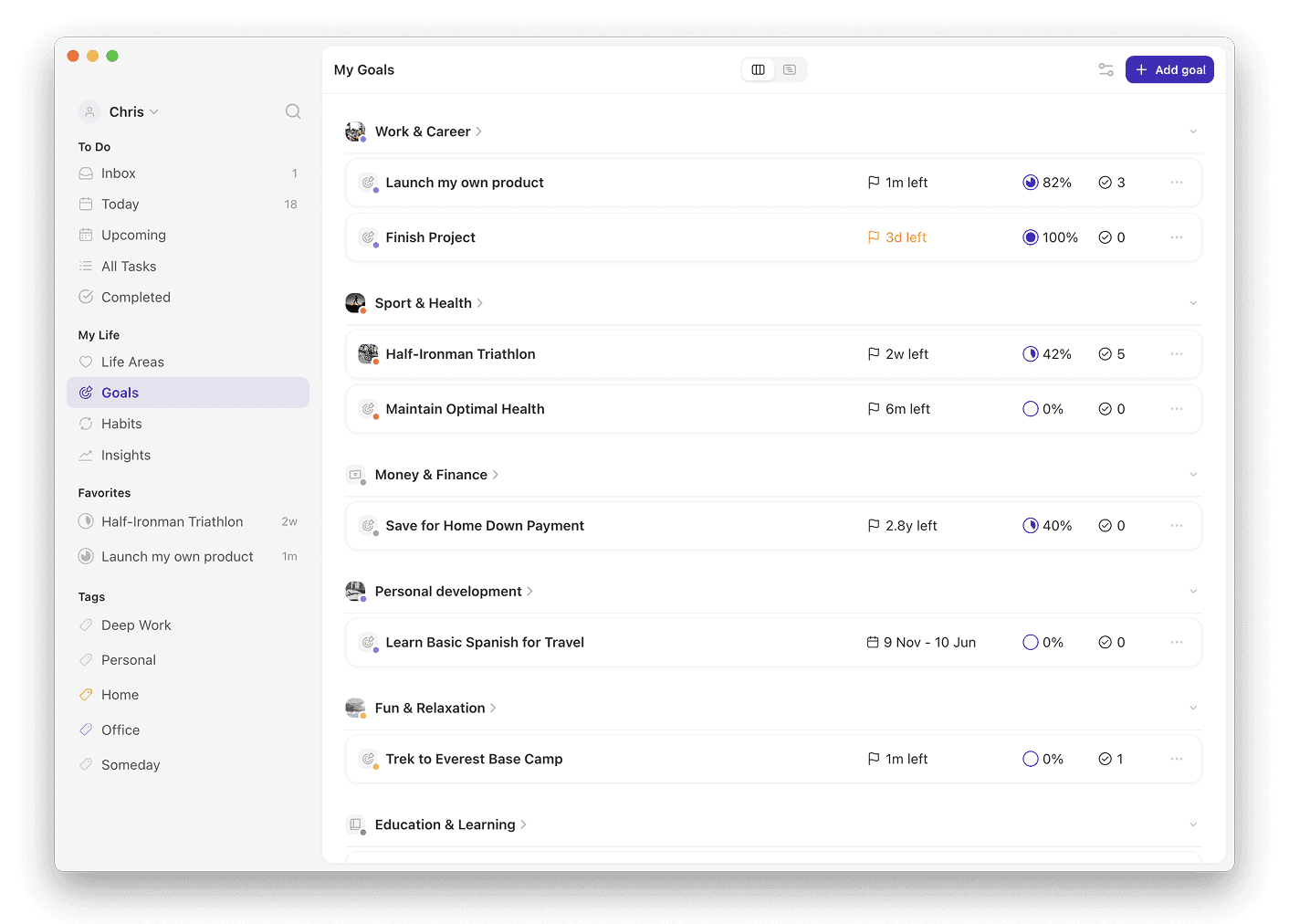
Griply does not have a wheel of life feature. What it has is a structure that answers the specific problem the wheel surfaces: you have identified which areas need work, and now you need somewhere to put that.
Each segment of the wheel maps directly onto a Life Area in Griply. You create a Life Area for each segment (Health & Fitness, Career & Work, Finances, and so on) and write a Vision statement under each one. A vision is not a goal; it is the direction the goals serve. A wheel score of 4 in Finances without a written direction produces guilt, not change.
Under each Vision, you set Goals with a start value, a target value, and a deadline. Progress is logged manually and shown as a line chart, so the gap between where you are and where you want to be is concrete, not assumed. That visibility is what makes a low score feel like a commitment rather than a vague problem.
Goals break into Subgoals, then Tasks and Habits. The Life Area Detail View shows your vision, active goals, and tasks for one area in a single screen, so the 4 you scored becomes a plan you can open on any given morning. The Goal Roadmap (Gantt view) shows your multi-month strategy across all life areas at once, which is useful when the wheel reveals that your effort is not distributed in proportion to where the work actually needs to go.
Frequently asked questions
What is the wheel of life?
The wheel of life is a coaching assessment that scores your satisfaction across eight life areas on a scale of 1 to 10, plotted on a circular diagram so you can see which areas are balanced and which are neglected. Paul J. Meyer developed it at Success Motivation Institute in the 1960s.
What are the standard wheel of life categories?
The eight standard categories are Health & Fitness, Career & Work, Finances, Relationships & Family, Personal Growth, Fun & Recreation, Physical Environment, and Spirituality & Purpose. These domains appear in most coaching and personal development versions of the wheel, though individual coaches sometimes relabel or split them depending on the context.
How often should you do a wheel of life assessment?
Once a year, ideally as part of an annual review, is the right cadence. More frequent scoring produces noise rather than signal because satisfaction levels change slowly. The exception is a significant life transition (a new job, a move, or a major relationship change) which can warrant an unscheduled re-assessment.
How do you use the wheel of life to set goals?
Choose one or two areas that scored lowest and matter most right now. Write a short vision for each: what that area would look like at an 8 or 9. Then set at least one measurable goal under each vision, with a specific target and deadline, so the gap becomes a commitment.
What do you do after completing a wheel of life?
Choose one or two low-scoring areas, write a vision for each, and attach at least one measurable, time-bound goal. If a low score reflects confusion about what you want rather than a clear gap, work through structured reflection questions first. The wheel only creates lasting change when the diagnosis connects to a concrete next step.
A score shows where the gaps are: the work starts when you write down where you want to go
The wheel of life is a simple diagnostic tool that does one thing well: it shows you where you are overinvested and where you are quietly neglecting something that matters. The scores themselves are not the output. The output is a set of priorities you did not have before you sat down with the exercise.
Each priority needs a vision, each vision needs a goal, and each goal needs a daily action connected to it. That chain is what turns a 20-minute exercise into a plan with staying power.
Related Guides
Meyer, Paul J. Attitude Is Everything. Paul J. Meyer Communications, 1994. https://www.pauljmeyer.com
Meyer, Paul J. Success Motivation Institute. Founded 1960. https://www.pauljmeyer.com
Robbins, Anthony. Awaken the Giant Within. Simon & Schuster, 1991. https://www.simonandschuster.com/books/Awaken-the-Giant-Within/Tony-Robbins/9780671791544
Prochaska, James O., John C. Norcross, and Carlo C. DiClemente. Changing for Good. William Morrow, 1994. https://www.harpercollins.com/products/changing-for-good-james-o-prochaskajohn-c-norcrosscarlo-c-diclemente
Csikszentmihalyi, Mihaly. Flow: The Psychology of Optimal Experience. Harper & Row, 1990. https://www.harpercollins.com/products/flow-mihaly-csikszentmihalyi