Guide


Table of Contents
Reflection questions are structured prompts that help you examine your experiences and patterns with more clarity than free-form journaling tends to produce. The moment that sends most people searching for them arrives without warning: you realize you've been busy for months without knowing whether any of it matters.
A career change or a significant birthday creates the same pull. Each one marks a natural boundary where you feel compelled to take stock but don't know where to begin. Structured questions give you the entry point that a blank page can't.
Reflection questions for three different situations are covered below: stuck moments, life-area reviews, and major transitions. Each set works as a standalone session or as part of a longer review. The step most people skip is also covered: what to do with the answers once you have them, since raw insight without a follow-through plan tends to fade.
Key takeaways
Reflection questions work because they force specificity: a structured prompt produces a concrete answer where open-ended thinking produces vague impressions.
Only 10–15% of people are genuinely self-aware despite 95% believing they are; structured prompts supply the process that closes that gap.
Stuck points, where effort is high but progress feels unclear, are often more important moments for reflection than obvious transitions, because they surface the real constraint you have been avoiding naming.
Questions organized by life area surface blind spots that a single "how are things going?" misses entirely.
Why open-ended reflection tends to circle the same three topics
The problem with open-ended reflection is that your brain defaults to what's recent and salient: last week's frustrations, last month's wins. Structured questions force you to examine periods and domains you'd otherwise skip. They're the difference between a conversation that goes somewhere and one that circles the same three topics.
95% of people believe they're self-aware, but only 10–15% actually are, and the central problem is a process gap. Structured questions supply the process that open-ended reflection tends to skip.
Workers who spent 15 minutes at the end of their workday writing about what they'd learned performed 23% better on subsequent tasks than those who didn't reflect. The benefit came not from the time spent but from the act of converting raw experience into explicit thought.
Transitions and stuck points are the two moments worth sitting down with these questions
Reflection questions are most useful at two types of moments: transitions and stuck points.
Transitions are the obvious entry points. Year-end is the most common because the calendar creates a natural boundary that makes the past feel reviewable. Birthdays and career changes work the same way, as does any moment where one chapter is clearly ending.
Stuck points are less obvious but often more important: they appear when you're working hard but can't tell whether it's on the right things, or when you've avoided a decision for months. Reflection questions won't make the decision for you, but they'll usually surface why you've been avoiding it.
When you're stuck, diagnostic questions work better than motivational ones
When you're stuck, diagnostic questions work better than motivational ones. You're trying to understand what's actually happening, and the right question gives you a direct line to the real constraint.
Work through these questions in writing, not just in your head. Writing slows you down enough to catch the answer your internal editor would otherwise discard.
What was I trying to achieve three months ago? How far did I get?
Which part of my work or life do I dread most right now?
What have I been saying "I'll do that later" about for more than two months?
Where am I putting in high effort but seeing low results?
What would I do differently if I started today with everything I now know?
Which of my current commitments would I take on again if offered them fresh?
What does a version of my life that feels right look like, in concrete terms?
What am I tolerating that I could stop tolerating?
What decision would remove the most friction from my day-to-day?
Who around me is doing something I want to be doing, and what's the actual gap?
Breaking reflection into life areas forces attention on domains that go unexamined until they become problems
A single "how are things going?" can't cover the full width of a life. Breaking reflection into life areas forces genuine attention on domains that tend to go unexamined until they become problems. The approach is central to life planning and to the holistic productivity framework: you review the whole before committing to changes in any part.
Work through each area below and aim to surface one clear insight, not a comprehensive review.
Career and work: are you moving toward what you actually want professionally
What did I accomplish that I'm actually proud of?
Which project or responsibility took up more time than it deserved?
Where do I want to be professionally in two years, and am I moving toward it?
What's the most honest description of how I actually spend my working hours?
What piece of feedback have I been sitting on without acting on it?
Health and energy: what is quietly costing you the most right now
When did I feel most physically sharp this year?
What habit has had the biggest positive effect on my energy?
What am I avoiding that I know needs to be addressed?
Am I sleeping enough, consistently?
What change would make the biggest difference to my physical well-being?
Money and finance: are you closer to financial security than you were a year ago
Am I closer to my financial goals than I was a year ago?
Where did money go that I don't have much to show for?
What financial decision would I reverse if I could?
What would make me feel financially secure, and how far away is it?
What one habit would improve my financial position the most?
Relationships: which connections have you invested in and which have quietly drifted
Which relationships have I invested in, and which have drifted?
Who challenged me in a way I'm grateful for?
Where have I been a better friend, partner, or family member than last year?
Who do I need to reconnect with, repair, or let go of?
Where have I said yes when I should have said no?
Learning and growth: what belief you held six months ago no longer holds
What belief did I hold six months ago that I no longer hold?
What skill have I built, and where am I applying it?
What subject would I study if no career justification were required?
What did I learn the hard way that I won't need to relearn?
What question keeps returning to me that I haven't taken seriously yet?
Major transitions need a deeper inventory than day-to-day reflection
Some moments call for a deeper inventory. These questions are for when something significant has changed or is about to: starting a new job, leaving one, ending or beginning a relationship, relocating, turning a round-number age.
When you're starting something new
What pattern am I bringing from the last chapter that I want to change?
What does success actually look like for me in this context, in concrete terms?
What am I willing to give up to make this work?
What would I need to believe about myself to show up fully here?
What would I tell a friend who was starting the same thing?
When you're ending something
What did this teach me that I couldn't have learned any other way?
What am I proud of, even if the outcome was hard?
What do I want to carry forward, and what do I want to leave behind?
What would have needed to be different for this to go the way I wanted?
How have I changed because of this?
For an annual or quarterly review
End of year reflection questions are among the most searched prompts in this category because the calendar creates a fixed boundary that makes the past feel reviewable. The questions below work for any annual or quarterly review, not just December.
Did my actions this period reflect my actual priorities?
What energized me most, and what drained me most?
Which goal am I furthest from, and why?
What would the next quarter look like if I ran it the way I actually want to?
What would I stop doing if I gave myself permission to?
For the year-end version in full, the end-of-year reflection guide covers the four-step framework, and the 101 end-of-year reflection questions goes wider across all life areas.
The answer that surprised you most is the one worth acting on
A reflection session that ends with a notebook full of insights but no follow-through is only an intellectual exercise. The point is what you do with the answers.
Once you've worked through the questions, find the answer that surprised you most. That answer usually points to a pattern, and the pattern points to a change you should name before you close your notes. The clearer and more specific that change is, the more likely you are to act on it.
The benefit of reflection comes from converting experience into explicit thought, not from the length of the session. Fifteen minutes of honest engagement beats two hours of vague journaling. The same logic applies here: depth on one question beats breadth across twenty.
How Griply turns a reflection session into a real plan
The problem this article addresses is that even a well-run reflection session ends without a structure to receive what it surfaces. The insight is genuine; the place to put it is missing. That gap is what causes the clarity from a reflection to fade within days.
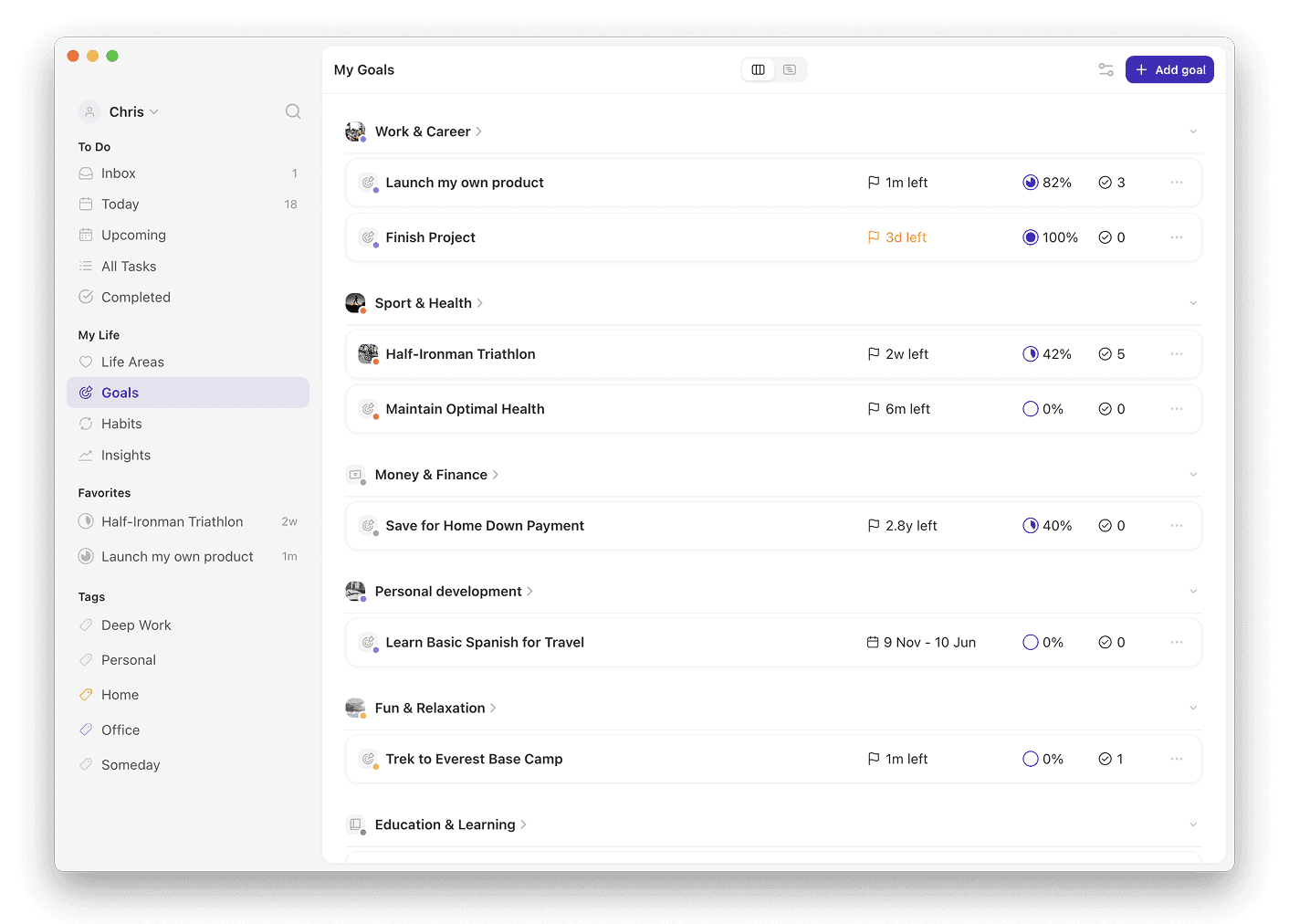
Griply is built around the same problem. You organize your life into Life Areas (Work, Health, Finances, Relationships) and write a short Vision under each one. When a reflection session shifts your thinking about a life area, updating the Vision recalibrates every goal below it.
Below each Vision, Goals carry a start value, a target value, and a deadline. Progress is logged manually and shown as a line chart, so the distance between today and your target is always visible, not assumed. That visibility is what makes the gap feel like a commitment rather than a vague intention.
Goals break into Subgoals, then into Tasks and Habits. A Habit in Griply is linked directly to the goal it serves: the daily action traces back to the pattern you named in your reflection. The full hierarchy runs: Life Area → Vision → Goal → Subgoal → Project → Task and Habit.
Frequently asked questions
What are reflection questions?
Reflection questions are structured prompts that help you examine your experiences and decisions more deliberately than open-ended thinking tends to allow. They're used in any structured review process to surface what free-form reflection tends to miss. The structure does two things: it covers areas your memory would skip, and it gives you a concrete starting point rather than a blank page.
How often should you use reflection questions?
The right cadence depends on what you're reviewing: a few minutes daily suits habit tracking, while a longer quarterly or annual session suits life-area reviews and goal setting. There's no single right frequency. The most useful cadence is the one you'll actually maintain.
What's the difference between self-reflection questions and personal reflection questions?
The terms are interchangeable. Both refer to structured prompts you use to examine your own decisions and patterns. Some people use "self-reflection" to mean inward psychological examination and "personal reflection" to mean life-area reviews, but neither term has a fixed technical meaning.
Do you need to answer every question?
No. Scan for the questions that trigger an immediate reaction: discomfort or something that makes you hesitate. Those are the ones worth working through; questions that produce no reaction can be skipped.
What should you do with the answers?
Identify one insight that surprised you and translate it into one specific, schedulable action. Reflection that ends with insight but no follow-through is just the first step. The shorter the gap between the insight and the first response to it, the more useful the session turns out to be. Griply lets you map that action to a life area and a goal, so the insight becomes part of a structure you open every day rather than a note that fades.
Specificity is what turns a reflection session into a usable plan
Reflection questions work because they force specificity. Instead of "thinking about your year," you answer a concrete prompt and get a concrete answer. That answer, written down, becomes the raw material for a real change.
The return on a reflection session comes from what you do with it. Map the insight to a life area and connect it to a goal. That's what turns a meaningful conversation with yourself into a meaningful change in how you live.
Related Guides
Eurich, Tasha. "What Self-Awareness Really Is (and How to Cultivate It)." Harvard Business Review, January 2018. https://hbr.org/2018/01/what-self-awareness-really-is-and-how-to-cultivate-it
Di Stefano, Giada, Francesca Gino, Gary Pisano, and Bradley Staats. "Learning by Thinking: How Reflection Aids Performance." Harvard Business School Working Paper 14-093, 2014. https://papers.ssrn.com/sol3/papers.cfm?abstract_id=2414478