

The 2-2-3 schedule is a rotating shift pattern where you work two days, take two off, work three, then flip the pattern the following week, so the same team covers a 24/7 operation with every other weekend free. It was built for hospitals, factories, and emergency services, where the problem is coverage rather than focus.
You are probably not a shift worker. But if your week has collapsed into an undifferentiated blur where every day is an everything-day, the 2-2-3 pattern holds an idea worth stealing. The rotation forces a rhythm, and rhythm is the thing most personal planning lacks.
When you strip the pattern out of the nursing station and read it as a template, it becomes a way to stop every day from carrying every kind of work. This guide, part of the wider productivity guide, reframes the 2-2-3 schedule as a weekly rhythm for knowledge work: two days of deep work, two of collaboration, three of execution.
Key takeaways
The 2-2-3 schedule is a 28-day shift rotation of two days on, two off, three on, designed to cover round-the-clock operations with every other weekend free.
Borrowed for knowledge work, its value is not the days off but the alternation: assigning different kinds of work to different days stops each day from being an everything-day.
Switching between unlike tasks leaves a cognitive drag, so grouping deep work into its own days protects the hours that matter most.
In Griply, a themed week works when each day's tasks trace up to a goal, so the block of deep-work days is spent on the goal that needs movement rather than whatever is loudest.
What the 2-2-3 schedule actually is
In its original form the 2-2-3 schedule, also called the Panama schedule, runs on a 28-day cycle. A team works two 12-hour days, rests two, works three, then the next week inverts to two off, two on, three off. Four teams run the pattern out of phase so someone is always on shift, and each worker lands every other weekend free.
The reason it spread through nursing, manufacturing, and emergency services is coverage. A hospital cannot close at 5pm, so the schedule solves the problem of keeping a desk staffed around the clock without burning any single person out. The frequent long weekends and the predictable pattern are why staff tend to prefer it over a flat five-day week.
None of that is your problem if you do knowledge work. You are not trying to cover a 24-hour operation. What carries over is the underlying shape: a repeating structure where days are not interchangeable, and a rest boundary is built into the pattern rather than hoped for.
Why an everything-day quietly costs you
The failure mode the 2-2-3 rhythm addresses is the week with no shape at all. Monday holds deep analytical work, three meetings, an inbox triage, and two quick favours. Tuesday holds the same mix. Every day is an everything-day, and the cost hides because you stay busy the entire time.
The cost is real and it has a name. Sophie Leroy's research on attention residue found that when you switch from one task to another, part of your attention stays stuck on the first, so you arrive at the second task already diminished. A day that alternates between a strategy document and a run of unrelated meetings pays that switching tax over and over.
Grouping unlike work onto different days is the structural answer. If Monday and Tuesday are for deep work and Thursday is for meetings, you stop paying the residue tax inside the day, because the day is not asking you to keep changing gears. The 2-2-3 pattern is one ready-made way to draw those lines.
How to map 2-2-3 onto a knowledge-work week
The transplant is a reframe, not a literal copy. You are not working 12-hour shifts. You are borrowing the "two, two, three" grouping and assigning each group a type of work rather than an on-or-off status.
A clean starting split for a five-day week looks like this:
Two deep-work days: protected time for the one or two goals that need real thinking, with meetings pushed off the calendar.
Two collaboration days: meetings, reviews, calls, and anything that runs better with other people available.
Three execution days: the follow-through work, the smaller tasks, and the loose ends that accumulate around the bigger pushes.
Since a workweek has five days and the pattern names seven slots, you compress: the "three execution" group overlaps the collaboration days or spills lightly into a weekend hour if you choose to work one. The exact arithmetic matters less than the principle. You are theming blocks of days so that similar work sits together and the switching cost drops.
Pick your deep-work days for the part of the week when your energy is highest, often the first two days before the meeting load builds. Guard them the way the shift schedule guards a rest day: as a fixed feature of the week, not a preference you renegotiate each morning.
What to borrow is the alternation between day types
It is tempting to read the 2-2-3 schedule as being about rest, given the long weekends. For a knowledge-work week the more useful lesson is the alternation between day types, though the built-in recovery boundary is worth keeping too.
Research on stepping away from work supports drawing the line deliberately. A 2016 study on psychological detachment found that moderate mental distance from work produced the highest engagement, while both no detachment and total detachment left people worse off. A week with no rhythm rarely gives you clean detachment, because work bleeds into every evening; a themed week with defined edges makes the boundary easier to hold.
The practical move is to treat the transition between block types as a real edge. When deep-work days end and collaboration days begin, that switch is a chance to close one mode before opening the next, rather than smearing both across all five days. The rhythm gives you somewhere to put down the previous kind of work.
Why a fixed rhythm beats deciding each morning
The strongest argument for a repeating weekly pattern is that it removes a daily decision you keep making badly. Without a rhythm, every morning you re-choose what kind of day it is, and the choice usually defaults to whatever is most urgent rather than most important.
Dan Ariely and Klaus Wertenbroch's study on self-imposed deadlines found that people who set fixed, evenly spaced deadlines outperformed those who left the timing open, even though the open option looked more flexible. A structure imposed in advance beat leaving it to in-the-moment judgement. A themed week is the same mechanism applied to the shape of your days: the decision about what Monday is for was made once, on purpose, not renegotiated under pressure.
That is what the shift schedule does automatically. A nurse does not decide each morning whether today is a work day. The pattern already answered. Borrowing that certainty is most of the value for a knowledge worker whose week would otherwise be improvised daily.
How Griply keeps a themed week pointed at your goals
A 2-2-3 rhythm can still fail in the way any calendar structure fails: you theme the days perfectly and fill your two deep-work days with work that moves nothing important forward. The rhythm decides when you focus. It does not decide what deserves the focus. That question sits one level up, at your goals.
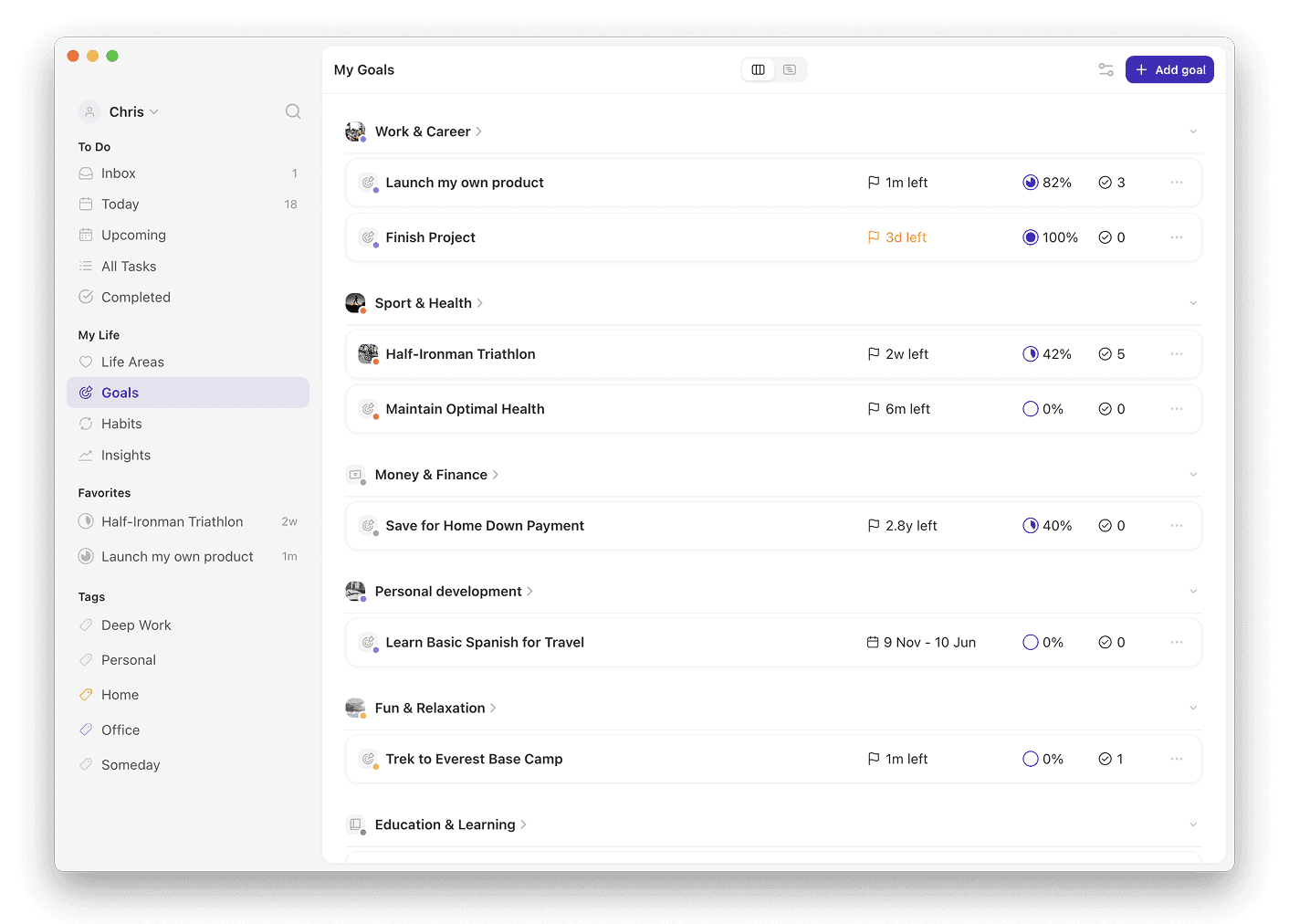
Griply is built so the answer is already attached. Tasks can belong to a hierarchy of Life Area, Vision, Goal, Subgoal, and Task, so when you plan your deep-work days you are choosing from work that carries its goal context rather than a flat list where everything looks equally worthy. The Goal Planner shows each goal's progress against its target, so you can point a block of deep-work days at the goal that is actually behind.
The Today view puts your tasks beside the calendar with each task's parent goal visible, which is where you build the actual blocks for a themed day. The rhythm gives the week its shape; the goal link makes sure the shape is spent on the right thing.
Frequently asked questions
What is a 2-2-3 schedule?
A 2-2-3 schedule is a rotating shift pattern where you work two days, take two off, and work three, then invert the pattern the next week. It runs on a 28-day cycle with four teams, is common in hospitals and factories, and gives each worker every other weekend off.
Can the 2-2-3 schedule be used for regular office work?
The literal shift version is built for round-the-clock coverage, not office work. The useful transplant is its rhythm: theme blocks of days by type of work, such as two deep-work days, two collaboration days, and three execution days, so each day is not carrying every kind of task.
Why is the 2-2-3 schedule popular?
Shift workers tend to prefer it because it delivers frequent three-day weekends, a predictable repeating pattern, and extended rest between rotations. For knowledge work, the appeal is different: the fixed rhythm removes the daily decision about what kind of day it is.
How do I stop every day from feeling the same?
Assign different types of work to different days instead of mixing everything into each one. Group deep work onto its own days, meetings onto others, and follow-through onto the rest, then tie each day's work to a goal so the focused days are spent on what matters. Griply lets you link each task to its goal so a themed week stays aimed at real progress.
The rhythm only works when the days point somewhere
The 2-2-3 schedule was designed to solve coverage, and most of what makes it work for shift teams does not transfer. What transfers is the one idea buried inside it: a week made of unlike days beats a week of identical everything-days, because it stops you paying the switching tax and it settles the daily question of what today is for. Draw the lines, guard the deep-work days, and make sure the goal each day serves is one you chose rather than one that shouted loudest.
Related Guides
Leroy, Sophie. "Why Is It So Hard to Do My Work? The Challenge of Attention Residue When Switching Between Work Tasks." Organizational Behavior and Human Decision Processes, Vol. 109, No. 2, 2009. https://ideas.repec.org/a/eee/jobhdp/v109y2009i2p168-181.html
Shimazu, Akihito, Matsudaira, Ko, De Jonge, Jan, Tosaka, Naoya, Watanabe, Kazuhiro, and Takahashi, Masaya. "Psychological Detachment from Work During Non-Work Time: Linear or Curvilinear Relations with Mental Health and Work Engagement?" Industrial Health, Vol. 54, No. 3, 2016. https://pmc.ncbi.nlm.nih.gov/articles/PMC4939862/
Ariely, Dan, and Wertenbroch, Klaus. "Procrastination, Deadlines, and Performance: Self-Control by Precommitment." Psychological Science, Vol. 13, No. 3, 2002. https://web.mit.edu/ariely/www/MIT/Papers/deadlines.pdf