

Slow productivity is a framework introduced by Cal Newport in his 2024 book of the same name, built on three principles: do fewer things, work at a natural pace, and obsess over quality. It treats meaningful output as the measure of a working day.
You probably feel the pressure from two directions at once. Your task manager fills faster than you can empty it, and the dashboard you rebuilt last weekend is quietly the work you're avoiding. Both versions end the week with a long completed list and nothing that moved a real outcome.
Newport calls this pseudo-productivity, and slow productivity is his answer. The framework sits at the selection layer described in the productivity guide, answering which work is worth doing before you plan when to do it. It decides the shape of your week before your calendar does, so execution methods like time-blocking and deep work have something real to protect.
Key takeaways
It takes an average of 23 minutes to resume a task after an interruption, and working faster under frequent interruption raises stress without raising quality, which is the cognitive basis for Newport's second principle.
Pseudo-productivity is Newport's name for using visible activity as a proxy for real output, which is what most task managers accidentally reward.
Switching tasks leaves attention residue that measurably degrades performance on the next task, so a day with three genuine priorities can be worse than a day with two.
In Griply, linking a task to a parent Goal with an Impact rating happens at capture time, so the selection decision Newport's first principle requires is built into the workflow rather than deferred.
What is slow productivity
Slow productivity is the framework Cal Newport set out in his 2024 book of the same name. It answers a knowledge-work culture that measures people by how busy they look across a day when the honest measure is what they finish across a year. Newport argues that industrial-era metrics like visible activity do not map onto cognitive work.
The framework has three principles: do fewer things, work at a natural pace, and obsess over quality. Each principle aims to reduce concurrent commitments and protect the time needed to do one commitment well. Newport's February 2026 MasterClass walks through each principle in sequence and adds the rituals he uses himself.
This is a later and more explicit framework than his 2016 book Deep Work, which focused narrowly on the cognitive conditions for focused output. Slow productivity asks which work is worth focusing on in the first place.
Pseudo-productivity is the problem slow productivity solves
Newport coined the term pseudo-productivity in his New Yorker essay to describe the habit of using visible activity as a proxy for real output. You end the day drained, with a completed list that wouldn't survive a six-month look-back.
Task-first productivity tools reinforce this by design, rewarding capture speed, notification responsiveness, and checkmark volume. Griply's internal name for the same symptom at the task layer is productive procrastination: getting busy on visible work because strategic work is harder to start. A site blocker can't catch it, because the busywork sits on your own to-do list. Catching it takes a different kind of anti-procrastination app.
An hour spent on low-stakes work is an hour you did not spend on the one project that would move a Goal. Over a quarter, those hours add up.
Do fewer things: the first principle of slow productivity
The first principle is the one most people resist, because it involves saying no to work that is already on the list. Newport argues that taking on more projects does not give you proportionally more output.
Attention residue gives this a cognitive basis: when you switch from one task to another, part of your attention stays on the first task, and that residue produces a measurable performance decrement on the next task. The implication for slow productivity is that a day with three genuine priorities is often worse than a day with two once attention residue is accounted for.
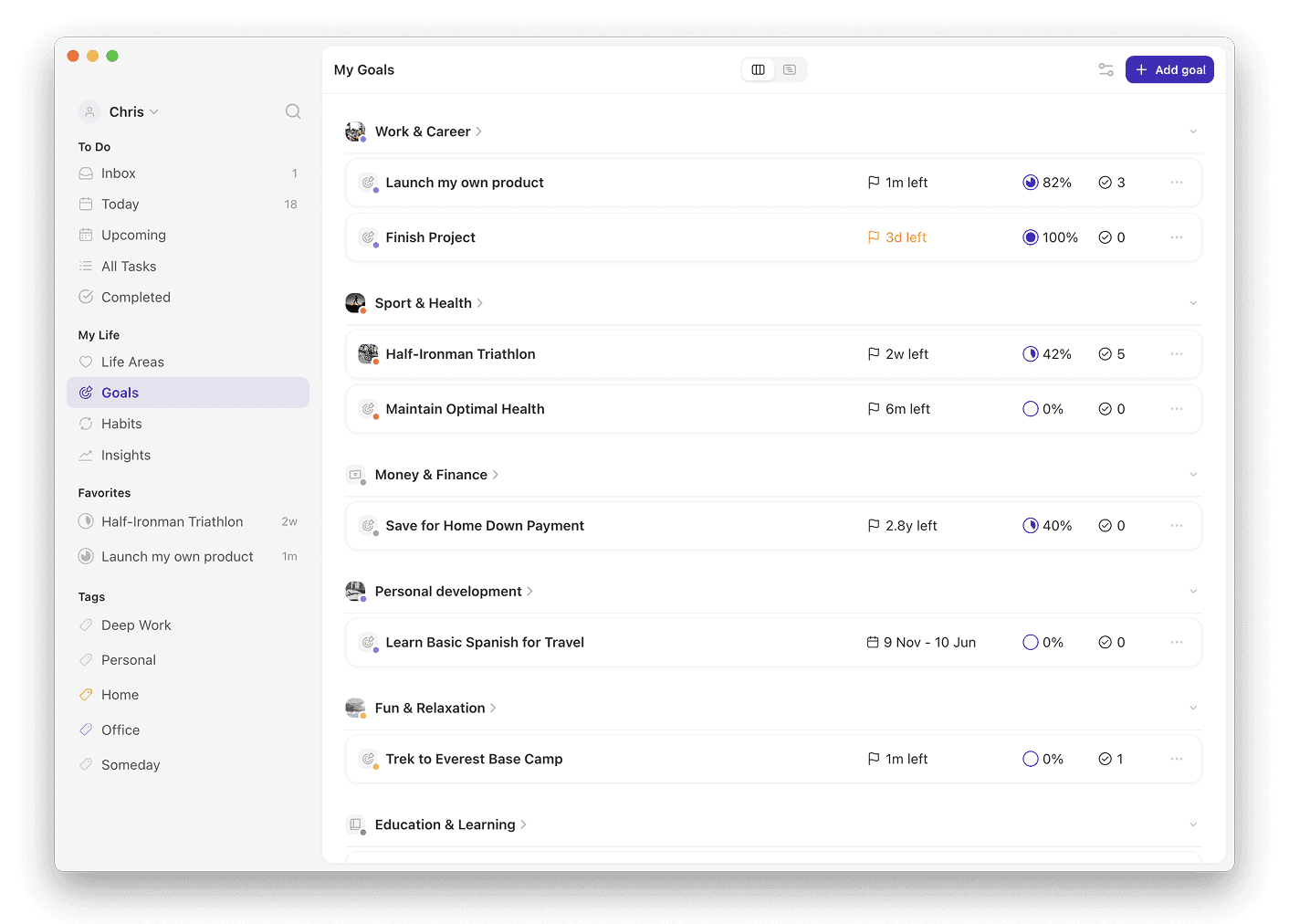
The operational move is to cap your active set. A short list of Goals with an Impact rating, each tied to a parent Vision, gives you a way to refuse new work on principle. In Griply, linking a task to a parent Goal happens at capture time, so the selection decision is in front of you before the task lands on your list.
Work at a natural pace: the second principle of slow productivity
The second principle targets the time horizon you plan on. Slow productivity assumes the unit of measurement is a quarter or a book rather than a single day. Newport argues that cognitive work does not fit evenly into daily quotas.
Research on interrupted work is a useful counterweight here: it takes an average of about 23 minutes to resume a task after an interruption, and working faster under frequent interruption raises stress and frustration without raising quality.
The practical expression is to plan on longer horizons and protect the days where you work, with time-blocking as the mechanism that carries Newport's earlier case for focused output into the week. Griply's time management features schedule blocks directly alongside your tasks, and the Goal Roadmap lays out Goals, subgoals, and Projects across months so you can plan in seasons.
Obsess over quality: the third principle of slow productivity
If you are going to do fewer things on longer horizons, the output has to be better. Newport argues that raising your quality bar makes it easier to refuse trivial work.
Quality becomes a filter at the point of commitment. You choose work you can realistically do at a level you would defend. Over time, what you have shipped sets the standard for what you agree to next.
For this to work in a tool, the quality bar has to be set when the Goal is defined. In Griply, a Goal's target value is the defended standard, so choosing the number forces the quality judgement before any work is logged against it. Manual progress entries also keep you close enough to the work to notice when output is drifting below the bar you committed to.
How slow productivity differs from pseudo-productivity in practice
Contrast a slow-productivity week with a pseudo-productivity week covering the same ground.
A pseudo-productivity week optimises for tasks completed, inbox zero, and fast response time.
A slow-productivity week optimises for Goal progress logged, deep blocks protected, and quality bar held.
A pseudo-productivity week treats every incoming request as equal weight once it is captured.
A slow-productivity week treats every incoming request as a question of which Goal it serves.
Capture-first tools like Todoist and TickTick are built around how quickly you can add a task and how cleanly you can sort it once captured.
How Griply's goal-first hierarchy operationalises slow productivity
Consider a single Tuesday morning: a colleague pings you asking for a quick competitor teardown by Friday. In a capture-first tool, you type the task, pick a due date, and move on.
In Griply, the task creation flow surfaces the Goal connection up front: which active Goal does this teardown serve? If it ladders up to a High-impact Goal you are already working on, it becomes a task there and the deadline is weighed against the other work. If it does not, you either promote it to a Goal in its own right (accepting that something else must be demoted) or you go back and say no.
The hierarchy runs Life Area to Vision to Goal to Subgoal to Project to Task/Habit, and the refusal happens at capture time. The same hierarchy carries the other two principles: Goals are planned across months, and the quality bar is the target you set when the Goal was created.
Frequently asked questions
What are the three principles of slow productivity?
The three principles are do fewer things, work at a natural pace, and obsess over quality. Newport sets them out in his 2024 book as a sequence: cap commitments, extend horizons, raise the quality bar. Each principle reinforces the others.
What is the slow productivity book about?
Cal Newport's 2024 book "Slow Productivity: The Lost Art of Accomplishment Without Burnout" (Portfolio / Penguin) argues that knowledge work has been measured with the wrong metric, which is visible activity, and gives three principles to replace it. The book diagnoses pseudo-productivity as the cultural default.
How is slow productivity different from Deep Work?
Deep Work (2016) is about the cognitive conditions for focused output. Slow Productivity (2024) is about which work to focus on in the first place. Deep Work sits inside slow productivity as the execution layer once you have chosen fewer, better commitments.
What tool supports slow productivity best?
A slow-productivity tool needs a goal hierarchy that makes tracing every task back to a parent goal the natural path. Griply surfaces that connection at capture time by default.
Is slow productivity realistic for busy roles?
Yes. The framework argues for fewer concurrent commitments and a higher quality bar. The shift is making that explicit at capture time so it survives the week.
Slow productivity needs a tool that stops rewarding busyness
The framework only works if your tool stops rewarding capture speed and checkmark volume. Newport's three principles need a hierarchy that anchors work to fewer, larger Goals.
Griply's Goal-First hierarchy and Impact rating push against pseudo-productivity. Pair this guide with the personal productivity system guide for the structural home your work needs once you have picked the fewer things.
Related Guides
Cal Newport. "Slow Productivity: The Lost Art of Accomplishment Without Burnout." Portfolio / Penguin, 2024. https://calnewport.com/slow-productivity/
Cal Newport. "It's Time to Embrace Slow Productivity." The New Yorker, 3 January 2022. https://www.newyorker.com/culture/office-space/its-time-to-embrace-slow-productivity
Cal Newport. "Deep Work: Rules for Focused Success in a Distracted World." Grand Central Publishing, 2016. https://www.calnewport.com/books/deep-work/
Sophie Leroy. "Why Is It So Hard to Do My Work? The Challenge of Attention Residue When Switching Between Work Tasks." Organizational Behavior and Human Decision Processes, Vol. 109, Issue 2, 2009, pp. 168-181. https://doi.org/10.1016/j.obhdp.2009.04.002
Gloria Mark, Daniela Gudith, Ulrich Klocke. "The Cost of Interrupted Work: More Speed and Stress." CHI 2008 Proceedings, pp. 107-110. https://www.ics.uci.edu/~gmark/chi08-mark.pdf