Guide

Table of Contents
A life OS is a personal framework that connects your values, goals, habits, and daily actions so that what you do today traces back to what you want from life.
The idea went mainstream around 2020–2022, carried by productivity creators building elaborate Notion dashboards and sharing them online. Ali Abdaal, one of the most-followed productivity writers online, described a life OS on his YouTube channel and blog as a single place where vision, goals, habits, and tasks all lived together. For many people who watched, it named something they already felt: goals set in January, tasks scattered across three apps, habits tracked somewhere else, and nothing connecting any of it.
That gap is the actual problem, and it is what this guide addresses. Not the short definition (for that, see What Is a Life OS?): this guide covers what a working life OS actually requires, where most attempts fail, and how to build something that holds past the first week.
Key takeaways
The term was popularized in productivity circles around 2020–2022, but the underlying problem it names (vision disconnected from daily action) predates the label by decades.
A working life OS has four layers: capture (inputs and ideas), planning (goals and subgoals), execution (tasks and habits), and review (reflection and recalibration).
Most life OS attempts fail not because the concept is wrong, but because the tools used to run them cannot hold all four layers together in daily practice.
You do not need a perfect system on day one. You need a structure that stays honest when you open it on a Wednesday morning and ask: is this the right thing to work on right now?
What a life OS actually is (and what it is not)
A life OS (operating system) is a personal structure for managing your whole life, not just your schedule or task list, but the full chain from what you value to what you do today.
The "OS" metaphor is deliberate. An operating system does not do the work; it creates the conditions for the work to happen. It manages resources, routes inputs, and keeps everything running in relation to everything else. A personal operating system does the same at an individual level: it routes your time and attention toward the goals and commitments that matter most.
At its core, a life OS answers four questions:
What do you want from life?
What goals are you actively working toward right now?
What actions will move those goals forward today?
Are you making progress?
Where the term "life OS" came from and why it spread so fast
The phrase spread quickly through the productivity community in the early 2020s, attached to Notion dashboards built by creators like Ali Abdaal and Thomas Frank and shared online as templates others could copy and adapt.
Before that, the concept had other names. David Allen's Getting Things Done (2001) made the case for a trusted external capture system and a clear collection of next actions. Stephen Covey's principle of beginning with the end in mind addressed the vision-to-action gap directly. The "personal operating system" framing had circulated in business writing and coaching before it became a YouTube tutorial topic.
What the newer label added was visual ambition: a single dashboard where every layer of your life could be managed, from a five-year vision down to today's task list. The appeal was real. The execution, for most people, turned out to be the hard part.
The four layers of a working life OS: most people only build one or two
A life OS that functions in daily practice has four distinct layers. Most people build one or two and wonder why the system does not hold.
The first layer is capture: a place where ideas, tasks, notes, and inputs land as they arrive. Tiago Forte's Building a Second Brain (2022) makes the case for this in depth: when your mind has to retain every incoming piece of information, it has less capacity for the work that matters. Without a reliable capture layer, things fall through and the whole structure becomes untrustworthy.
The second layer is planning: life areas, visions, goals, and subgoals. This is the strategic layer, the part that answers "what am I building and why?" Most people who say they want a life OS are thinking of this layer specifically.
The third layer is execution: the daily task list, habit tracker, and calendar that turn plans into action. This is the layer most people already have, usually in a to-do app with no structural connection to the planning layer above it. Tasks pile up. The goals page goes unvisited. The two never talk to each other.
The fourth layer is review: a recurring practice of checking in on your goals, reflecting on what is working, and recalibrating. An annual review is the fullest version of this layer, a deliberate process of examining each life area, identifying patterns, and translating insights into next year's goals. Weekly and monthly reviews serve the same function at a shorter horizon. Without this layer, the system drifts.
Why most life OS attempts collapse: it is usually the tool, not the person
The most common failure mode is not a lack of discipline. It is structural: the tool used to run the life OS cannot hold all four layers together in a way that is practical to open every day.
Notion is the clearest example. You can build a comprehensive life OS in Notion, and many people have following templates from popular creators. But every database, every linked relation, every filtered view is something you design and maintain yourself. The result is a system that takes more time to build than to use, and that falls apart the moment you stop maintaining it.
The second failure mode is disconnection. Most people start from the execution layer and work backward: they have a task list and add a goals page, then try to link the two manually. Without a pre-built hierarchy that enforces the connection, the link breaks within weeks.
The third failure mode is the gap between planning and daily use. A life OS consulted only during your weekly review is not running your day; it is a filing cabinet. For the system to work, it needs to surface the right information at the moment you need it, not after you go looking for it.
How to build a life OS: the practical version is shorter than most guides suggest
The practical version is shorter than most guides suggest.
Start with life areas. These are the five to seven domains that make up your life: Work, Health, Finances, Relationships, and Personal Growth are typical. Life areas are the organizing categories for everything else in your system. Griply's holistic productivity guide covers how life areas work as a planning structure in more detail, including the Wheel of Life framework they are drawn from.
Write a short vision under each life area. A vision is a direction, not a goal. "I want to be financially independent by my early 40s" is a vision. "Save $25,000 by December 2026" is the goal that sits under it. The vision tells you why the goal matters.
Set measurable goals under each vision. A goal without a metric is an intention. Every goal in a working life OS needs a start value, a target value, and a deadline. This is what makes progress visible rather than simply felt.
Break goals into subgoals and tasks. A subgoal holds the work required to move a goal forward. Tasks are the individual actions connected to that subgoal. This hierarchy is what gives you a meaningful daily task list: not a freestanding queue of everything you need to do, but a filtered view of what moves your goals forward today.
Tie habits to goals. The habits that persist are the ones connected to a goal you have already committed to. A habit tracker is useful for streaks, but a habit tied to a goal draws its motivation from something larger than the streak itself.
Close the loop with a review. This can be five minutes on Sunday to check which tasks carry forward and whether your goals are on track. The review is what keeps the system honest.
Where notes and knowledge capture fit, and why confusing them with execution breaks both
A common question is where note-taking fits in a life OS, because many popular templates treat notes, saved articles, and knowledge databases as part of the same system.
Notes and personal knowledge management (PKM) are about capturing and organizing information for future reference. Tools like Obsidian, Roam, or a structured Notion database do this well. A life OS is about execution: translating intention into action. You can run both in parallel, and many people do.
But if your "life OS" is primarily a collection of notes and saved links with a goals section you rarely visit, what you have is a knowledge base, not an operating system. The distinction matters because the two serve different functions: a knowledge base preserves what you learn; a life OS determines what you do.
The capture layer of a life OS connects to your knowledge base but serves a specific function. Its job is triage: what needs action, what needs filing, what can be deleted. David Allen's Getting Things Done remains the best treatment of this distinction, and it holds up twenty-five years on.
How Griply works as a life OS
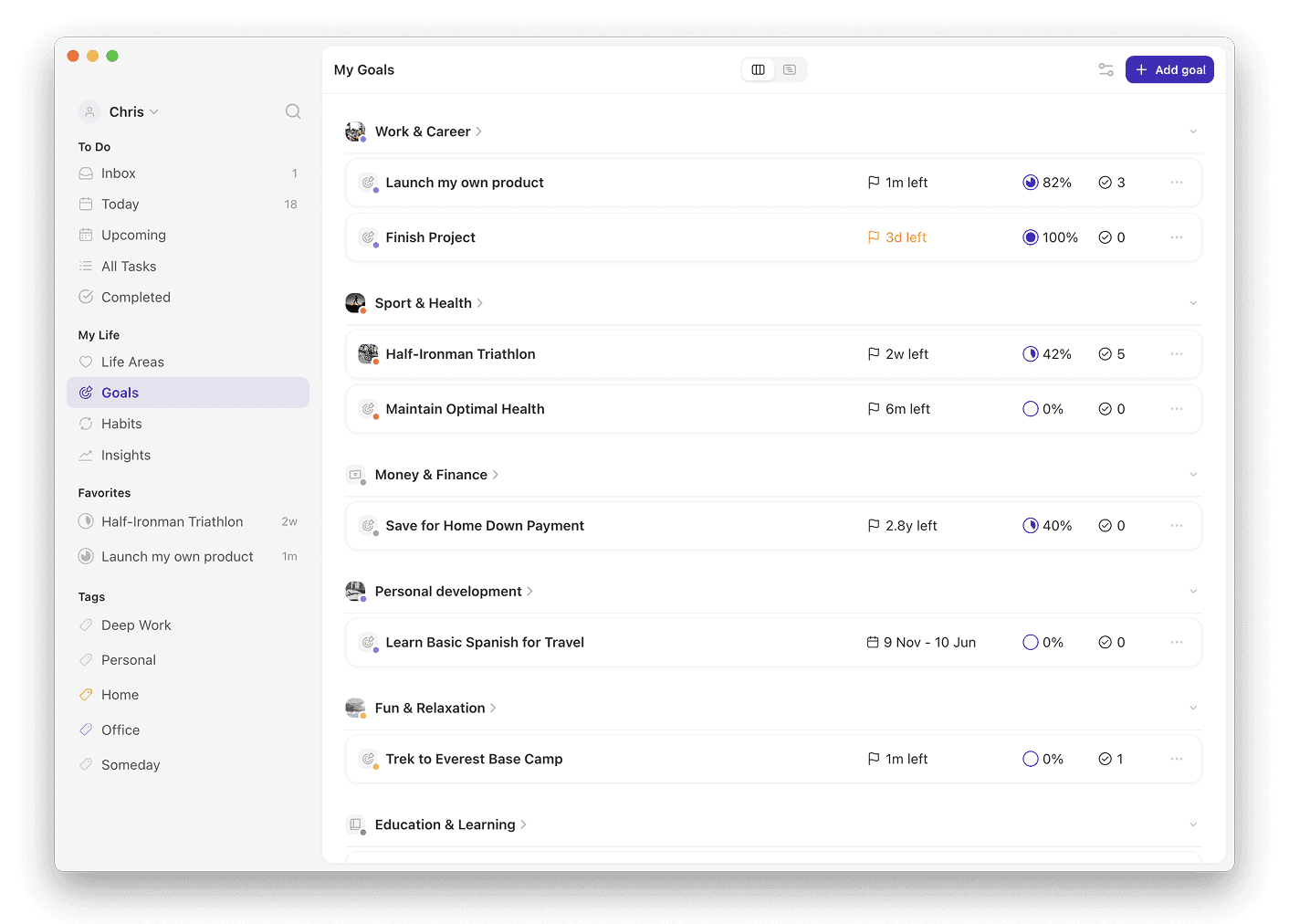
The specific failure this article describes (goals in one place, tasks in another, habits tracked separately, nothing connecting any of it) is the problem Griply is built to solve. You do not configure a hierarchy; the hierarchy is the product.
The structure runs: Life Area → Vision → Goal → Subgoal → Project → Task and Habit. Every task and habit can live inside this chain. When you open the Today view, you see what is scheduled and which goals your linked items serve. There is no overhead required to answer "is this the right thing to do?": the connection is already built in.
Each Goal has a start value, a target, and a deadline. Progress is logged manually and displayed as a line chart, so the gap between where you are and your target is concrete, not assumed. Habits connect directly to the goals they serve, so the motivation behind the daily action comes from something larger than a streak.
Griply does not replace the capture layer. It handles the planning, execution, and review layers. If you use a separate tool for notes, Griply slots in as the execution side of your system.
Frequently asked questions
What is a life OS?
A life OS is a personal framework for managing the full chain from what you value to what you do each day. It connects life areas, goals, habits, and tasks in one structure so that your daily actions trace back to a longer-term intention. For a concise answer, see What Is a Life OS?
Is "life OS" the same as "personal operating system"?
The terms are used interchangeably in most productivity writing. "Personal operating system" is slightly older; "life OS" is more common in current creator and app-focused content. Both describe the same core idea: a framework that routes your attention and time toward the goals that matter most.
Do I need Notion to build a life OS?
No. Notion became the dominant platform for life OS templates because of its flexibility, but that flexibility requires setup time and ongoing maintenance. Purpose-built tools like Griply offer the life OS structure without configuration.
How is a life OS different from a to-do list?
A to-do list manages what you need to do. A life OS explains why each item belongs on the list. The difference is the hierarchy: a life OS connects tasks to goals, and goals to a vision. A task list without that hierarchy is a queue, not a system.
How long does it take to set up a life OS?
In a purpose-built tool, an initial setup takes under an hour: define your life areas, write a brief vision for each, and add two or three active goals. The system grows from there as you work within it. In a flexible tool like Notion, setup time depends on which template you start from and how much you customize it.
The system only works when what you do today is visibly connected to what you are building
A life OS works when it is honest: when you can open it on any given morning and know, without second-guessing, that what you are about to do connects to what you are building over the next year. Most attempts fail not because the concept is wrong but because the structure collapses under the weight of a tool not built to hold it.
If you want a system that comes with the structure already in place.
Related Guides
Allen, David. Getting Things Done: The Art of Stress-Free Productivity. Penguin Books, 2001. https://gettingthingsdone.com
Forte, Tiago. Building a Second Brain. Atria Books, 2022. https://buildingasecondbrain.com
Abdaal, Ali. aliabdaal.com. (source: search "Ali Abdaal life OS" to verify URL before publishing)