Guide


Table of Contents
A morning routine checklist is a fixed sequence of daily habits you complete before your first obligation, designed to prime focus, energy, and direction before the reactive part of your day begins. Most published checklists give you ten to twenty items and skip the one that determines whether any of them matter.
You can hydrate, meditate, exercise, journal, and read every morning and still end the year having made no real progress on what you set out to do. The sequence runs but nothing about it tells you which goal today is in service of.
Research on 12,000 daily work diary entries found that daily progress on meaningful work was the single strongest predictor of positive engagement and creative output. The word "meaningful" is doing the work. A morning checklist without a goal anchor is activity; with one, it becomes daily evidence of progress toward something specific.
Key takeaways
A morning routine checklist is a sequenced list of habits completed before your first obligation; its defining feature is consistency.
The single item most morning routine checklists omit is a deliberate goal declaration: which goal does today's work serve?
Specifying when and how you will pursue a goal roughly triples follow-through compared to goal intention alone.
Griply's Habit Tracker ties each morning habit to a specific goal in your hierarchy, so the checklist has a reason to exist beyond the streak.
What a morning routine checklist actually is
A morning routine checklist is a sequence: items in an order, run consistently before the day's first external demand arrives. The sequence matters because habits chain off each other: the prior action is the cue for the next one.
The checklist form gets misused when people treat it as a buffet. You add every habit you admire in other people's routines and end up with a 90-minute gauntlet you abandon by Wednesday. A checklist that only works when conditions are perfect is not a routine.
Two criteria separate a functional morning routine checklist from a wishlist. First, you can complete every item on your worst day in under 30 minutes. Second, at least one item connects directly to a goal you have formally committed to.
The item missing from most morning routine checklists
Most morning routine templates give you categories: move your body, hydrate, meditate, plan your day. These are fine habits. The gap is that they give you no mechanism for deciding which goal the rest of the day serves.
Research on implementation intentions shows that the act of specifying "I will pursue goal X when situation Y occurs" delegates goal pursuit to an automatic response rather than a daily willpower decision. Writing down which goal today serves, at the start of the morning as a checklist item, is that implementation intention.
A 2016 meta-analysis of 138 studies found that prompting people to monitor their goal progress significantly increased attainment. The morning checklist review is exactly that prompt. Skipping it means the rest of the checklist has no target.
How to build a morning routine checklist that works
Start with three to five items, not fifteen. Every item must pass one test: does completing this habit move a current goal forward, or prepare you to do so?
A structure that works across goals and schedules:
One physical habit: movement, breathing, or a brief walk. This shifts your cognitive state before strategic thinking begins.
One goal declaration: write or say out loud which goal today is in service of. This is the anchor item.
One goal-linked habit: whatever directly advances your main current goal. Writing, practicing, building, outreaching.
One planning step: confirm your most important task for the day and assign it a time block.
Keep everything else optional. Add items only after the core sequence feels stable for at least four weeks. For a deeper look at habit formation timelines and the science of making any morning habit stick, see the guide on how to build a productive morning routine.
Morning routine checklist examples by goal type
A morning routine checklist must connect to a specific current goal to work. The structure stays the same across all goal types; the goal-linked habit changes.
If your goal is completing a creative project:
10 minutes of movement (walk, stretch)
Goal declaration: write down the project goal and today's specific output target
30 minutes of deep work on the project before email
Confirm today's task in your planner
If your goal is a fitness milestone:
20-30 minutes of training (the goal-linked habit is also the movement habit here)
Goal declaration: log your training goal and today's session target
5 minutes of planning: confirm tasks linked to other life areas
Review tomorrow's schedule to protect the training time
If your goal is a professional or career outcome:
10 minutes of movement
Goal declaration: state the professional goal and one concrete action today
20 minutes of skill-building or strategic work before reactive tasks begin
Confirm the day's priorities and block time for goal-linked work
The principle is the same in every case: the goal declaration comes early, the goal-linked habit follows immediately, and everything else supports rather than competes with those two items. For habit stacking strategies that help these items chain together reliably, see the habit stacking template guide.
What to cut from your morning routine checklist
More items do not make a morning routine more productive. They make it harder to complete and more likely to collapse at the first difficult week.
Cut any item you included because someone else includes it. Cold showers, elaborate journaling prompts, and extended meditation practices belong in your checklist only if they connect to a goal or prepare you to pursue one.
Cut any item that takes longer than its value justifies. A 10-minute run that actually happens beats a 45-minute workout that doesn't. The checklist should be short enough that you feel no friction starting it.
Cut any item with no connection to your current goals. Social media scrolling and news are reactive responses, not morning habits. They have no place in the focused hour before your first goal-linked work.
How Griply supports a goal-anchored morning routine
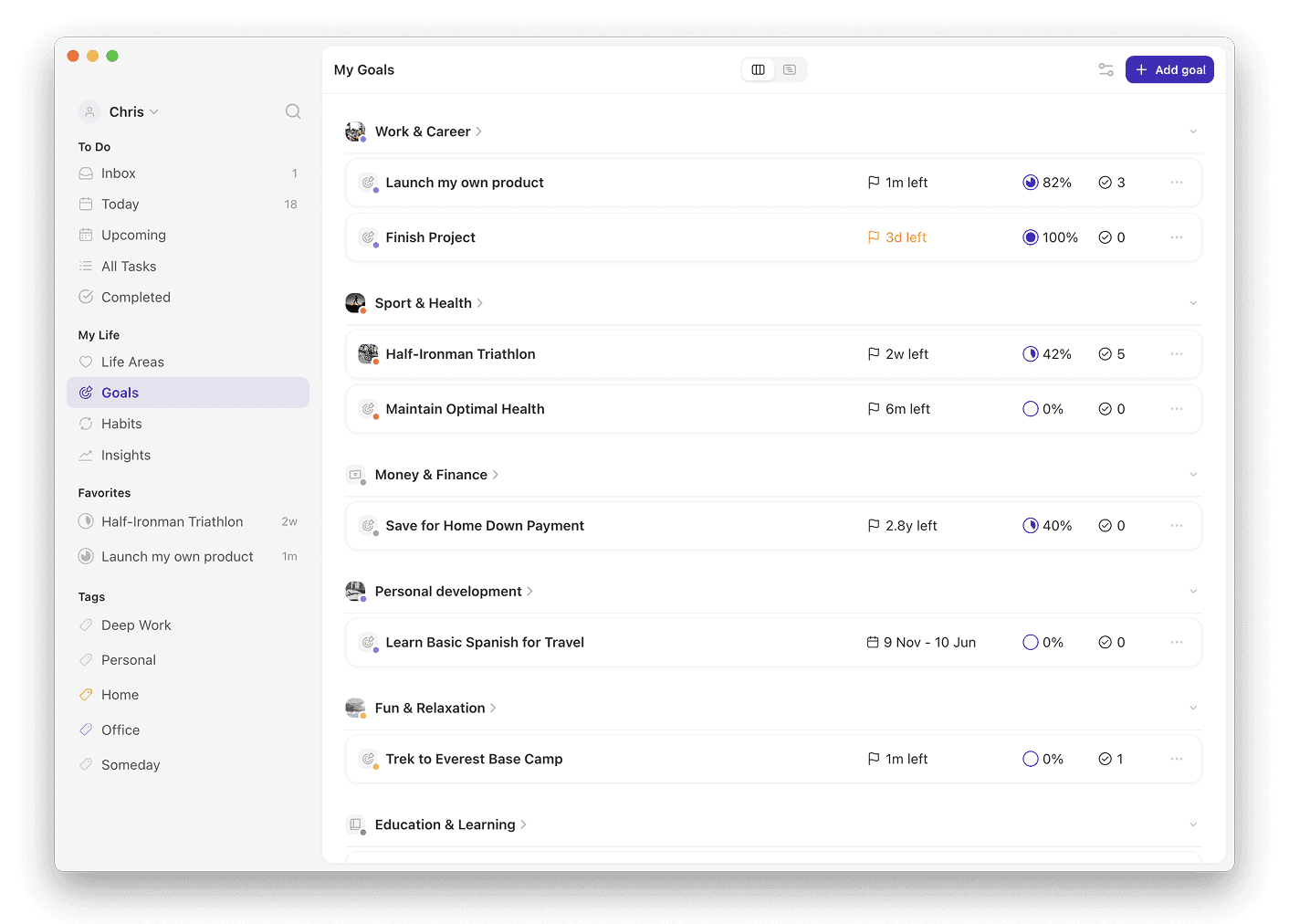
A morning routine checklist without a goal layer is a sequence of habits tracked in isolation. Griply's Habit Tracker lets you tie each habit directly to a goal in the Life Area → Vision → Goal hierarchy, so the morning checklist has a visible goal connection for every item you link to one.
When you open Griply's Today view in the morning, each habit appears alongside its parent goal and the rest of the day's planned tasks. You see not just what to do but which goal it serves. That visibility is the goal anchor built into the daily view.
Griply's Habit Tracker also surfaces completion statistics per habit over time, so you can see which morning habits have high completion rates and which do not. For managing the goals your morning routine serves, the Goal Planner holds the progress chart, start value, target value, and deadline for every active goal.
Frequently asked questions
What should a morning routine checklist include?
A morning routine checklist should include one physical movement habit, one goal declaration step, one habit directly tied to a current goal, and one planning step to confirm the day's priorities. Keep the total to four or five items so the checklist runs in under 30 minutes on a difficult morning.
How long should a morning routine checklist be?
Three to five items is the functional range for most people. A checklist you can complete in 20 to 30 minutes on your worst day beats a 90-minute sequence you complete only twice a week. Add items only after the core routine has held for at least a month.
What is the most important item on a morning routine checklist?
The goal declaration step: a brief written or spoken statement of which goal today's work is in service of. It is the structural anchor for the rest of the checklist; without it, the other habits have no shared target. Implementation intentions research shows this kind of when-goal pairing roughly triples follow-through.
Why do morning routine checklists fail?
Most morning routine checklists fail because they are too long and disconnected from specific goals. They collapse when a difficult morning arrives and there is no reason to prioritise them over reactive demands. A shorter baseline and a visible goal connection per habit fixes both problems.
Can a morning routine checklist app help?
A morning routine app is most useful when it connects each checklist item to the goal it supports. A tracker that only records completion tells you what you did, not whether it mattered. Griply's Habit Tracker links each morning habit to a parent goal so your checklist is part of a strategic plan.
The goal anchor is what makes a morning checklist worth keeping
A morning routine checklist is a tool for building consistency. It does not create progress on its own. Progress comes from habits connected to outcomes you have committed to, and from checking each morning whether today's sequence is actually serving those outcomes.
The Progress Principle research found that the feeling of making progress on meaningful work was the strongest driver of engagement across 12,000 work diary entries. The goal anchor in your morning checklist is how you manufacture that feeling before 8am. Tying each morning habit to a goal you have committed to turns the checklist into the first strategic decision of the day.
Related Guides
Amabile, Teresa, and Steven Kramer. The Progress Principle: Using Small Wins to Ignite Joy, Engagement, and Creativity at Work. Harvard Business Review Press, 2011. https://progressprinciple.com/progress-principle/
Gollwitzer, Peter M. "Implementation Intentions: Strong Effects of Simple Plans." American Psychologist 54, no. 7 (1999): 493-503. https://www.prospectivepsych.org/sites/default/files/pictures/Gollwitzer_Implementation-intentions-1999.pdf
Harkin, Benjamin, Thomas L. Webb, Betty P.I. Chang, Andrew Prestwich, Mark Conner, Ian Kellar, Yael Benn, and Paschal Sheeran. "Does Monitoring Goal Progress Promote Goal Attainment? A Meta-Analysis of the Experimental Evidence." Psychological Bulletin 142, no. 2 (2016): 198-229. https://pubmed.ncbi.nlm.nih.gov/26479070/