What is a second brain?
A second brain is an external system for capturing and retrieving ideas you've already encountered. Tiago Forte popularized the concept in Building a Second Brain (Simon Element, 2022). Griply addresses the question the second brain doesn't answer: what are you actually working toward?
What the second brain does
Tiago Forte defines the second brain in Building a Second Brain through his CODE method: Capture, Organize, Distill, Express. You save ideas and resources that connect to your current work or interests, sort them using the PARA structure (Projects, Areas, Resources, Archive), distill the content into usable notes, and eventually express them as creative output.
The second brain solves a real problem. Your biological brain is poor at long-term storage but strong at making connections. By offloading the storage job to an external system in Notion, Obsidian, or Roam Research, you free attention for the work that matters.
What CODE and PARA do not address is the goal layer above your notes. A second brain tells you where you put that article. It does not tell you what you're trying to achieve or whether today's work moves you closer to it.
The gap the book doesn't fill
Many people finish building their second brain and still feel directionless. The notes are organized. The highlights are captured. But there is no system above the knowledge saying which projects to prioritize, which habits to run daily, or how today's tasks connect to a longer outcome.
That question belongs to a different kind of system. The second brain vs a life OS comparison makes the distinction precise: the second brain is the knowledge retrieval layer; a life OS is the execution layer above it. Both can coexist. Most productivity problems that persist after a second brain is built come down to execution, not to how the notes are organized.
How Griply fills the execution gap
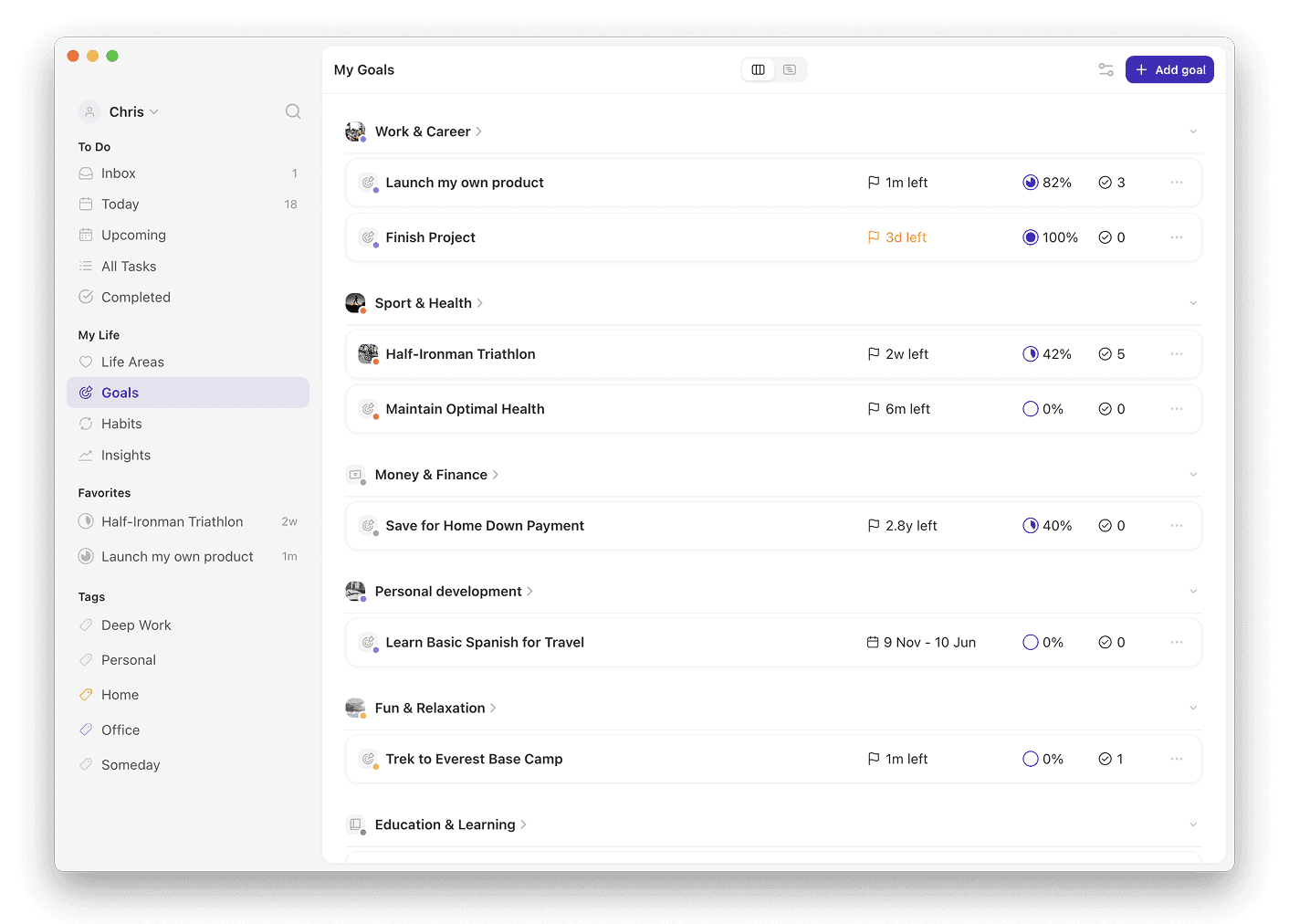
Griply is the goal-first system for the half the second brain leaves open. Its hierarchy runs from Life Area to Vision to Goal to Subgoal to Project to Task and Habit. The tasks you link trace back to a measurable goal, which traces back to a life area and a written vision.
This is what a personal productivity system built for execution looks like: the day has a direction before it starts. Griply's Today view shows your tasks for the day alongside the goals they serve, so the connection is visible every morning without a separate review ritual.
Griply's Goal Progress Tracking gives each goal a start value, a target value, and a progress line chart you update manually. That logged entry is the feedback loop the second brain's PARA structure has no equivalent of.
Related questions
What is the CODE method in Building a Second Brain?
CODE stands for Capture, Organize, Distill, Express: save ideas that connect to your current work, sort them into PARA categories, summarize them into discoverable notes, then turn them into output. Tiago Forte introduced the method in Building a Second Brain (Simon Element, 2022).
What is the PARA method?
PARA is the organizational structure Tiago Forte uses inside a second brain. Projects are active short-term efforts with defined endpoints. Areas are ongoing responsibilities with no end date. Resources are reference topics. Archive holds inactive items from the other three categories.
Does a second brain replace a goal-setting system?
A second brain and a goal-setting system address different problems. A second brain retrieves information you've already collected. A goal-setting system tells you what to work on and tracks progress toward measurable outcomes. People who feel scattered after building their second brain are usually missing the goal layer.
What apps are used to build a second brain?
Notion, Obsidian, Roam Research, and Logseq are the most common tools. All four support the PARA structure and work well as knowledge repositories. None of them have a native goal hierarchy with progress tracking, which is where Griply fits as the execution layer alongside your second brain.
How does Griply compare to a second brain app for goal tracking?
Griply has no note-taking or knowledge capture layer, and does not try to replace a second brain. Its job is goal execution: Life Area, Vision, Goal, Subgoal, Task, Habit in one connected hierarchy. A second brain app captures what you've learned. Griply tracks what you're building.