What is the difference between a second brain and a life OS?
A second brain is a retrieval layer: it captures, organises, and surfaces what you've learned. A life OS is an execution layer: it connects your vision, goals, habits, and tasks so you make progress on what matters. Griply is the life OS. Notion or Obsidian is the second brain.
What a Second Brain actually does
The term comes from Tiago Forte's Building a Second Brain (BASB), first published as a course in 2017 and later as a book. Forte's framework is built around CODE: Capture, Organise, Distill, Express. Its organisational backbone, PARA, sorts everything into Projects, Areas, Resources, and Archive.
The goal of a Second Brain is to reduce cognitive load by externalising memory. Your biological brain is for generating ideas; the second brain stores and retrieves them. When you need to write a report, draft a pitch, or recall a book you read six months ago, the second brain surfaces the relevant material.
What a Second Brain does not do is tell you which goal to pursue, when to work on it, or whether you're on track. It is a knowledge retrieval system. Deciding which goals matter and whether your daily work moves them forward is outside its scope.
What a Life OS does differently
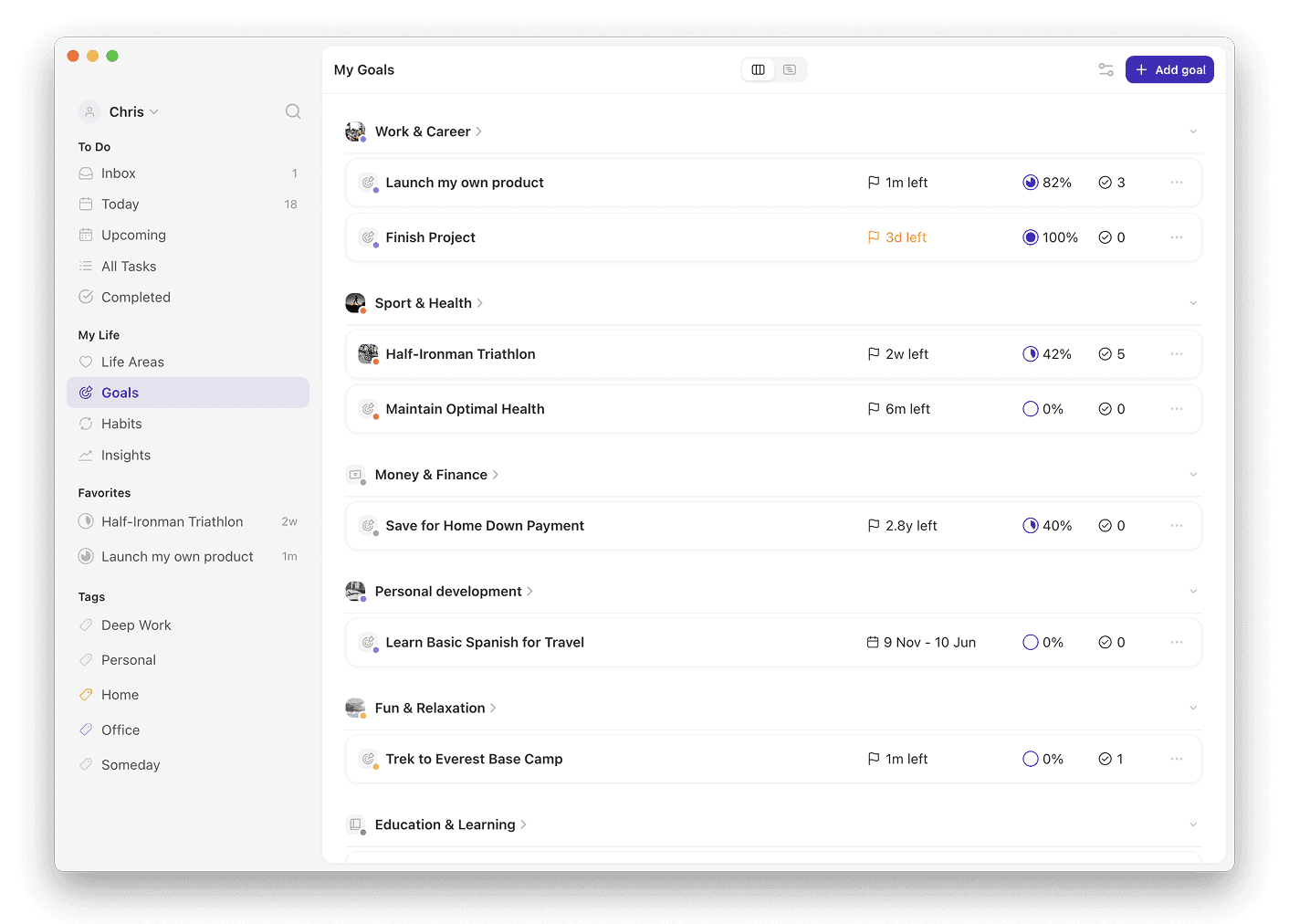
A life OS is a top-down execution structure. It starts with your life areas and a vision for each one, then works down through goals, subgoals, projects, and daily tasks and habits. Every action has a traceable reason for existing.
Griply implements this as the Goal-First hierarchy: Life Area, Vision, Goal, Subgoal, Task, and Habit. When you open Griply, you see your tasks alongside the goals they serve in the Today view, so your daily priorities are self-evident. The Goal Roadmap shows your goals and subgoals on a Gantt view, so your months-long strategy is visible at a glance.
A second brain answers "What did I learn and where is it?" A life OS answers "What am I working toward and what do I do today?"
When a second brain is not enough
The person who has a fully built Notion database, dozens of well-tagged notes, and still feels scattered has a life OS problem. The notes are organised. The goals are not. There is no hierarchy connecting daily work to outcomes, no deadline on any commitment, and no way to see whether Tuesday's tasks move any important goal forward.
More capture does not fix this. A structured execution layer does. The same person who runs a second brain in Obsidian and a life OS in Griply has both problems solved: the knowledge is retrievable and the work is purposeful. Running them in parallel is a common setup among people who build serious personal productivity systems.
If you are starting from scratch and can only pick one, start with the life OS. Structured execution without perfect notes beats perfect notes without structured execution.
Related questions
Can you use a Second Brain and a Life OS together?
Yes. They solve different problems. A second brain (Notion, Obsidian, Roam) stores knowledge for retrieval. A life OS (Griply) structures goals and daily execution. Many people run both in parallel, using the second brain as the reference layer and Griply as the action layer.
Is Notion a Second Brain or a Life OS?
Notion can be set up as either, but it defaults to a blank canvas. Without deliberate structure, most Notion setups become reference databases rather than execution systems. Griply provides the goal-first structure pre-built, so you fill it in instead of designing it.
Does Griply replace a Second Brain?
No. Griply is an execution layer for goals, habits, and tasks. Griply has no note-taking or document storage. If you need a second brain, pair Griply with Obsidian or Notion for the knowledge layer.
What is PARA and how does it relate to a Life OS?
PARA (Projects, Areas, Resources, Archive) is Tiago Forte's organisation system for a second brain. It is a filing structure. A life OS adds what PARA lacks: measurable goals, deadlines, habit tracking, and a daily view that ties tasks to outcomes.
How is a Life OS different from a task manager?
A task manager (Todoist, Things 3, Apple Reminders) manages the list. A life OS starts from your vision and works down to the list. In Griply, the tasks you link trace back to a goal, back to a life area and a vision. The why of a linked task is explicit by design.