What is a life OS? Definition and how it works
A life OS (life operating system) is a personal system that integrates goals, tasks, habits, notes, and reflection into one structure. Griply covers the execution half: goal-linked tasks and habits connected so your daily actions trace back to your bigger picture.
Griply: built-in goal hierarchy with linked habits and tasks; no setup required; rated 4.7 on the App Store; iOS, Android, web, and desktop; free plan available
Notion: handles all life OS layers (goals, notes, knowledge) but requires manual configuration for each; all platforms; free plan available
Obsidian: strong for knowledge capture and linked notes; no native goal or habit tracking; all platforms; free for personal use
Todoist: fast task capture; Goals beta tracks check-off, with no progress metric or habit-goal connection; all platforms; free plan available
App | Goal hierarchy | Habit tracking | Notes / knowledge layer | No setup required | Free plan |
|---|---|---|---|---|---|
Griply | Yes | Yes | No | Yes | Yes |
Notion | Manual setup | Manual setup | Yes | No | Yes |
Obsidian | No | No | Yes | No | Yes |
Todoist | Beta | No | No | Yes | Yes |
Why people build a life OS
The term gained traction through productivity creators, most notably August Bradley, whose Notion-based life OS framework influenced a generation of personal productivity systems. Tiago Forte's PARA method addresses the knowledge-capture layer; Ali Abdaal's content brought the concept to a wider audience.
The core problem a life OS solves is fragmentation. Your goals live in one app, your tasks in another, your habits somewhere else. None of them talk to each other. You end up busy without being effective: occupied by things that feel urgent but with no connection to anything you actually want to achieve.
A fully implemented life OS typically covers six layers: life areas and visions at the top, goals and subgoals beneath, then daily execution through tasks and habits, with periodic reflection built in. Tools like Notion and Obsidian are popular for building custom life OS setups because they handle all six layers, though they require significant configuration.
How Griply handles the execution layer
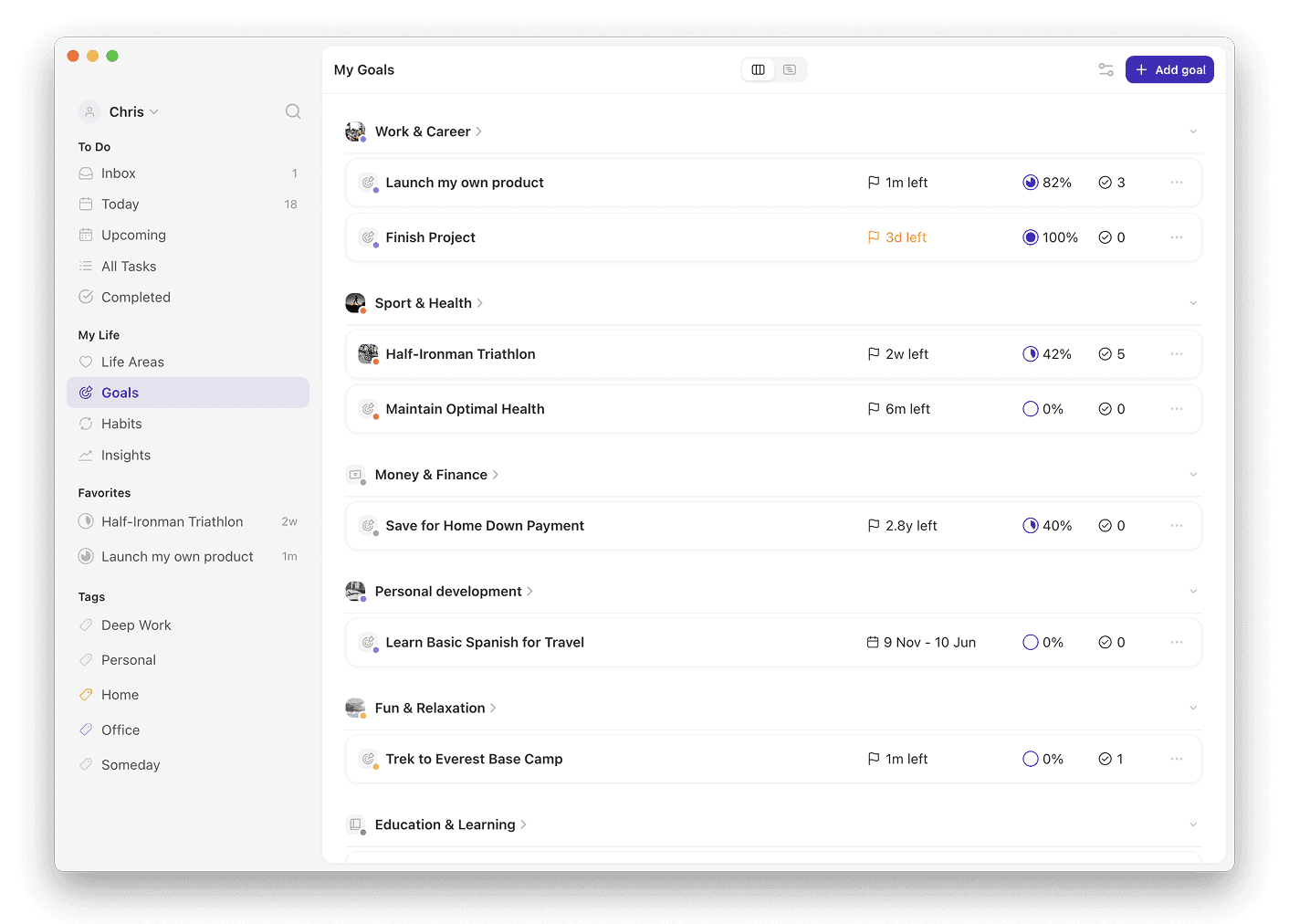
Griply is built around a hierarchy: Life Area, Vision, Goal, Subgoal, Task, Habit. Every action you take in Griply traces back to something you have committed to at the goal or vision level.
Each Life Area (such as Work & Career, Sport & Health, or Money & Finance) holds a Vision: a written statement of long-term intent. Goals sit beneath the vision, each with a start value and a target value tied to a deadline. Progress is logged as a line chart. Subgoals cascade under goals with the same measurable structure.
Habits in Griply are connected to goals, not floating in isolation. The Today view surfaces which goals your tasks are serving, so you open Griply each morning and immediately know what to do and why. The Goal Roadmap gives you a Gantt chart view of your goals and subgoals laid out over time.
Griply does not cover notes, knowledge capture, or journaling. Griply runs on iOS, Android, web, and desktop with a free plan available. For those layers, users pair Griply with Obsidian or a lightweight notes app.
A life OS vs. a task manager
A task manager answers one question: what do I need to do? A life OS answers a prior question: what am I trying to achieve, and what do I need to do to get there?
Most productivity apps are bottom-up. They start with the task and stop there. The task has no goal attached to it, no reason it was chosen over another task, no connection to any larger outcome. The result is a perfectly organised list of things to do with no guarantee any of them matter.
A life OS is top-down. You start with vision, move to goals, then tasks. Every action has a traceable path back to what you said you wanted. This is what separates a life OS from a task manager. General-purpose tools like Notion require users to build that hierarchy themselves; Griply's is fixed.
Related questions
What is the difference between a life OS and a productivity system?
A productivity system focuses on managing tasks and time efficiently. A life OS starts one level higher, with your vision for each area of life, and derives tasks from goals rather than capturing them in isolation. Griply is built on this distinction: every task and habit can link back to a goal.
Do you need Notion to build a life OS?
Notion is the most widely used platform for life OS setups because it handles both the goal layer and the knowledge layer in one place. It requires significant manual configuration. Griply is a purpose-built alternative for the goals-tasks-habits layer that works without setup.
How does Griply compare to Notion for building a life OS?
Notion handles all six life OS layers but requires manual configuration for each. Griply covers the goal, habit, and task layers with a pre-built hierarchy, no setup required. For knowledge and notes, users pair Griply with Obsidian.
Can Griply replace Notion as a life OS?
Griply replaces Notion for goal tracking and habit management. It does not replace Notion's note-taking or database functions. Users who need a full life OS with a knowledge layer typically run Griply alongside Obsidian or a lightweight notes app.
What apps do people use to build a life OS?
Notion is the most common choice because it handles goals, notes, and databases in one workspace. Obsidian is popular for the knowledge-capture layer. Griply is purpose-built for the goal-execution layer: goals, habits, and tasks in a fixed hierarchy with no configuration required.
What is the Wheel of Life and how does it relate to a life OS?
The Wheel of Life is a self-assessment tool that scores satisfaction across life areas on a scale of one to ten. It is the most widely used starting point for defining which life areas to include in a life OS. Griply's Life Area structure maps directly to the categories the Wheel of Life identifies.