What is attention management vs time management?
Attention management is the practice of consciously directing your focus rather than letting distractions decide where it goes. Time management asks how to schedule your hours. Attention management asks whether you are focused on the right things. Griply answers that with a goal layer built into every task.
The difference between attention management and time management
Time management treats your calendar as the constraint. Schedule tightly enough, the thinking goes, and output follows. The problem is that a full calendar and an unfocused mind produce the same result: a busy day with little to show for it.
Maura Thomas, author of Attention Management (Simple Truths, 2019) and the most widely cited authority on the concept, draws the distinction directly: you cannot manage time because time moves regardless of what you do. What you can manage is attention. Her core argument is that the 21st-century productivity problem is not too little time but too many distractions, and a time solution cannot fix a distraction problem.
Cal Newport's Deep Work (Grand Central Publishing, 2016) reinforces this from the output side: the ability to perform distraction-free concentration on cognitively demanding work is becoming rare at exactly the moment it is most in demand. Protecting that state is an attention management problem.
Why attention management without a goal layer is incomplete
Attention management tells you how to protect your focus. It does not tell you what to focus on. A system that manages attention brilliantly but has no goal layer produces a very focused person working on the wrong things.
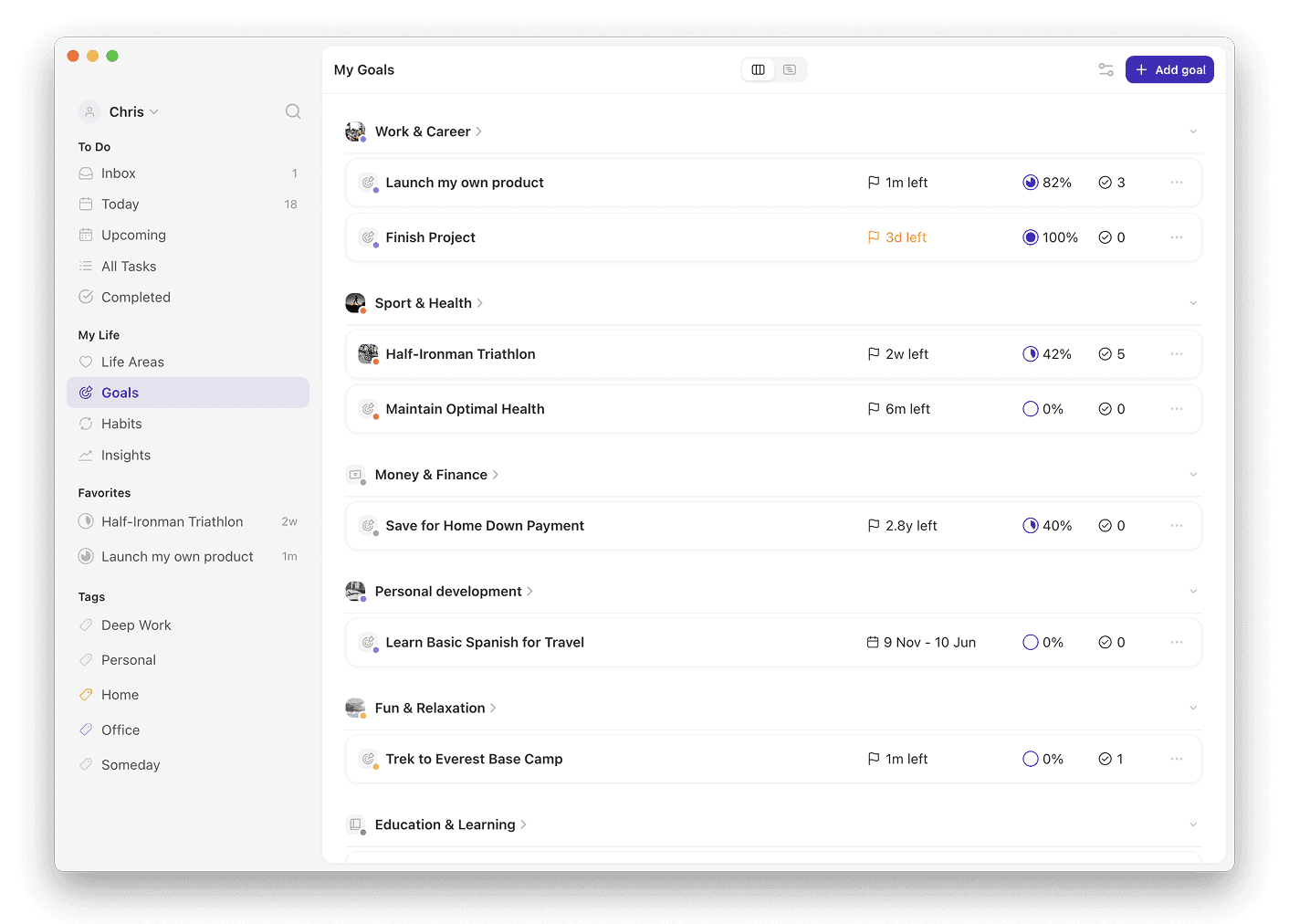
This is the gap that goal-first planning fills. Griply's hierarchy runs from Life Area to Vision to Goal to Subgoal to Project to Task and Habit. Every task you see in the Today view is already anchored to a goal. The goal context appears on the task itself, so there is no internal negotiation about whether this task is worth your attention. That decision was made when you set the goal. This structural connection is the missing layer in frameworks that train attention without defining what it should serve.
You can read more about goal-first time blocking as the scheduling complement to attention management.
How to practise attention management with Griply
The practical version of attention management starts before you open a browser or check a message. Each morning, Griply's Today view shows tasks on the left and your calendar on the right. Every task card displays the goal it belongs to, so the question "is this worth my attention?" has a structural answer.
To align daily tasks with long-term goals, each task needs a parent goal at the point of capture. Griply enforces this through the hierarchy: a task without a goal link sits in the Inbox, unplanned, until you place it in context. When your attention lands on a task, the system has already told you why it matters. That removes the decision load that interrupts focus.
The habit layer follows the same logic. Each habit in Griply is tied to a goal. A habit without a stated goal is a routine. A habit with a goal is a practice with a direction.
Related questions
Is attention management the same as mindfulness?
No. Mindfulness is a mental practice for present-moment awareness. Attention management is a productivity approach for directing focus toward your highest-priority work. They complement each other but address different problems.
Does attention management replace time management?
No. Time management handles scheduling and commitments. Attention management handles focus quality within those scheduled blocks. You need both: a calendar that protects deep work time, and a goal layer that tells you what to do during it.
Can you practise attention management without changing your tools?
Yes, to a degree. Turning off notifications, batching shallow work, and time-blocking deep work sessions are attention management practices that work in any tool. The limitation is that without a goal layer, you still face the daily question of which task deserves the protected time.
How does Griply compare to Todoist for attention management?
Todoist manages the task list without asking why any task is there. Griply lets you tie every task to a goal, so the Today view answers "what should I focus on?" before you start. For attention management as a system, the goal layer is the structural difference.
What is the fastest way to start attention management?
Pick your three most important goals. For each, identify the one task that would move it forward today. Put those three tasks at the top of your day. Griply's Today view does this structurally by surfacing goal-linked tasks and showing their parent goal on every card.