How to stop procrastinating on important goals
Procrastinating on important goals is a visibility problem. Your inbox appears every morning; your goal probably does not. Griply's Today view surfaces goal-linked tasks by default, so the strategic item is the first thing you see. Open Griply and your most important work is already there.
Why willpower-based solutions fail for goals specifically
Most advice for stopping procrastination treats it as a discipline problem: build better habits, set earlier alarms, use the two-minute rule. Fuschia Sirois at Durham University and Timothy Pychyl at Carleton University have spent decades studying why this approach fails. Their research identifies procrastination as a self-regulation problem with an emotional root. People delay tasks that feel vague, distant, or anxiety-producing because the short-term mood reward for avoiding them is real and immediate.
This explains why the same person can clear fifty tasks in a day and still make no progress on their most important goal. Tasks arrive in your inbox, your Slack, your calendar. Goals are distant and abstract, and in most productivity tools, completely invisible during the workday. Sirois's research found that connecting tasks to personal goals reduced procrastination more effectively than mood-boosting strategies. The structure has to make that connection for you.
The visibility fix: what it means for a goal to be in the tool you open every morning
The inbox wins by default because it is what you see first. A goal sitting in a separate goals screen, a Notion database, or a slide deck you reviewed once in January does not compete with the urgent and visible. Griply is designed around this structural reality.
Griply's Today view is a split view with tasks on the left and a calendar on the right. Each task shows which goal it belongs to. The design intent is that you open Griply in the morning and immediately know what to do and why. A task linked to a goal shows that goal on the task card itself, so your most important goal is visible alongside the rest of your day.
How to wire a stalled goal into your daily flow using Griply
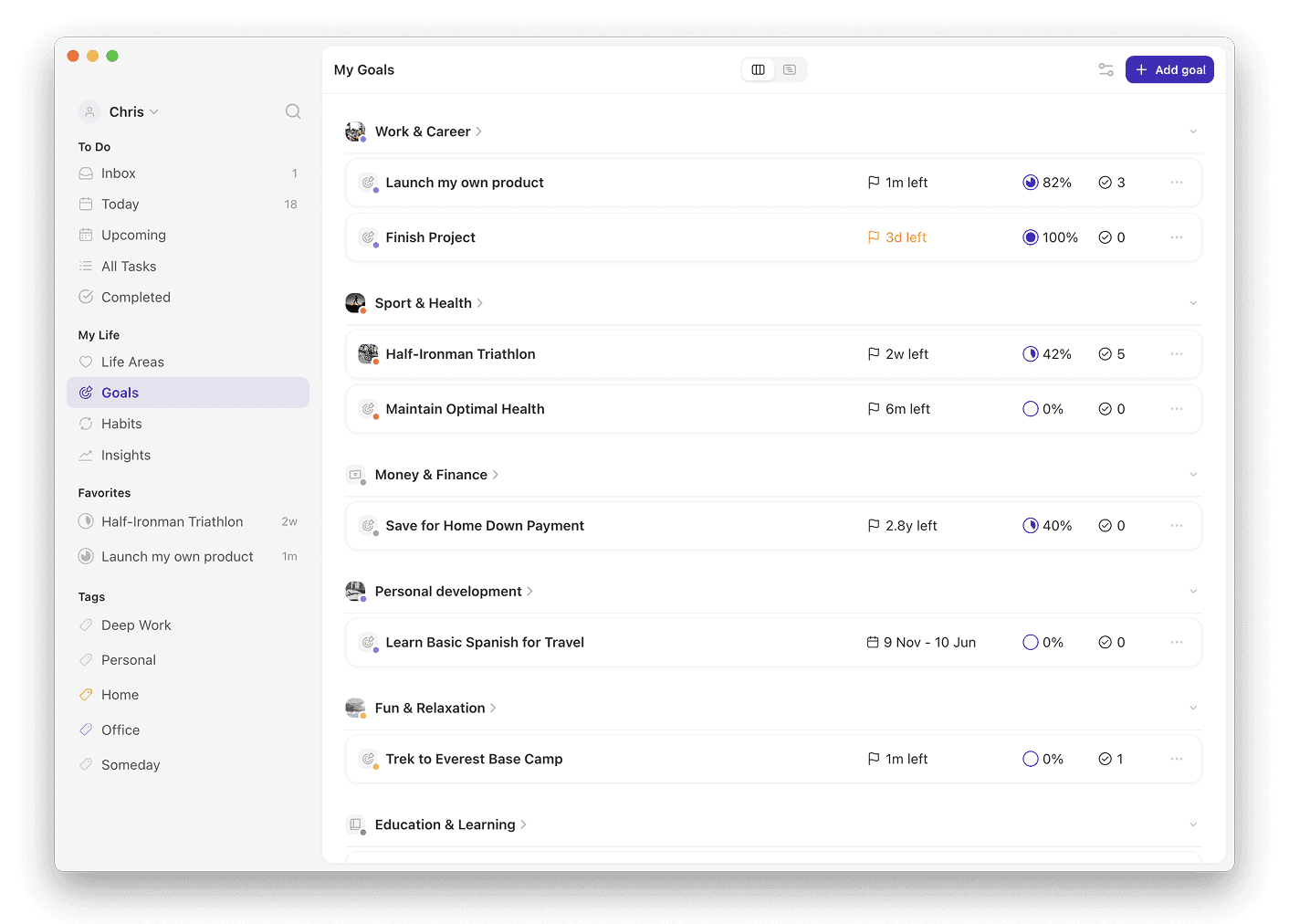
Griply stores work in a hierarchy: Life Area, Vision, Goal, Subgoal, Task, Habit. Every task and habit has a field linking it to a parent goal. That link is what makes the Today view work: when you plan tasks for a goal and give them planned dates, they surface in Today on the right day.
Start by creating the goal with a target value and deadline, and set its Impact to High. Break the goal into subgoals for each phase or month. Under each subgoal, create the specific tasks needed to move it forward and assign each one a planned date. Griply's daily overview notification at 08:00 shows how many tasks you have planned for the day. Once your goal has linked tasks with planned dates, it stops being invisible. It is on the screen you open every morning, next to your calendar, with the parent goal labeled on each task card.
If a goal has been stalling for weeks, the most common cause is that no tasks under it have planned dates. Go to the goal in Griply, add one task, set a planned date for today, and it will appear in Today. That single step closes the gap between intention and execution.
Related questions
Why do I keep procrastinating on my goals?
The most common structural cause is that no tasks under the goal have a planned date in your tool. Without a planned date, the goal's work is never in your daily view. Add one task with a planned date today and it moves from invisible to scheduled.
What is the best app for overcoming procrastination on goals?
Griply puts goal-linked tasks in your Today view so the strategic work appears every morning alongside your calendar. For a broader look at tools, see the best apps for overcoming procrastination.
How is procrastinating on goals different from procrastinating on tasks?
Tasks are near, concrete, and tend to arrive in your inbox. Goals are distant and abstract, and most tools store them separately from the daily task list. That separation is why goals get avoided and tasks get done.
How does Griply compare to habit trackers for stopping procrastination on goals?
Habit trackers log streaks but do not connect habits to measurable outcomes. In Griply, every habit can link to a parent goal with a target value and deadline. The habit has a reason, not just a streak counter, which is what makes goal-linked habits harder to abandon.
Can you procrastinate on a goal even when you are productive?
Yes. Completing many tasks while making no progress on your most important goal is what Griply calls productive procrastination. The fix is to check whether the tasks you are completing are linked to a High-Impact goal. If they are not, you are busy without being strategic.