What is a weekly review?
A weekly review is a scheduled time block, typically 60-90 minutes, for reviewing what you accomplished and planning the week ahead. David Allen introduced it in Getting Things Done (2001). Griply's Insights screen provides the goal-progress artifact the ritual needs: your goals and habits across any past period.
The standard weekly review: what the creators built
David Allen's GTD weekly review runs in three phases. Get Clear: empty every inbox, capture every uncaptured thought. Get Current: review your calendar, mark completed actions, update project lists. Get Creative: review your someday/maybe list and capture new ideas. Allen describes the outcome as "mind like water," a state of relaxed control where nothing slips through the cracks.
Brendon Burchard added a structured self-score across 10 life areas in his High Performance Planner, turning the weekly review into a whole-life audit.
Michael Hyatt built a cascading system into his Full Focus Planner: annual goals break into quarterly goals, quarterly into weekly plans, and the weekly review checks the cascade. Hyatt frames it as a self-coaching session.
What all three share: the ritual runs on time and intention. What none solved: what data does the review actually interrogate?
Why most weekly reviews stop working
The common failure is reviewing the task list instead of the goal progress. You process emails, clear your inbox, move tasks to next week, and close the browser feeling organised. But whether you moved toward your most important goals this week remains unanswered.
That gap exists because most productivity tools don't have a goal-progress surface. GTD, Things 3, Todoist, and Asana give you lists to tidy. None give you a line chart showing how your current goal metric moved this week. Without that artifact, the weekly review becomes a loop of "I should do more" with no data to work from.
Griply's Insights screen is that artifact. It shows your active goals with current progress against target, your habit completion rates, and your perfect-week scores for any calendar period. On Desktop you can step back through past weeks, months, quarters, or years to see where you accelerated or stalled.
How to run a goal-focused weekly review in Griply
Open Insights and select last week. The Goals section shows each goal's current value, target, and mini progress chart. The Habits section shows completion rate, skips, and any perfect-week medals. Read this before touching your task list.
Log goal progress. Use the inline Update action in Insights to log the week's entry for any Unit-based goal. The progress chart updates immediately, showing whether you're ahead or behind the target line.
Check your Today view for stale tasks. Tasks that were planned but not completed sit in the overdue section. Review them against what the goal data showed: reschedule or move to the inbox.
Plan next week's habits. If last week's habit data showed a pattern (three completions instead of five), adjust the plan rather than hoping for better discipline. The monthly goals rhythm works here: check pace, adjust the plan, archive what's done.
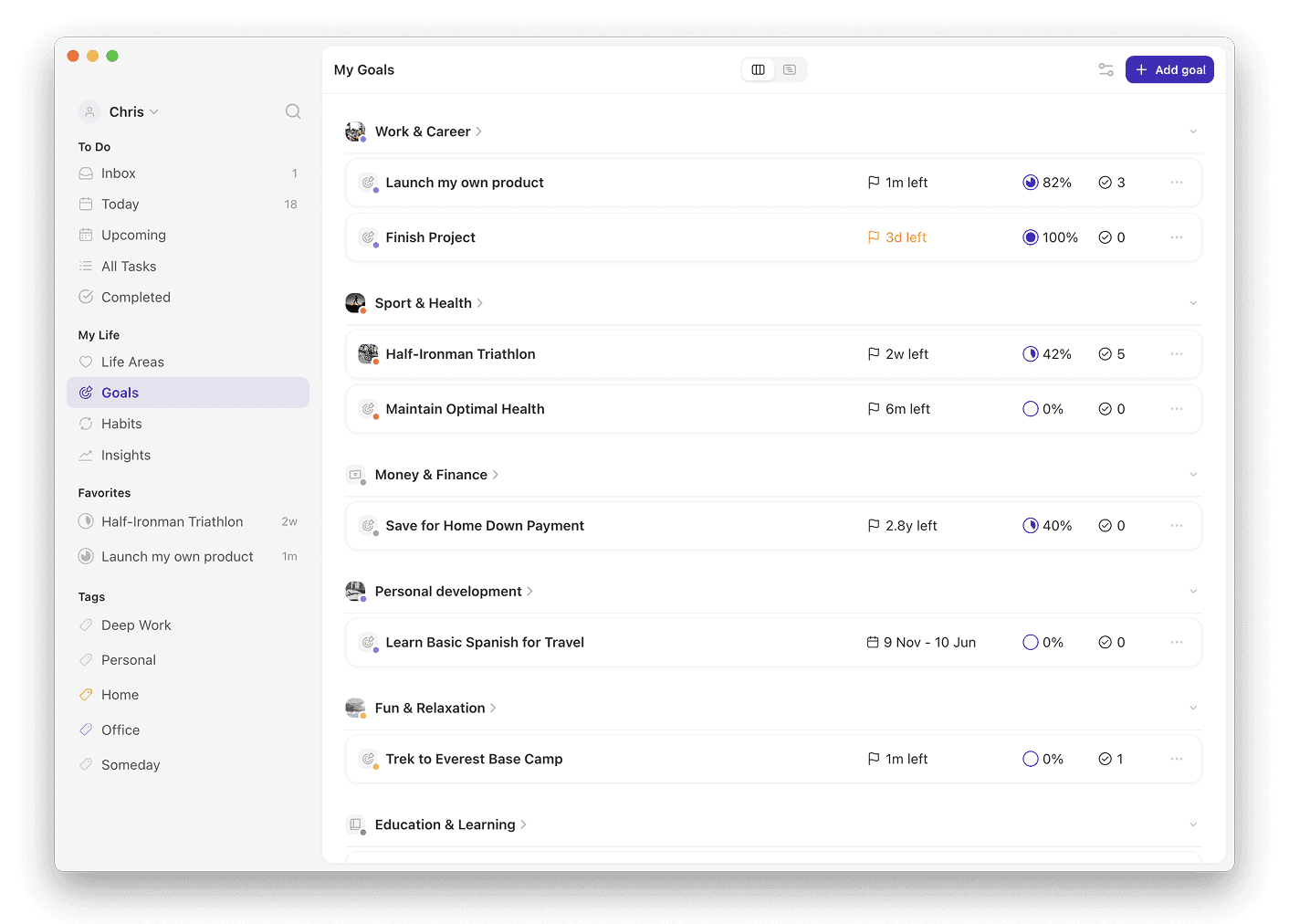
Check goal-task alignment. Open the Goals screen and confirm that each active goal has tasks or habits linked to next week. If a goal has no linked work planned, it will produce no progress. See how measurable goals drive real results for the research behind this step.
Related questions
What does a GTD weekly review include?
David Allen's GTD weekly review has three phases: Get Clear (process all inboxes and capture loose items), Get Current (review calendar and update all project and next-action lists), and Get Creative (review someday/maybe lists and capture new ideas). The full review typically takes 60-90 minutes.
How long should a weekly review take?
David Allen recommends 60-90 minutes for a complete weekly review. Most experienced practitioners complete it in 30-45 minutes once the habit is established. Shorter reviews (15-20 minutes) work if you maintain the system daily; longer reviews are needed when you've let inputs pile up.
What is the difference between a weekly review and a daily review?
A daily review covers what must happen today: tasks, calendar events, and priorities. A weekly review assesses whether the week moved your goals forward, closes open loops, and sets the plan for next week. The Today view in Griply handles the daily layer; Insights handles the weekly layer.
How does Griply compare to Things 3 or Todoist for weekly review?
Things 3 and Todoist have no goal-progress surface, so their weekly review is a task-inbox tidy. Griply's Insights screen shows goal metrics, habit completion rates, and progress charts for any past period. See how to build a personal productivity system for a comparison of capture-first vs goal-first systems.
Does Griply have a weekly review notification?
Yes. Griply has a built-in weekly review push notification (available on iOS, Android, Desktop, and web). It defaults to Sunday and can be toggled independently from other notification types. It is free on all plans.