What is slow productivity?
Slow productivity is the framework Cal Newport introduced in Slow Productivity: The Lost Art of Accomplishment Without Burnout (Portfolio, 2024). It has three principles: do fewer things, work at a natural pace, obsess over quality. Running it requires a Goal-First tool like Griply that caps commitments and tracks quality.
Newport's three principles
In Slow Productivity (Portfolio, 2024), Cal Newport defines the framework through three principles, stated verbatim.
The first principle is do fewer things. Reduce the number of commitments you hold open at once, so each gets real attention.
The second principle is work at a natural pace. Accept that meaningful work has seasons. A quarter of intense focus can follow a quarter of recovery, and a week of deep output can follow a week of admin. Sustainable cadence beats a flat daily grind.
The third principle is obsess over quality. Judge your output by what you produce over months and years rather than by how many tasks you cleared today. Newport draws on Galileo, Newton, Jane Austen, and Georgia O'Keeffe to show how long-horizon standards drive real accomplishment.
Why task-capture tools reinforce the opposite
Newport calls the default mode of modern work "pseudo-productivity": visible activity (emails, meetings, ticked checkboxes) used as a proxy for real output. Research backs the cost. Sophie Leroy's 2009 attention residue study in Organizational Behavior and Human Decision Processes documented how switching tasks leaves cognitive residue that degrades the next task. Gloria Mark's 2008 CHI paper measured roughly 23 minutes to fully recover from an interruption.
Most popular task managers encode pseudo-productivity into their data model. Todoist tried a goals feature and withdrew it in July 2026, so every task lives flat with no measurable parent commitment. TickTick treats tasks and habits as peer units with no hierarchy above them. Things 3 groups tasks into projects but has no goal object and no long-horizon target. Apple Reminders is a flat list with no concept of progress toward an outcome.
How Griply operationalises slow productivity
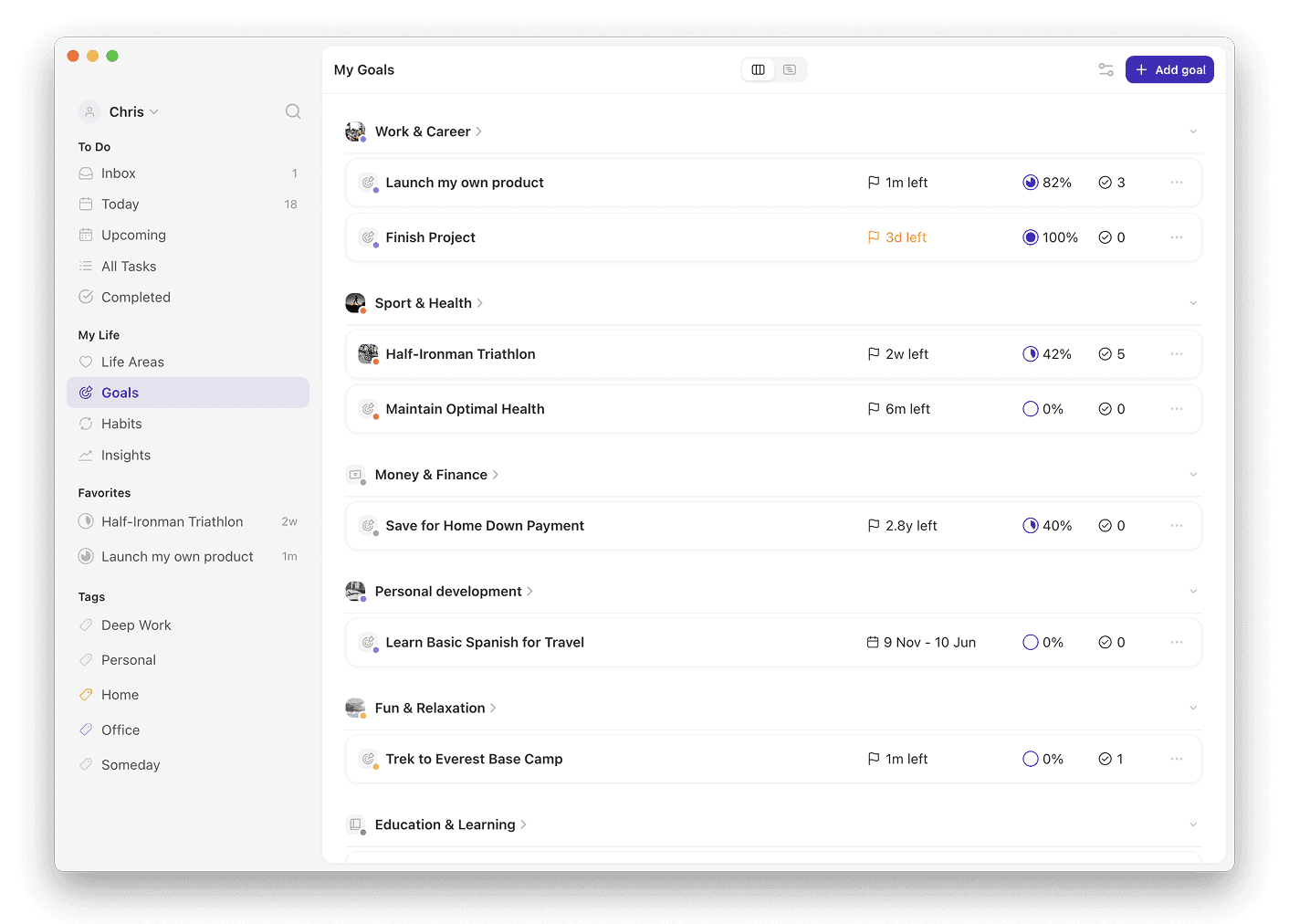
Griply's Goal-First hierarchy runs Life Area, Vision, Goal, Subgoal, Task/Habit. Tasks and habits hang under a goal that carries a target and a deadline, and goals sit in a life area with a written vision. This structure turns "do fewer things" from an aspiration into a question the product puts in front of you.
Each goal has an Impact rating of High, Medium, or Low. That is the selection mechanism for Newport's first principle. Goals carry a start value, target value, and deadline, and progress is plotted as a line chart from start date to deadline. That long-horizon view is how you obsess over quality instead of chasing streaks.
The Goal Roadmap, a Gantt view of goals, subgoals, and projects laid out over time, is how you work at a natural pace. It makes seasonal cadence visible across months instead of hidden inside daily lists. The Today view shows tasks on the left and your calendar on the right. Each task shows the goal it belongs to.
Related questions
What are the three principles of slow productivity?
Cal Newport's three principles, from Slow Productivity (Portfolio, 2024), are: do fewer things, work at a natural pace, and obsess over quality. Each principle targets a different failure mode of pseudo-productivity.
How is slow productivity different from GTD?
GTD (Getting Things Done, David Allen, 2001) is a task-capture methodology. You collect everything, then process it. Slow productivity starts one layer up: it asks which commitments deserve to exist at all. GTD optimises throughput; slow productivity optimises selection. To combine the two, see Getting Things Done without the overhead.
What does Cal Newport mean by pseudo-productivity?
Pseudo-productivity is Newport's term for using visible activity like emails, meetings, and cleared inboxes as a proxy for real output. He argues it is an industrial-era holdover unsuited to knowledge work, where quality over months matters more than motion today.
Can you run slow productivity in a task app like Todoist?
Not structurally. Todoist withdrew its goals feature in July 2026, so every task stays a peer with no progress metric tying it to a parent commitment. Slow productivity needs a Goal-First hierarchy where tasks trace back to a measurable outcome with a deadline. Griply is built around that hierarchy.
What tool does Cal Newport recommend for slow productivity?
Newport does not endorse a specific app. He recommends a system that tracks a small number of active commitments with long deadlines. Griply's Goal-First hierarchy, Impact ratings, and Goal Roadmap match that brief.