

The Eisenhower matrix is a four-quadrant decision tool that sorts every task by two criteria: how urgent it is and how important it is, so you know whether to do it now, schedule it, delegate it, or cut it entirely.
President Dwight Eisenhower reportedly drew the urgent-versus-important distinction in a 1954 address at the Second Assembly of the World Council of Churches. Stephen Covey's The 7 Habits of Highly Effective People turned it into the Eisenhower decision matrix that most people use today, labelling the four quadrants by their defining action: Do, Schedule, Delegate, and Eliminate. You may also see it called the Eisenhower box or the Eisenhower method; the framework is the same regardless of name.
The matrix has genuine power. It forces a question that most to-do lists never ask: is this task actually worth your attention? But it also has a structural gap that becomes visible once you try to use it consistently.
It tells you which task to do. It does not tell you why it matters or whether the category called "important" is tracking anything real in your life. Pairing it with a broader productivity system is what makes the "important" category actually hold.
Key takeaways
The Eisenhower matrix sorts tasks into four quadrants: urgent and important (Do), not urgent but important (Schedule), urgent but not important (Delegate), and neither (Eliminate).
Stephen Covey's Time Management Matrix in The 7 Habits of Highly Effective People popularised the framework for personal effectiveness and identified Quadrant 2 as where most high-impact work lives.
Specific, difficult goals beat "do your best" in roughly 90% of studies, which matters because the matrix's "important" category only does work when it's anchored to a real goal.
In Griply, every task has a Priority field (High / Medium / Low / None) and a Goal link field, giving you the urgency and importance data the matrix needs at capture time without a separate triage step.
What the four quadrants actually mean
Each quadrant has a default action:
Urgent and important (Q1, Do): Crises, deadlines, genuine emergencies. Handle these first.
Not urgent but important (Q2, Schedule): Strategic work, skill development, relationship building. Covey argued this is where high performers actually spend their time.
Urgent but not important (Q3, Delegate): Interruptions, many meetings, requests that feel pressing but don't serve your priorities.
Neither (Q4, Eliminate): Busy work, distraction, anything you do to avoid the harder tasks.
Most people arrive at the matrix with a Q1 backlog and almost nothing in Q2.
Why Quadrant 2 is where your real work lives
Covey's central argument in The 7 Habits of Highly Effective People is that effective people live primarily in Q2. They invest time in the work that matters before it becomes urgent, which means fewer crises and more progress on the things they chose on purpose.
The reason Q2 work gets skipped is simple: nothing forces it. Q1 items have deadlines and consequences. Q2 items have neither. You can defer strategy work, learning, and relationship maintenance indefinitely without any immediate cost, and the cost only shows up months later when the goal you were "getting around to" is still untouched.
Procrastination is a self-regulation failure rooted in short-term mood regulation. Q2 tasks are the natural home of procrastination because they carry no external pressure. The fix is to give them a scheduled block before the week starts, treating them like Q1 work that hasn't turned urgent yet. The time blocking method is built around exactly this move.
The matrix's structural gap: what does "important" mean?
Here is where most guides on the Eisenhower matrix go quiet. They explain the quadrants clearly and then assume you already know which category is important. You don't, and neither does the framework.
"Important" is not a property of the task. It is a relationship between the task and a goal you have committed to. Writing a proposal for a client you have decided to pursue is important. Writing a proposal for a client you are not sure about is not. The task is identical. What changes is whether it traces back to something you have chosen.
The goal-setting research makes the point directly: specific, difficult goals outperform vague intentions like "do your best" in roughly 90% of studies. The reason is feedback. A goal with a target gives you a way to know whether the work you are doing is closing the gap. Without that, "important" is just a feeling that changes with your mood.
This is the gap the matrix alone cannot close. It categorises tasks by urgency and importance but leaves the definition of "important" up to you. To know what belongs in Q2, you need to have defined your goals first, so "important" has an actual referent.
How to use the Eisenhower matrix for time management
Sort every task by asking two questions: does it have a real deadline or immediate consequence? Does it move a goal you have committed to? The answers place it in a quadrant.
Work through Q1 first. Schedule protected time for Q2 before anything else claims the calendar. Delegate genuine Q3 requests where possible and delete Q4.
The review frequency matters as much as the initial sort. A weekly sweep of your task list against the four quadrants takes fifteen minutes and keeps Q2 from filling silently with tasks that should be eliminated. If Q1 expands every week, the root cause is usually deferred Q2 work that became urgent.
For Q1 items specifically, treating the hardest one as your first task of the day captures the most cognitive energy for the work that cannot wait.
Is the Eisenhower matrix good for ADHD?
The matrix has real appeal for ADHD because it replaces a flat, undifferentiated task list with a structure that makes priority visible at a glance. When every task looks identical on a list, the one nearest the top or the one that feels least threatening wins by default, and that is rarely the most important one.
The challenge is that the matrix requires the sorting step to happen before the workday starts, and that step is easy to skip when executive function is low. The solution is to build the sorting as a fixed ritual at the end of the previous day so you wake up to an already-organised list rather than a triage problem.
The ADHD-specific adaptation that tends to work best is keeping Q1 to a hard maximum of three tasks. A Q1 list with ten items is not Q1, it is an unreviewed inbox. The constraint forces honest ranking.
Eisenhower matrix examples across common situations
A few examples across work and personal contexts:
Work tasks:
Q1: A presentation due in two hours for a client who has asked for it.
Q2: Researching a skill gap that would change your career trajectory in the next two years.
Q3: A colleague's Slack request for input on their project, marked urgent by them.
Q4: Reformatting last quarter's report in a way nobody asked for.
Personal tasks:
Q1: A medical appointment you have been postponing that now has a deadline from your doctor.
Q2: Weekly exercise that compounds over time but has no external pressure.
Q3: A family member's request to review their CV by Friday.
Q4: Scrolling for tools to optimise your existing system.
The consistent pattern is that Q4 often looks like productivity. Reformatting, reorganising, and researching new tools can feel like work and generate zero real output. The guide on why goals fail calls this productive procrastination, the habit of staying busy on low-stakes visible work to avoid high-stakes invisible work.
How Griply makes the matrix decision structural
The Eisenhower matrix is a thinking tool. You can use it with a paper notebook. The reason most people use it inconsistently is not that the framework is hard to understand; it is that applying it requires a separate triage step that most apps do not support.
Griply gives you the two pieces of information the matrix needs at capture time. Each task has a Priority field (High / Medium / Low / None) and a field to link it to a Goal in the Goal Planner. Together, those two fields let you see whether a task is urgent, whether it connects to a goal you have committed to, and therefore where it belongs, without a separate triage exercise.
The Task Manager Today view surfaces which goals today's tasks are serving, so when you open Griply in the morning you can see the goal behind every task on your list.
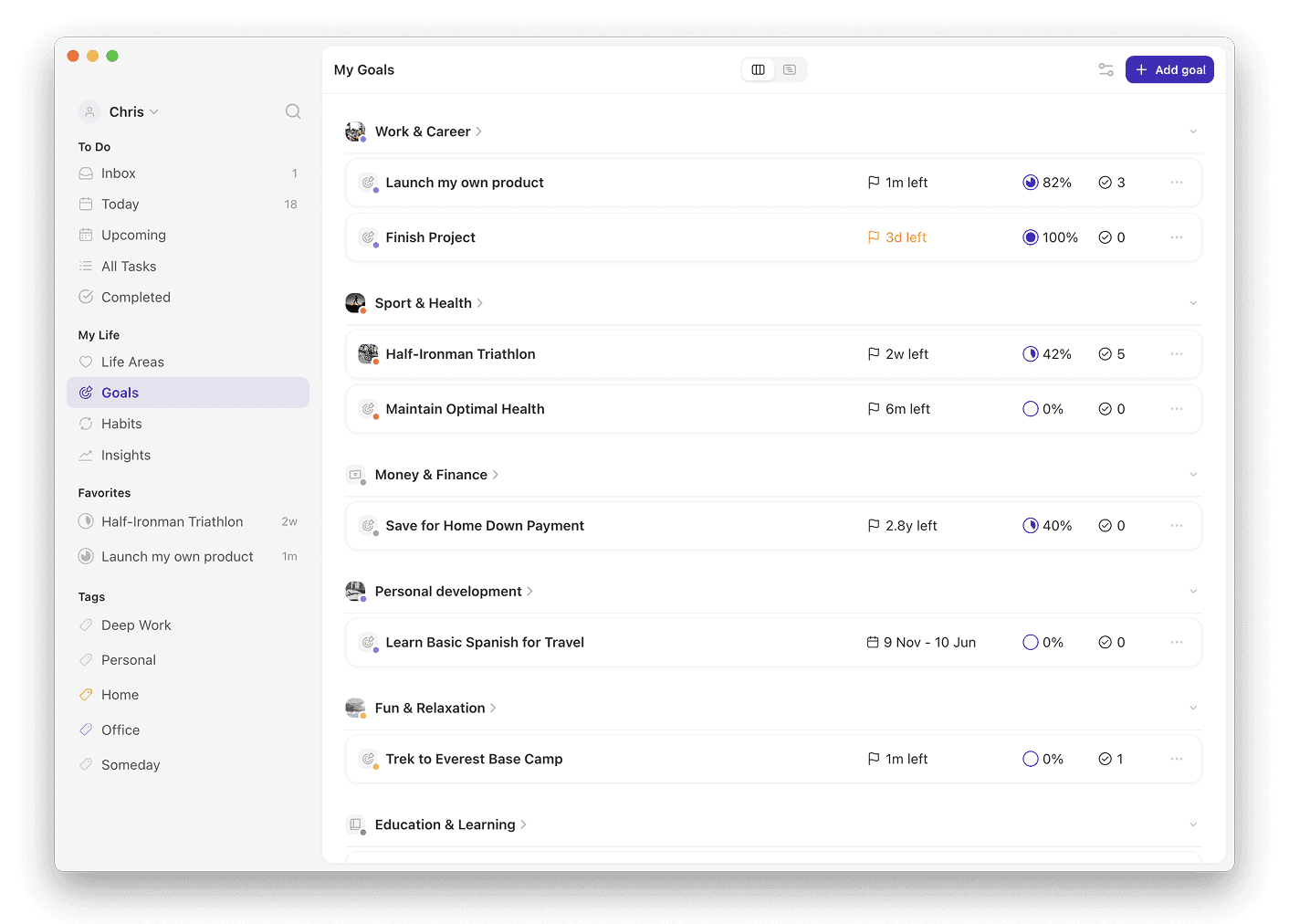
For Q2 work specifically, Griply's Goal Roadmap shows multi-month and multi-year goals laid out on a timeline. That view turns Q2 from "someday" into a specific window on the calendar with a measurable target, which is the structural move that makes Q2 work actually happen.
Frequently asked questions
What is the Eisenhower matrix in simple terms?
The Eisenhower matrix is a four-quadrant grid that sorts tasks by urgency and importance. Urgent and important tasks go in Q1 (do now). Important but not urgent go in Q2 (schedule). Urgent but not important go in Q3 (delegate). Neither go in Q4 (eliminate).
Which quadrant do most productive people focus on?
Covey's argument in The 7 Habits of Highly Effective People is that high performers live primarily in Quadrant 2: important but not urgent work like strategic planning, skill development, and relationship building. Q2 expands only when you schedule it deliberately before Q3 requests fill the week.
What can be urgent but not important (Q3)?
Common Q3 tasks include most meeting requests, many email replies, colleague interruptions, and requests that feel pressing because someone else has a deadline. The test is: if this task disappeared, would it affect any goal you have committed to? If not, it belongs in Q3 at best.
How often should you review your Eisenhower matrix?
A weekly review of fifteen to twenty minutes keeps the matrix current. Sort new tasks as they come in and check once per week that Q2 items have protected time on your calendar. Without the weekly sweep, Q2 empties as tasks get displaced by Q3 pressure without being deliberately promoted.
Is the Eisenhower matrix enough on its own?
The matrix sorts tasks well. It does not define what "important" means. Pairing it with a goal-setting framework, where every task in Q2 traces back to a specific measurable outcome, gives "important" a concrete definition and prevents the category from filling with tasks that feel significant but do not move anything forward.
The matrix sorts tasks; your goals define which quadrant they belong in
The Eisenhower matrix gives you a structure for the question most productivity tools never ask: should this task be on your list at all? That is worth taking seriously.
But the framework's "important" column only does useful work when it is anchored to goals you have actually defined. Without that anchor, "important" shifts with stress levels and social pressure, which means Q2 fills with whatever felt meaningful at the moment of capture and empties when the week gets busy.
The most durable version of the matrix is paired with goals specific enough that "important" has the same answer on Monday and on Friday.
Related Guides
Covey, Stephen R. The 7 Habits of Highly Effective People. Simon & Schuster, 1989. https://www.simonandschuster.com/books/The-7-Habits-of-Highly-Effective-People/Stephen-R-Covey/9781982137274
Locke, Edwin A., and Gary P. Latham. "Building a Practically Useful Theory of Goal Setting and Task Motivation." American Psychologist, 2002. https://pubmed.ncbi.nlm.nih.gov/12237980/
Steel, Piers. "The Nature of Procrastination: A Meta-Analytic and Theoretical Review of Quintessential Self-Regulatory Failure." Psychological Bulletin, 2007. https://pubmed.ncbi.nlm.nih.gov/17201571/