Guide


Table of Contents
A mid year review is a structured check on your personal goals at the halfway point of the year, where you read your first six months of progress data and decide what to keep, change, or let go for the second half. It is not the employee performance review your manager schedules. It is the one you run on yourself, on the goals you set in January.
By June, most January goals have split into three groups: ones ahead of pace, ones that quietly stalled, and ones that no longer match the person who set them. The temptation is to either pretend nothing changed or to scrap everything and start over.
Both skip the only thing that makes the next six months better than the last: the data you already have. Six months of progress is the most honest feedback your goal setting system gives you, and a good mid year review reads it before deciding anything.
Key takeaways
A mid year review is a decision procedure: read the data first, then choose what to keep for the second half.
Treat each goal as a feedback loop, where the gap between your current number and your target is the signal to act on.
Dropping an unreachable goal only helps if you redirect that time into a new one, so demote and replace in the same sitting.
In Griply, archiving a drifted goal keeps it recoverable, while a surviving goal can hold fresh H2 subgoals on the progress chart.
Why a mid year review lands at a real reset point
The middle of the year feels like a natural place to start again, and that feeling has a measurable basis. It is called the fresh start effect: temporal landmarks such as the start of a week, a month, or a year prompt people to pursue goals more aggressively because the landmark separates them from a past self that fell short.
A mid year goal review uses that effect on purpose. June and July sit far enough from January that your old plan no longer feels binding, which makes it easier to drop what is not working without treating it as failure.
The risk is spending that motivation on a blank-slate restart instead of an informed reset. The fresh start gives you the energy to change direction; your six months of data tells you which direction.
Read the progress chart before you judge any goal
Start with the number, not the feeling. For every goal you set in January, find three things: where you started, where you are now, and where you planned to be by this point. The distance between your current value and your expected pace is the only fact a mid year review needs to begin.
Think of each goal as a feedback loop: you compare where you are against where you meant to be, and the gap is what tells you to act.
Without a tracked metric, there is no gap to read, only a vague sense that things went well or badly. This is why a measurable goal with a baseline and a target survives a mid year review and a vague intention does not.
Tracking your own progress is one of the strongest predictors of whether you reach what you set out to do. Reading that progress is the work, not the prep for it.
Sort every goal into promote, hold, or demote
Once you can see each gap, sort your goals into three groups. This is the core of any goal review, and it replaces the all-or-nothing instinct with a decision per goal. Two quarters of evidence are now in, so your Q2 goals have either closed their gap or shown you they will not.
Promote: goals ahead of pace or clearly still mattering. Give them more time in H2.
Hold: goals on track and well-scoped. Leave them and keep logging.
Demote: goals that stalled or no longer fit who you are now.
Promotion is where most reviews underinvest. A goal that is ahead of schedule is evidence about where your energy actually goes, so raising its priority for the second half is a data-backed bet rather than a guess. Demotion is harder, because dropping a January goal can feel like quitting.
Demote what drifted without pretending it never mattered
Not every goal earns the second half of the year. Some were set by a version of you whose priorities have moved, and dragging them forward out of guilt costs attention the surviving goals need. The research on goal disengagement and reengagement is direct here: letting go of an unreachable goal protects your well-being, but only when you reengage with a new goal in its place.
That finding is the rule for demotion. Cutting a goal in isolation leaves a hole; cutting it and redirecting that time into a goal you do care about is what the review is for. When you demote a goal, name what takes its place in the same sitting.
Be honest about which goals are genuinely unreachable versus merely behind. A goal that is behind because the target was always realistic still belongs in your H2 plan, possibly with a longer timeline. A goal that is behind because you no longer want the outcome belongs in the demote pile, and that is a legitimate result of a goal review, not a personal shortcoming.
Rebuild a 90-day plan for the second half
With your goals sorted, the second half needs a plan you can actually run. A six-month horizon is too long to hold attention, which is why Brian Moran and Michael Lennington's 12 week year treats a roughly 90-day cycle as a full planning unit. For an H2 reset, that means turning each surviving goal into a set of subgoals scoped to the next quarter.
Break each promoted or held goal into two or three subgoals with their own targets and deadlines inside the July-to-September window. These shorter cycles give you a checkpoint before the year ends, so a stalled goal becomes visible in September rather than in December when it is too late to correct. Operating those subgoals month by month is exactly the cadence covered in the guide to monthly goals.
A rebuilt H2 plan should be smaller than your January list. You have six months of evidence about how much you can carry at once, so use it to set a load you will still be running in October.
How Griply turns a mid year review into a few decisions
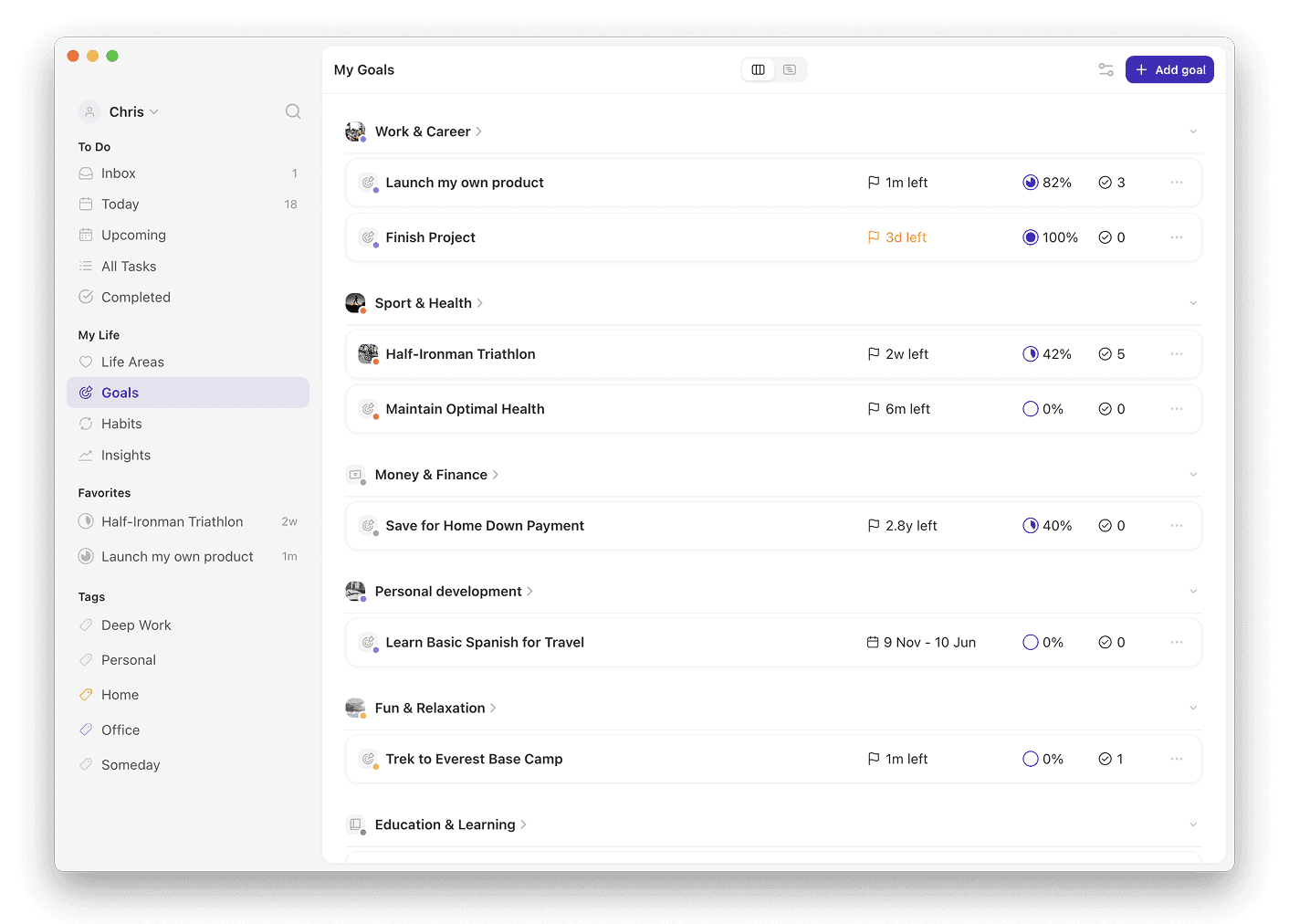
A mid year review depends on having the data in front of you, and that is the gap most planning tools leave open. Griply gives each goal a start value, a target value, and a deadline, with progress shown on a line chart against a target line, so the gap you need to read in step one is already drawn. The Goal Planner is where you see at a glance which goals are ahead of pace and which have stalled.
Sorting follows from that chart. A goal that is clearly working gets a higher Impact rating to promote it through H2, and a goal that drifted gets archived, which keeps it recoverable rather than permanently deleted, so demoting a goal stays reversible. For the goals you keep, the Goal Roadmap lays subgoals across the second half so your rebuilt 90-day plan is visible as a timeline.
Because Griply uses the hierarchy Life Area to Vision to Goal to Subgoal to Project to Task and Habit, each new H2 subgoal stays connected to the goal it serves and the life area above it. The review ends as a handful of decisions on goals you can already see, instead of a blank page.
Frequently asked questions
What is a mid year review?
A mid year review is a structured check on your personal goals at the year's halfway point. You read your first six months of progress data, then decide which goals to keep, adjust, or drop for the second half. It is run on yourself, not by a manager.
When should I do a mid year review?
Late June or early July works best, because it sits at the calendar midpoint and benefits from the fresh start effect that temporal landmarks create. Block 60 to 90 minutes once, rather than reviewing in scattered pieces, so you can see all your goals together.
How is a mid year review different from a quarterly review?
A quarterly review checks one three-month cycle, while a mid year review weighs six months of data and resets the whole second half. The mid year version is where you make bigger calls, like dropping a goal or rebuilding your plan around what the data shows.
Should I drop goals I have not made progress on?
Drop a goal only if you no longer want its outcome, not just because it is behind. Letting go protects your well-being when you reengage with a replacement goal, so name what takes its place before you cut it.
What is the best way to track goals through the second half?
Track each goal with a metric, a target, and a deadline so progress stays visible week to week. Griply lets you link every habit and task to a parent goal and charts progress automatically, which is what makes the next mid year review a reading exercise rather than a guess.
The review is a reading exercise before it is a planning one
The instinct in June is to plan: a new list and a clean slate. The more useful move is to read first. Your six months of progress data already contains the answer to which goals deserve the second half, and skipping it means rebuilding on guesses instead of evidence.
Sort before you plan, demote with a replacement in hand, and scope H2 to a load you have proven you can carry. Done that way, a mid year check in costs an evening and saves the half-year that follows.
Related Guides
Charles S. Carver, Michael F. Scheier. "Control theory: A useful conceptual framework for personality-social, clinical, and health psychology." Psychological Bulletin, 1982. https://pubmed.ncbi.nlm.nih.gov/7134324/
Hengchen Dai, Katherine L. Milkman, Jason Riis. "The Fresh Start Effect: Temporal Landmarks Motivate Aspirational Behavior." Management Science, 2014. https://faculty.wharton.upenn.edu/wp-content/uploads/2014/06/Dai_Fresh_Start_2014_Mgmt_Sci.pdf
Traci Sitzmann, Katherine Ely. "A Meta-Analysis of Self-Regulated Learning in Work-Related Training and Educational Attainment: What We Know and Where We Need to Go." Psychological Bulletin, 2011. https://pubmed.ncbi.nlm.nih.gov/21401218/
Carsten Wrosch, Michael F. Scheier, Gregory E. Miller, Richard Schulz, Charles S. Carver. "Adaptive Self-Regulation of Unattainable Goals: Goal Disengagement, Goal Reengagement, and Subjective Well-Being." Personality and Social Psychology Bulletin, 2003. https://pubmed.ncbi.nlm.nih.gov/15018681/