What is a personal operating system?
A personal operating system is the integrated set of principles, habits, routines, and tools a person designs to manage their life and work. The concept is broader than any single app. Griply covers the execution layer: goal hierarchy, linked tasks and habits, and progress tracking.
Griply: built-in Life Area → Goal → Habit hierarchy with goal metrics and a visual roadmap; no setup required; rated 4.7 on the App Store; iOS, Android, web, and desktop; free plan (2 goals, 2 habits, unlimited tasks), Premium $4.99/month or $29.99/year
Notion: fully flexible workspace where you build your own personal OS from scratch; no native goal tracking or habit layer; all platforms; free plan available
Obsidian: local-first markdown knowledge base; strong for the direction layer (journaling, PKM) but has no goal or habit tracking without plugins; all platforms; free for personal use
Spreadsheet (Google Sheets / Excel): zero learning curve; no automation, no reminders, no progress visualization; free or included with Office 365
App | Built-in hierarchy | Goal tracking | Habit tracking | No setup required | Free plan |
|---|---|---|---|---|---|
Griply | Yes | Yes | Yes | Yes | Yes |
Notion | No | No | No | No | Yes |
Obsidian | No | No | No | No | Yes |
Spreadsheet | No | Manual only | Manual only | No | Yes |
The full definition: what a personal OS covers
The computer metaphor is deliberate. Just as an operating system runs beneath every application on a device, a personal OS is the layer beneath all individual productivity tools. It coordinates direction, action, and feedback across every area of life.
The concept has no single originator. It emerged organically across productivity communities, Substack writers, YouTube creators, and Reddit threads, as a metaphor for taking a systems-level view of how you run your life. Reforge published personal OS templates for professionals. Writers like Steve Rio built entire programs around it. There is no canonical book.
The broadly agreed structure has three layers: a direction layer (values, vision, goals), an action layer (routines, habits, daily tasks), and a feedback layer (regular review to check whether actions still serve direction). A complete personal OS can also include knowledge management, journaling, financial routines, and relationship practices. Griply runs on iOS, Android, web, and desktop with a free plan (2 goals, 2 habits, unlimited tasks); Premium is $4.99/month or $29.99/year. Griply covers two of the three layers directly.
How Griply covers the execution layer
Griply is built around a fixed hierarchy: Life Area, Vision, Goal, Subgoal, Task, Habit. Every action you take in Griply traces back to something you committed to at the goal or vision level.
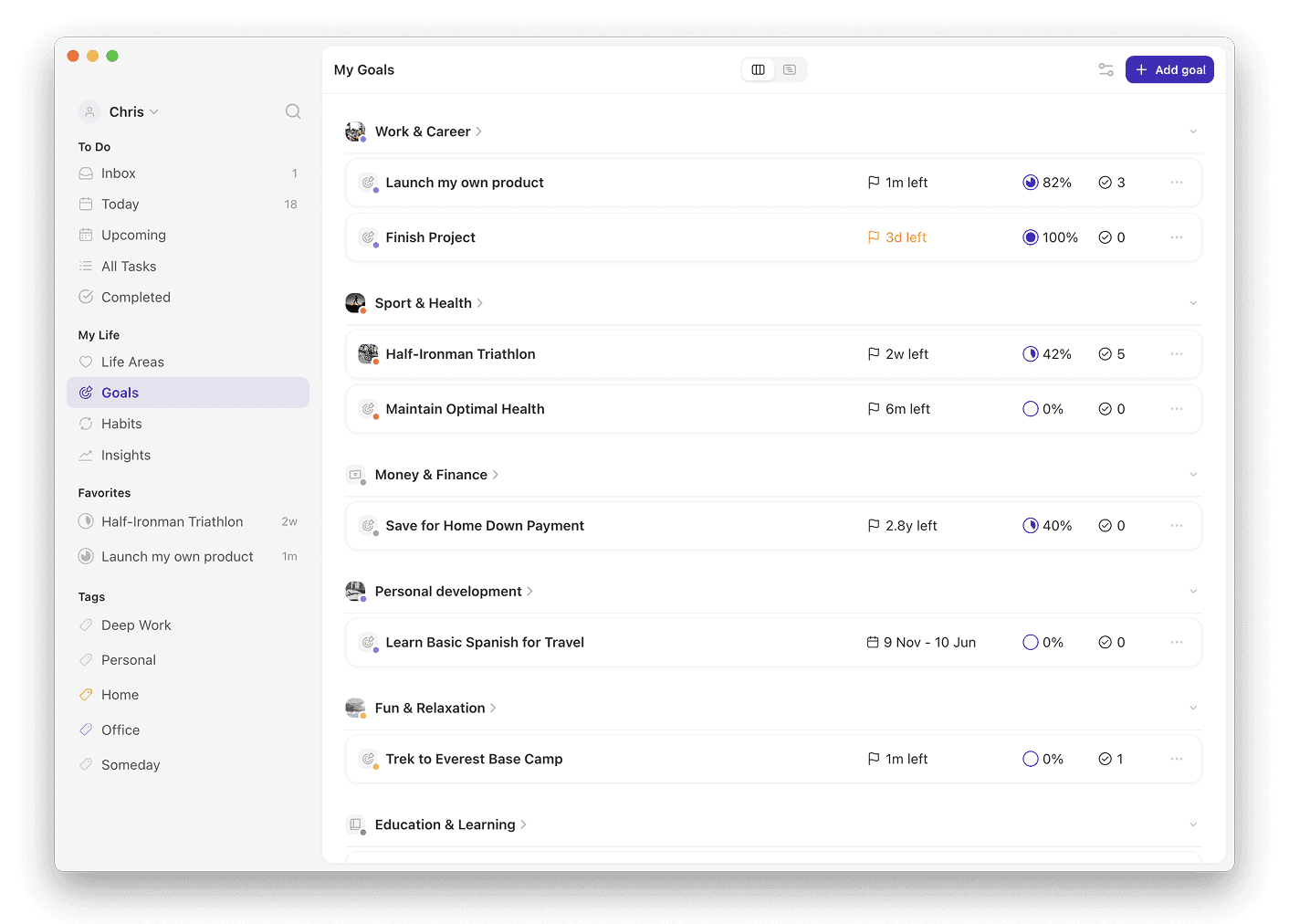
Each Life Area (Work & Career, Sport & Health, Money & Finance, and others) holds a Vision: a written statement of long-term intent. Goals sit beneath each vision with a start value, a target value, and a deadline. Progress is logged and displayed as a line chart. Subgoals cascade under goals with the same measurable structure.
Tasks link to a goal or life area, not to a generic inbox. Habits connect to a goal or life area, have a set frequency, and track completion, skips, and fails over time. The Today view shows everything planned for the day alongside your calendar. The Goal Roadmap gives you a Gantt chart of goals and subgoals laid out over time, so the direction layer stays visible, not buried.
How to use Griply as your personal OS execution layer
Start with Life Areas. Name the areas that matter to your life: career, health, finances, relationships, learning. Write a Vision for each, one or two sentences about where you want to be.
Beneath each Vision, create Goals with measurable targets and deadlines. Break larger goals into Subgoals using the same start-value and target-value structure. Griply's goal list gives you a tree view of the full hierarchy, and the Goal Roadmap shows how your goals and subgoals relate across time.
For the action layer, create Tasks linked to specific goals. Add recurring Habits with a frequency and link them to the goal they serve. The Today view then surfaces exactly what to work on and why. For knowledge management, journaling, and values work beyond Griply's scope, users pair Griply with Obsidian or a lightweight notes app.
Related questions
What is the difference between a personal OS and a life OS?
The terms are used interchangeably by most writers. Where a distinction exists, a life OS tends to emphasise holistic coverage including notes and knowledge, while a personal OS emphasises the execution layer: routines, habits, and decision defaults. Griply covers both the direction and action layers of either definition.
Do you need a special app to build a personal operating system?
No. Many people build personal OS frameworks in Notion, Obsidian, or plain text files. Griply is purpose-built for the goal, task, and habit layers, so the hierarchy is already in place. You add your goals instead of designing the structure yourself.
What is the action layer of a personal operating system?
The action layer is the set of daily and weekly routines, habits, and tasks that translate your direction into behaviour. In Griply, every task and habit can link to a goal or life area, so the action layer stays connected to your stated priorities.
What is the feedback layer of a personal operating system?
The feedback layer is the regular review practice that asks whether your actions are still aligned with your direction. Griply sends a weekly review reminder and tracks goal progress in a line chart, but the review itself is a practice you run, not a guided in-app workflow.
What does Griply not cover in the personal OS concept?
Griply does not cover knowledge management, note-taking, journaling, or values clarification exercises. It is the execution infrastructure. Users who need those layers typically pair Griply with Obsidian or a dedicated notes app.