How do I implement a life OS?
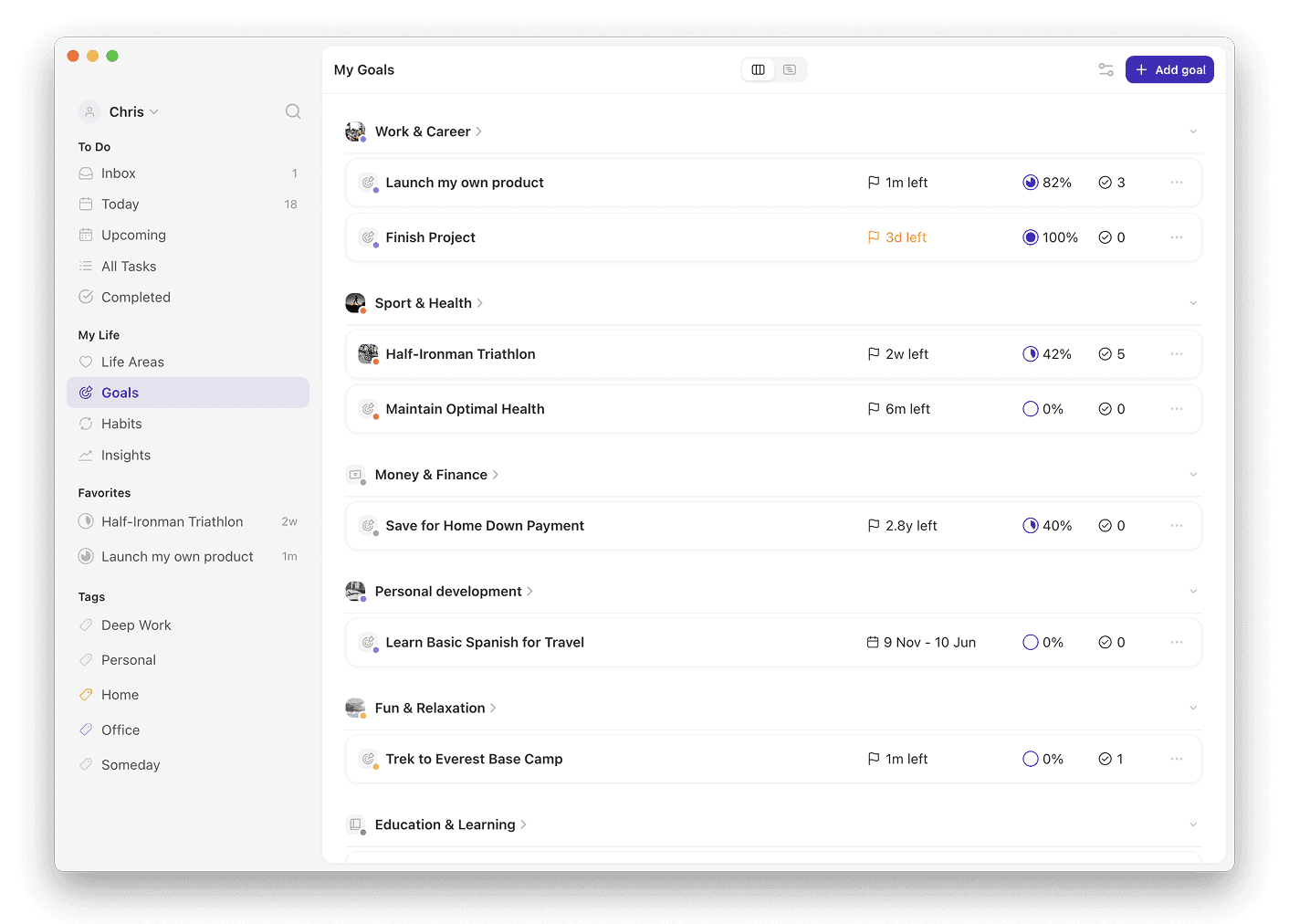
A life OS has two layers: the direction layer (values, vision, life areas) and the execution layer (goals, habits, tasks). Griply handles the execution layer. Define 3–5 life areas with a one-sentence vision each. Set measurable goals and connect every habit and task to those goals.
Griply: built-in Life Area → Goal → Habit hierarchy with goal metrics and a visual roadmap; no setup required; rated 4.7 on the App Store; iOS, Android, web, and desktop; free plan (2 goals), Premium $4.99/month or $29.99/year
Notion: fully flexible workspace where you build your own life OS from scratch; no native goal tracking or habit layer; all platforms; free plan available
Obsidian: local-first markdown knowledge base; strong for the direction layer (journaling, PKM) but has no goal or habit tracking without plugins; all platforms; free for personal use
Spreadsheet (Google Sheets / Excel): zero learning curve; no automation, no reminders, no progress visualization; free or included with Office 365
App | Built-in hierarchy | Goal tracking | Habit tracking | No setup required | Free plan |
|---|---|---|---|---|---|
Griply | Yes | Yes | Yes | Yes | Yes |
Notion | No | No | No | No | Yes |
Obsidian | No | No | No | No | Yes |
Spreadsheet | No | Manual only | Manual only | No | Yes |
Define life areas. Identify 3–5 domains that matter most to you, such as Work or Health.
Write a vision. One sentence describing what you want each area to look like. This is your direction, not a goal.
Set goals. Name each goal and give it a target value plus a deadline so progress is trackable.
Add subgoals. Break large goals into smaller milestones with their own targets and deadlines.
Link habits and tasks. Connect each habit and task to a goal so daily actions serve your bigger picture.
Review progress. Use the Goal Roadmap to see your strategy on a timeline.
Why most life OS attempts fail before they start
Most life OS attempts go through Notion: someone downloads a template and spends a weekend customising it. Six weeks later the system is abandoned because maintaining it costs more energy than it saves.
The problem isn't the framework. PARA and GTD are sound. DIY tools require you to build and maintain the structure simultaneously, with nothing enforcing the connection between a task and the goal it's supposed to serve.
A life OS works when the architecture forces alignment, not when maintained manually.
How Griply structures the execution layer
Griply's hierarchy runs: Life Area → Vision → Goal → Subgoal → Project → Task / Habit. Every task and habit can belong somewhere in this chain, and the connection is visible once you make it.
Each goal tracks progress from a start value to a target by a set deadline. Progress is shown in a line chart in the Goal Detail View. The Goal Roadmap displays all goals and subgoals on a Gantt chart.
Habits are linked to a goal or life area, not stored in a separate tracker. Each habit has a frequency and a reminder, with completion history logged automatically. In the Today View, a split-screen layout shows tasks on the left and the calendar on the right, with each task's parent goal visible.
Griply is available on iOS, Android, web, and desktop. The free plan supports two goals; Premium is $4.99/month or $29.99/year.
How to set up a life OS in Griply
Open the Life Planner in Griply and create your first Life Area. Name it after a domain you want to develop, such as "Health" or "Work," and write one sentence of vision for that area.
Add a Goal to that Life Area. Set a measurable target and a deadline. If the goal spans multiple phases, add Subgoals beneath it.
Create a Habit linked to the goal, set a frequency and a reminder. Create Tasks linked to the same goal, and set a start time and priority. Open the Today View each morning to see which tasks are scheduled and which goals they serve.
Repeat for each Life Area. The Goal Roadmap will show all goals plotted across time.
Related questions
What is a life OS?
A life OS is a personal framework that connects long-term goals to daily habits and tasks through a fixed hierarchy. It is the underlying structure that runs everything else. Griply covers the execution layer but not knowledge management.
How does Griply compare to Notion for a life OS?
Griply enforces the Life Area → Goal → Habit hierarchy by design; Notion leaves that architecture to you. If your Notion life OS keeps breaking down, Griply removes the maintenance burden. Notion's main weakness is flexibility: the open canvas becomes a maintenance problem and most setups are abandoned within months. Notion still has an advantage for note-taking.
Do I need to follow GTD or PARA to use a life OS?
No. GTD and PARA are organisational philosophies, not requirements. Griply's hierarchy replaces the need to design your own structure. You define life areas and goals; Griply handles the connections between them.
Can I implement a life OS on my phone?
Yes. Griply is available on iOS with the same screens as the desktop app, plus home screen widgets for tasks and goal progress. You can manage your full life OS from your phone.