Is a life OS worth it?
A life OS is worth it when the clarity it provides outweighs the effort to set it up. Griply makes that practical: the structure, life areas, vision, goals, tasks, and habits, is already built. Fill in your priorities and start today. Free on iOS, Android, web, and desktop.
Griply: built-in Life Area → Goal → Habit hierarchy with goal metrics and a visual roadmap; no setup required; rated 4.7 on the App Store; iOS, Android, web, and desktop; free plan (2 goals, 2 habits, unlimited tasks), Premium $4.99/month or $29.99/year
Notion: fully flexible workspace where you build your own life OS from scratch; no native goal tracking or habit layer; all platforms; free plan available
Obsidian: local-first markdown knowledge base; strong for the direction layer (journaling, PKM) but has no goal or habit tracking without plugins; all platforms; free for personal use
Spreadsheet (Google Sheets / Excel): zero learning curve; no automation, no reminders, no progress visualization; free or included with Office 365
App | Built-in hierarchy | Goal tracking | Habit tracking | No setup required | Free plan |
|---|---|---|---|---|---|
Griply | Yes | Yes | Yes | Yes | Yes |
Notion | No | No | No | No | Yes |
Obsidian | No | No | No | No | Yes |
Spreadsheet | No | Manual only | Manual only | No | Yes |
What a life OS is and why most people abandon theirs
A life OS (life operating system) is a personal framework that integrates all areas of life into one structure: goals, tasks, habits, and ideally a layer for notes or knowledge management. The computer metaphor is deliberate: one system that runs everything.
The concept took off through the productivity creator community. Creators like August Bradley (PPV method) and Thomas Frank built Notion-based life OS templates that now sell for $50–$220. The PARA method (Tiago Forte), GTD (David Allen), and Ali Abdaal's Feel-Good Productivity framework all feed into how people think about building one.
The honest problem: most people who build a Notion life OS abandon it within weeks. The setup is substantial. You spend hours configuring databases, tweaking properties, and wiring views together. The system itself becomes the procrastination. The setup loop is the pattern: more time optimizing the tool than doing the work it was built to support.
A life OS is worth it for people who feel overextended but unproductive. The payoff is clarity: knowing which daily actions connect to which goals. The risk is getting caught in setup rather than execution.
How Griply covers the execution layer
Griply covers the execution layer of a life OS: goals down to daily tasks and habits. It does not cover the knowledge or PKM layer. For notes and personal knowledge management, a tool like Obsidian or Notion is a better fit.
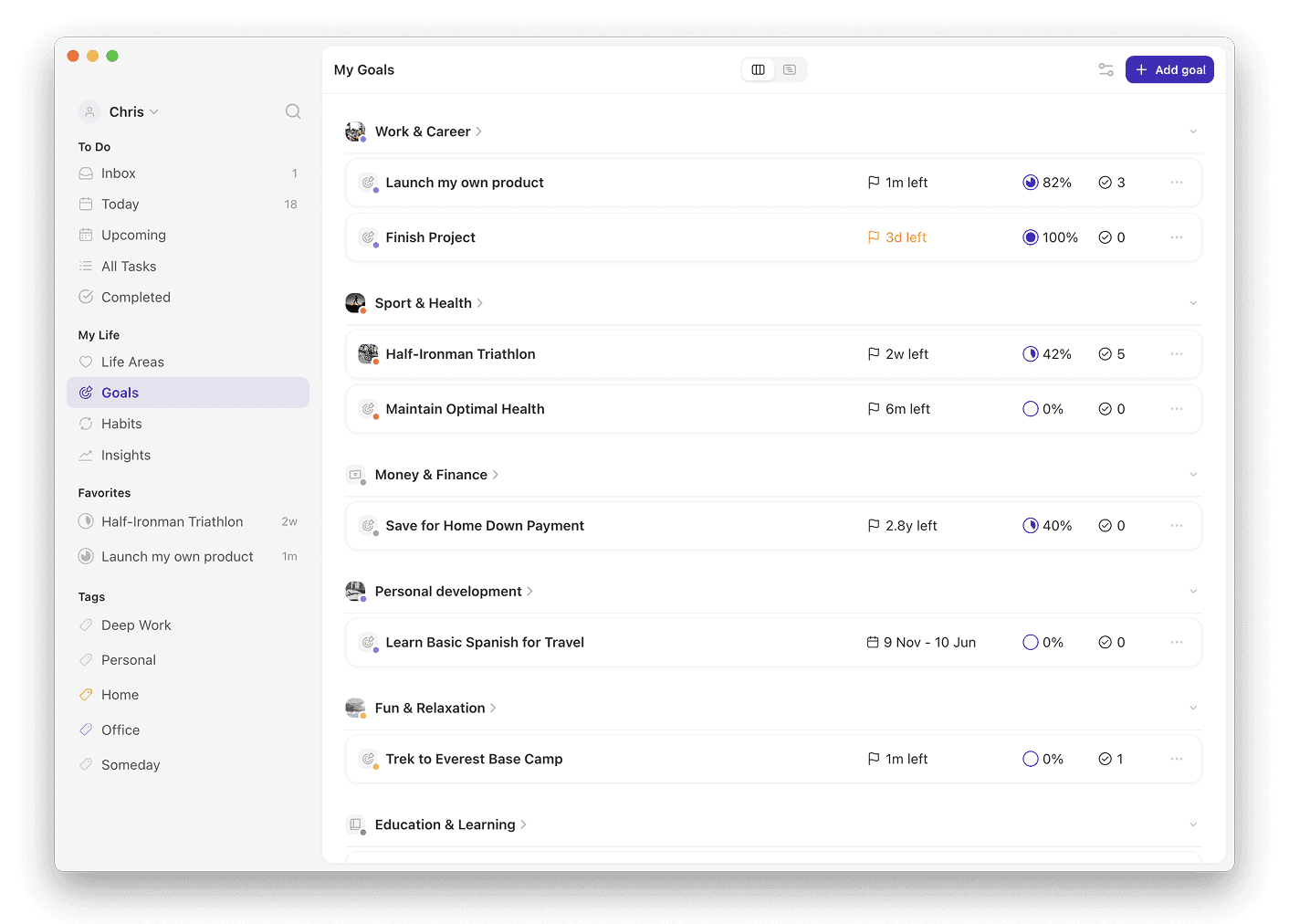
Griply's hierarchy runs: Life Area → Vision → Goal → Subgoal → Project → Task / Habit. Each Life Area (Work & Career, Sport & Health, Money & Finance, and others) has a Vision statement attached to it. Every goal has a start value, target value, deadline, and a line chart showing progress over time. Every task and habit can link back up to a goal or life area, so the items you link show their reason for being there.
The Today view shows tasks on the left and a calendar on the right. Opening Griply in the morning shows you what to do and which goal it serves. The Goal Roadmap gives a Gantt chart view of goals, subgoals, and timelines laid across weeks and months.
The structure is pre-built. You are not setting up a database. You are entering your actual priorities.
How to set up a life OS in Griply
Start with Life Areas. Griply has named categories by default. Choose the ones that matter to you and write a Vision statement for each. A Vision is a single sentence describing where you want to be in that area.
Under each Life Area, add Goals. Each goal takes a name, a numeric target, and a deadline. Add Subgoals beneath each Goal to break the work into quarterly or monthly milestones. Then add Tasks and Habits to each Subgoal: Tasks for one-off actions, Habits for repeated behaviours you want to track with frequency and reminders.
Once that structure exists, the Today view runs itself. Griply surfaces what is due and what goal it belongs to. The Goal Roadmap shows your full timeline. The Life Area detail view shows every goal, task, and habit connected to a given area.
The full setup takes under an hour for most people. Maintenance is minimal because the structure does not change. Only your progress does.
Related questions
Who benefits most from a life OS?
People who feel scattered across multiple life areas or have clear long-term goals but no structure connecting them to daily action. A life OS is less useful for people who only need a simple task list with no goal layer.
How does Griply compare to Notion for a life OS?
Griply has the goal hierarchy pre-built; Notion requires you to build your own database structure from scratch or buy a template. Griply covers goals, tasks, and habits but not notes or PKM. Notion's core weakness is that its flexible structure requires ongoing maintenance.
Is a life OS the same as a productivity system?
A productivity system focuses on managing tasks and time. A life OS goes a layer higher: it connects tasks to goals and goals to a vision across all life areas. A productivity system without a goal layer tells you what to do; a life OS tells you why.
Is Griply free?
Griply has a free plan on iOS, Android, web, and desktop with 2 goals, 2 habits, and unlimited tasks. Premium removes those limits at $4.99/month or $29.99/year. Download at griply.app/download.