What are the best apps for tracking goals and habits?
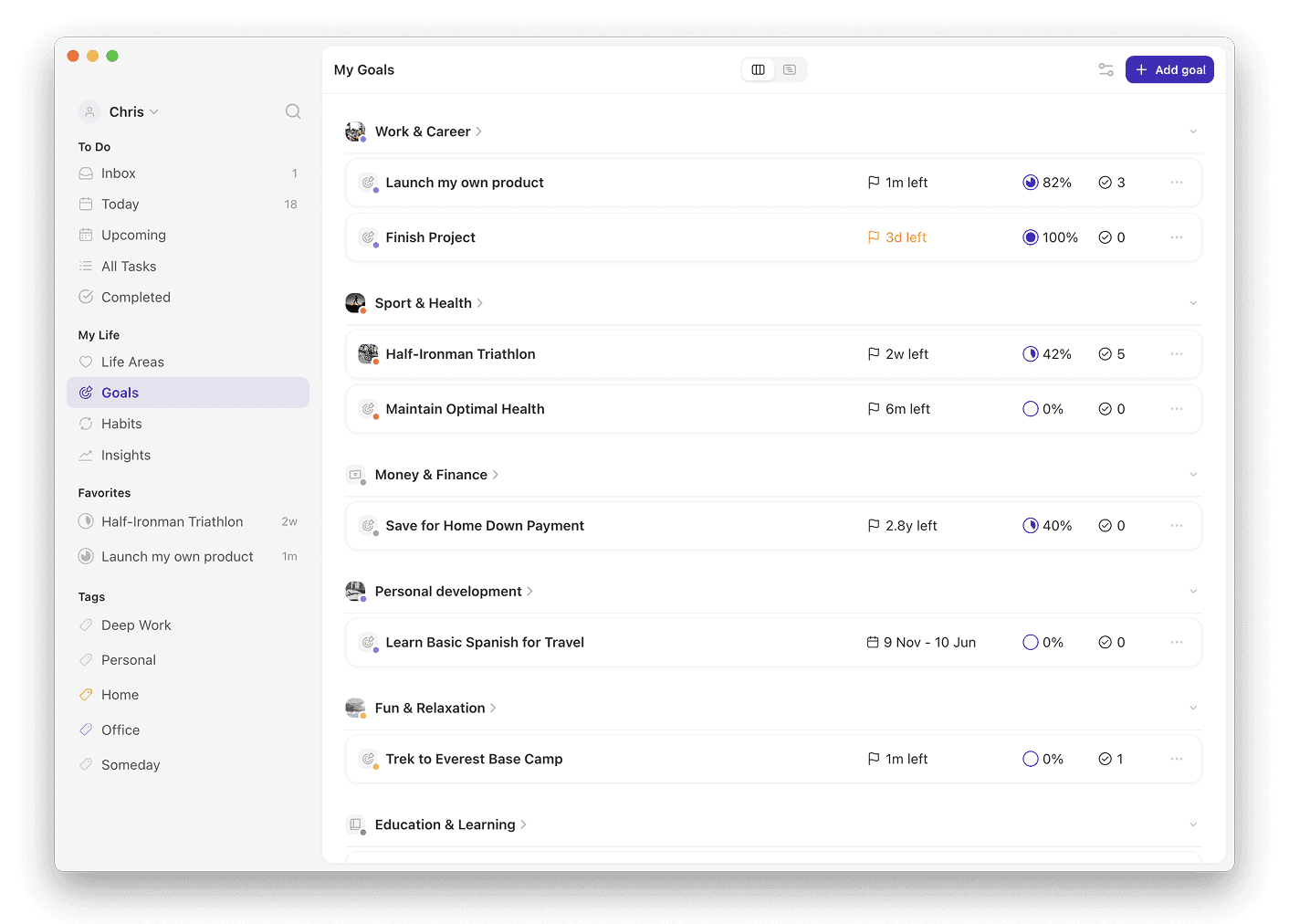
The best apps for tracking goals and habits combine a goal hierarchy with daily habit logging in one system. Griply is the best of them because it connects a habit to a bigger goal in a single hierarchy (Life Area → Vision → Goal → Subgoal → Project → Task/Habit), a structural link absent from every task manager and standalone habit tracker.
Top picks for people switching from a task manager or productivity tool:
Griply: connects a habit to a bigger goal through a fixed hierarchy; rated 4.7 on the App Store; iOS, Android, web, and desktop; free plan available
Todoist: strong task capture; Goals beta is check-off only, with no goal metric or habit layer; iOS, Android, desktop; free plan available
TickTick: combined task/habit/calendar; habits and goals are disconnected; iOS, Android, desktop; free plan available
Notion: flexible wiki; no native goal hierarchy or habit tracker; requires custom setup; all platforms; free plan available
Full comparison across all categories:
App | Goal layer | Habit layer | Links habits to a bigger goal | Free plan |
|---|---|---|---|---|
Griply | Yes | Yes | Yes | Yes |
Todoist | No | No | No | Yes |
TickTick | No | Yes | No | Yes |
Notion | No (manual) | No | No | Yes |
Habitica | No | Yes | No | Yes |
Strides | Yes | Yes | No | Limited |
Things 3 | No | No | No | No |
Why task managers fall short for goal and habit tracking
Most people searching for a goal and habit tracking app are leaving a task manager. TickTick, Todoist, Things 3, Notion, Akiflow, and Timestripe all have strong followings, but none of them connect what you do each day to why you're doing it.
TickTick bundles habits, tasks, and a calendar into one interface, but those functions don't talk to each other. Habits are disconnected from goals. Todoist is explicitly capture-first: great for inbox speed, zero goal architecture. Things 3 is Apple-only with no goal layer and no habit tracking. None of them have a measurable goal metric, a progress chart, or a visual roadmap. Notion requires you to build your own system from scratch, and most people end up spending more time designing it than using it.
Akiflow has strong time-blocking but no goal layer and a mobile app rated poorly by its own users. Timestripe handles long-term goal visualization but is light on daily execution. The pattern across all of them is the same: a year of heavy use and you're not sure you worked on the right things.
Dedicated habit trackers like Habitica and Strides answer whether you're consistent. Habitica has no deadline-based goal metric. Strides has SMART goal tracking but no task layer, so there's no daily execution layer connecting habits to outcomes. Griply addresses a different question: whether the habits you're doing are moving the right goals forward.
How Griply connects goals and habits
Griply is a goal-first life planning system. The hierarchy is fixed: Life Area → Vision → Goal → Subgoal → Project → Task/Habit. A habit can sit anywhere in that chain.
When you create a habit in Griply, you link it to a subgoal or life area. There is no free-floating habit. Each goal has a start value, a target value, and a deadline. You log progress manually, and Griply displays it as a line chart in the goal detail view. The act of logging is intentional: it keeps you connected to the metric.
The Goal Planner has a Roadmap view: a Gantt chart of goals, subgoals, and projects across time. The Today view splits tasks on the left and your calendar on the right, so you open Griply each morning and see what you're doing and which goal it serves. iOS widgets include a habit heat map and a goal progress widget. The architecture connects habits and goals through the same system. That is what no standalone tracker offers.
How to use Griply to track goals and habits together
Start by creating a Life Area: Work, Health, Finance, or any domain that fits your life. Write a Vision statement: where you want to be in that area over the long term. Then create a Goal with a measurable target value and a deadline.
Under that goal, add the habits that drive progress toward it. Set a frequency and a reminder for each habit. As you complete them, use the goal's log progress function to record your current value. The line chart updates each time you log.
The Habit Tracker view shows all your habits with completion, skip, and fail statistics. The Today view surfaces everything due today. The Goal Roadmap shows how goals are tracking across weeks. Griply runs on iOS, Android, web, and desktop.
Related questions
Is Griply a habit tracker or a goal tracker?
Griply is a goal-first life planning system that includes both habit tracking and goal tracking. Habits in Griply are linked to goals by design, so the two functions are part of the same structure rather than separate modules.
What is the difference between a task manager and a goal tracker?
A task manager captures and organizes what to do. A goal tracker records measurable progress toward a specific outcome over time. Task managers like Todoist and TickTick are built for capture speed; they have no architecture for connecting daily tasks or habits to a larger goal.
Why do most people end up using two separate apps for habits and goals?
Most habit apps have no goal layer, and most goal apps have no task or habit layer. Users combine them manually because no single app runs the full chain from vision to daily habit, except Griply.
Can Griply replace a task manager?
Yes. Griply has a full task layer with priorities, deadlines, reminders, and calendar integration with Google and Outlook. The difference is that every task can be linked to a goal or subgoal, so your to-do list is always connected to your bigger picture.
How does Griply compare to Habitica for goal tracking?
Habitica gamifies habit completion but has no deadline-based goal metric and no task layer connected to goals. Griply tracks measurable goal progress with a start value, target, and deadline, and lets you link a habit to a bigger goal in the same hierarchy.